Some links on this page are affiliate links. If you book through them we may earn a commission, at no extra cost to you.
The short answer
Nerja is a seaside town of about 22,000 people on the coast east of Málaga, at the foot of the Sierra de Almijara. It is known for the Balcón de Europa, a promenade on a headland above the sea, for small coves below the old town and for the Nerja caves (Cueva de Nerja), one of the largest show caves in Spain, about 4 km east of the centre in the village of Maro.
- Why go: the Balcón de Europa, the caves, clear water and cliffs around Maro, and the white village of Frigiliana 10–15 minutes away.
- Time needed: a full day for the town, the caves and a beach; 2–3 nights for the coves, kayaking and the Río Chíllar walk.
- Cost: the town, the Balcón and the beaches are free. The caves cost about €15.
- Getting there: about 50 minutes to 1 hour by car from Málaga, or 1 h–1 h 30 by bus. There is no train.
Balcón de Europa and the old town
The Balcón de Europa is where every visit starts: a palm-lined promenade on a rocky headland in the centre of town, with views along the coast in both directions. The name is usually credited to King Alfonso XII, who came in 1885 after an earthquake in the area; his bronze statue stands by the railings. Next to it is the white Iglesia de El Salvador, from the 17th century.
Behind the Balcón, the old town is a small grid of white streets with shops, bars and restaurants. Calle Pintada is the main street, and Plaza de España and Plaza Cavana are a short walk away. Spanish visitors often look for the Parque Verano Azul, with the boat from Verano Azul, the 1981 television series filmed in Nerja.
Where to eat
Nerja lives from the sea: fried fish, sardines grilled on skewers (espetos) on the beach, and cold ajoblanco, the almond and garlic soup of Málaga province. On Burriana beach, Ayo’s paella, cooked over a wood fire in huge pans, is a local institution. The restaurants around the Balcón are convenient but busy; the side streets inland are quieter. Try the miel de caña (cane honey) from Frigiliana and the mangoes and avocados of the Axarquía, the farmland behind the coast.
The Nerja caves (Cueva de Nerja)
Five local boys found the caves in 1959, climbing down a sinkhole near Maro. The visit follows a path with stairs through a series of huge chambers full of stalactites, stalagmites and rock curtains. The highlight is the Sala del Cataclismo, with a column about 32 metres tall, among the largest known in the world. Archaeologists have found remains of prehistoric people and cave paintings in other parts of the cave, but these sections are not open on the normal visit.
- Visit: about 45 minutes, self-guided, with an audio guide. It is about 19–20 °C inside all year, so it is a good plan on a hot day or a rainy one.
- Tickets: about €15 for adults, less for children. In summer and at Easter, book a time slot on the official website, cuevadenerja.es, a few days ahead.
- Hours: every day from about 9:30 to the late afternoon, with longer hours in July and August. The caves close on 1 January and 15 May.
- Also there: the Jardín Botánico Cueva de Nerja, a garden of local plants next to the cave, and, in summer, an international music and dance festival held at the caves.
How to get to the caves from Nerja
The caves are about 4 km east of the town centre, just above Maro.
- By bus: local buses run from Nerja (stop on Avenida de Pescia) to the caves in about 10 minutes.
- By car or taxi: about 10 minutes. There is a paid car park at the entrance.
- On foot: possible, but the walk along the main road is about an hour, with little shade.
Next to the road below the caves is the Puente del Águila, a tall 19th-century brick aqueduct built to carry water to a sugar mill. It is worth a stop on the way to Maro.
Nerja beaches
Nerja has about a dozen beaches, from coves under the old town to longer beaches either side. Most are sand mixed with some pebbles, darker than on the Atlantic coast.
| Beach | Where | Best for |
|---|---|---|
| Calahonda | Below the Balcón, by steps | Photos, fishing boats, a quick swim |
| El Salón | Just west of the Balcón, down steps | A small, sheltered cove |
| Carabeillo | Between the Balcón and Burriana | Quieter swimming below the cliffs |
| Burriana | 15–20 min walk east | Services, restaurants, water sports |
| Maro | 4 km east, below Maro village | Clear water, snorkelling, kayaking |
- Burriana is the main beach, about 800 metres long, with sunbeds, beach restaurants, kayak and paddle board hire and a lift down from the Parador. It usually has a Blue Flag.
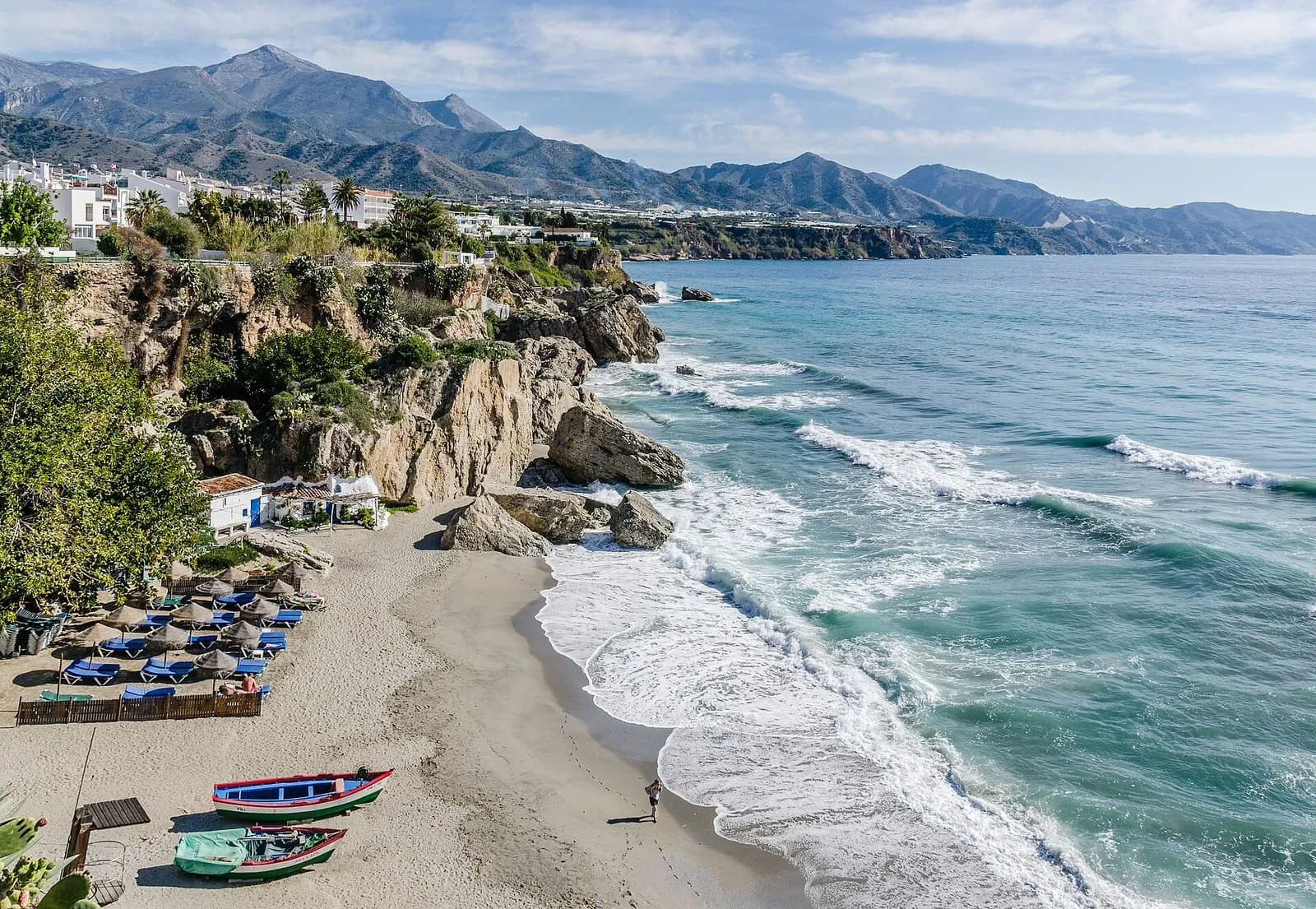
- Calahonda, El Salón and Carabeillo are small coves reached by steps from the town, busy in August but lovely early in the day. Calahonda, with its boats and houses built into the rock, is the postcard view from the Balcón.
- Torrecilla and El Playazo, west of the centre, are longer and less crowded.
For more beaches along the coast, see our guide to Málaga beaches.
Maro and the Maro-Cerro Gordo cliffs
East of Nerja, the mountains drop straight into the sea. This stretch of coast, about 12 km long to the border with Granada province, is protected as the Acantilados de Maro-Cerro Gordo natural area, with clear water, sea grass and old watchtowers on the cliff tops.
Playa de Maro is a cove at the bottom of a steep lane below the village, with pebbles, coarse sand and green water. Further east, coves such as Las Alberquillas and El Cañuelo are reached by tracks down the cliffs. In summer, car access and parking are limited, and shuttle buses may run to some coves: check the rules before you go.
The best way to see the cliffs is from the water. A kayak tour usually leaves from Burriana or Maro beach, lasts about 2–3 hours and follows the cliffs to sea caves and the waterfall at Maro, which falls straight into the sea. Kayak tours along the Maro cliffs. For something less active, boat trips along the Nerja coast run in season.
The Río Chíllar walk
The Río Chíllar is Nerja’s favourite summer walk: you follow a river up into the mountains, walking in the riverbed itself. The water is usually ankle to knee deep, and after about two hours the valley narrows into the Cahorros, a gorge only a few metres wide. The full walk there and back takes about 5–6 hours; many people turn round earlier.
- Start: on the edge of town, by the old cement works, a short walk from the centre.
- Wear: shoes that can get wet and grip on stones, not flip-flops. Bring water and sun cream: the first part has little shade.
- Access rules: the river is in the Sierras de Tejeda, Almijara y Alhama natural park. Access can be restricted in summer, with daily limits, advance booking, parking controls or closures on days of high fire risk. Check the Nerja town hall website (nerja.es) before you go.
- Safety: don’t go after heavy rain or when storms are forecast, as the water rises fast in the narrow parts.
Some operators offer guided Río Chíllar hikes with transport and a guide.
Frigiliana
Frigiliana, about 6 km inland and 10–15 minutes by car or local bus, is one of the prettiest white villages in Andalusia: steep cobbled lanes, flowers on every wall and a Moorish old quarter. It makes an easy half day from Nerja, ideally in the late afternoon when the day-trippers have gone. See our guide to Frigiliana and the other white villages of Andalusia.
When to go
- May, June, September and October are the best months: warm, with a sea you can swim in and fewer people than in high summer.
- July and August are hot and busy, with the warmest sea (about 22–24 °C) and the best time for the Río Chíllar, but beaches and car parks fill up. Book the caves and your hotel ahead.
- Winter is mild and sunny, and Nerja is popular with long-stay visitors from northern Europe. Too cold for most swimmers, but good for walking and the caves.
- Events: the fishermen’s sea procession for the Virgen del Carmen on 16 July, and the Feria de Nerja, usually in October.
For the weather month by month, see the best time to visit Andalusia.
Getting to Nerja
Nerja has no train station. The closest station is Málaga.
| From | Car | Bus |
|---|---|---|
| Málaga | about 50 min–1 h | about 1 h–1 h 30 (ALSA), many a day |
| Málaga airport | about 1 h | change in Málaga |
| Granada | about 1 h 15 | about 2 h (ALSA), a few a day |
| Frigiliana | 10–15 min | about 15 min (local bus) |
- By bus: ALSA buses leave Málaga’s main bus station, next to María Zambrano train station. In Nerja they stop on Avenida de Pescia, a few minutes’ walk from the Balcón. Compare times on Málaga to Nerja by bus.
- By car: take the A-7 motorway east from Málaga. A car makes it easy to add Frigiliana, Maro and the coves. Park in one of the underground car parks near the centre, such as the one under Plaza de España, as parking in the old streets is very limited. See car hire at Málaga airport or compare prices on DiscoverCars.
- On a tour: a Nerja and Frigiliana day trip from Málaga covers the town, the caves and the village without driving. From Granada, there is a Nerja and Frigiliana day trip from Granada.
Day trip or base?
As a day trip, Nerja is one of the easiest from Málaga: the Balcón, the caves and a swim fit in a day, and Frigiliana too if you start early. See all day trips from Málaga.
As a base, it suits travellers who want the sea without the high-rise resorts of the western Costa del Sol. Stay two or three nights to add the Maro coves, a kayak tour, the Río Chíllar and Frigiliana at sunset. Granada is about 1 h 15 by car, and Málaga’s museums and old town about an hour: see our Málaga travel guide. For other places to combine, see the best places to visit in Andalusia.
Where to stay
Stay in the centre, within walking distance of the Balcón, so you can go out for dinner and to the beaches on foot.
- Parador de Nerja: on the cliff above Burriana beach, with gardens, a pool, sea views and a lift down to the sand.
- Hotel Balcón de Europa: right next to the famous viewpoint, with rooms facing the sea. The most central address in town.
- Hotel Carabeo: a small hotel on a quiet street on the cliff between the Balcón and Burriana, with a pool and sea views.
- More options: hotels in the centre of Nerja.
FAQ
Is Nerja worth visiting?
Yes. It is one of the most attractive towns on the Málaga coast, with the Balcón de Europa, the caves, good beaches and the Maro cliffs, and it has kept a small-town feel.
How far are the Nerja caves from the town?
About 4 km east of the centre, in Maro: about 10 minutes by car, taxi or local bus.
Do you need to book the Nerja caves in advance?
Not usually outside the high season. In summer and at Easter, book a time slot on the official website a few days ahead, as slots can sell out.
Can you get from Málaga to Nerja by train?
No. Nerja has no train station. Direct ALSA buses from Málaga bus station take about 1 h–1 h 30, and driving takes about 50 minutes to an hour.
What is the best beach in Nerja?
Burriana is the best all-round beach, with space and services. For clearer water and cliffs, go to Maro beach or the coves of Maro-Cerro Gordo, ideally by kayak.