
Some links on this page are affiliate links. If you book through them we may earn a commission, at no extra cost to you.
The short answer
The Costa de la Luz is Andalusia’s Atlantic coast: the shores of Cádiz and Huelva provinces, from Tarifa at the Strait of Gibraltar to Ayamonte on the Guadiana river, the border with Portugal. Compared with the Costa del Sol, it is wilder, windier and lower-rise, with long golden beaches, dunes and pine woods, and a slightly cooler sea.
- Best for kitesurfing and a lively surf town: Tarifa.
- Best beaches: Bolonia, Valdevaqueros, Zahara, Los Caños de Meca and El Palmar.
- Best for families and a real town by the sea: Conil.
- Best for a quiet, food-focused stay: Zahara de los Atunes.
- Best for culture with city beaches: Cádiz.
- Best hilltop base: Vejer de la Frontera, 15–30 minutes from the beaches.
- Best for sherry and seafood: El Puerto de Santa María and Sanlúcar de Barrameda.
We’d hire a car if you can. Trains reach only Cádiz, El Puerto and Jerez; the beach villages rely on buses that run a few times a day. We’d check the wind forecast before any beach day: the levante decides more than the weather.
Costa de la Luz or Costa del Sol?
| Costa de la Luz | Costa del Sol | |
|---|---|---|
| Sea | Atlantic, with tides and waves | Mediterranean, usually calm |
| Beaches | Long, wide, golden sand, dunes | Mostly grey or grey-brown sand |
| Buildings | Mostly low-rise, long empty stretches | Built up from Torremolinos to Estepona |
| Wind | Often strong, especially near Tarifa | Usually light |
| Sea in August | About 23 °C on average, colder on levante days | About 24 °C |
| Getting around | Car strongly advised | Airport train to the main resorts |
| Visitors | Mostly Spanish, plus Germans and surfers | International, many British |
We’d choose the Costa de la Luz for beaches and nature, and the Costa del Sol for an easy, car-free holiday with guaranteed calm water. Much of the Atlantic coast is protected: natural parks, a military zone and the Doñana National Park keep large stretches free of building.
The towns compared
| Town | Vibe | Best for | Car needed? |
|---|---|---|---|
| Tarifa | Surf town, walled old centre | Kitesurfers, young couples, Morocco trips | Helps for the beaches |
| Bolonia | Tiny hamlet, Roman ruins | A beach day, not a base | Yes |
| Zahara de los Atunes | Small fishing village | Couples, food lovers | Yes |
| Los Caños de Meca and Barbate | Bohemian coves; working port | Nature, cliffs, tuna | Yes |
| El Palmar | Surf beach, no real village | Surfers, sunsets | Yes |
| Conil de la Frontera | White town with a beach | Families, first visit | Not for town beaches |
| Vejer de la Frontera | Hilltop white town | Couples, a prettier base | For the beaches |
| Chiclana and Sancti Petri | Resort hotels on a long beach | Families, golf, all-inclusive | Helps |
| Cádiz | Old port city on the sea | Culture, food, no-car trips | No |
| El Puerto de Santa María | Sherry town, big beaches | Food, bodegas, easy Cádiz trips | No |
| Chipiona | Spanish family resort | Budget beach holidays | No |
| Sanlúcar de Barrameda | Manzanilla and prawns | Food, Doñana boat trips | No |
| Huelva coast | Pine woods, very long beaches | Space, nature, trips to Portugal | Yes |
The towns, from Tarifa to Portugal
1. Tarifa
The southernmost town of mainland Europe, with Morocco about 14 km across the Strait. It is Europe’s kitesurfing capital, with a walled old town, a castle, beach bars and a young, international crowd. Ferries sail to Tangier, and boats go whale and dolphin watching in the Strait (whale watching trips). West of town, Los Lances and Valdevaqueros are among the best beaches on the coast. See the full Tarifa guide.
2. Bolonia and Baelo Claudia
About 25 minutes west of Tarifa, Bolonia is a wide bay with clear water, a handful of houses and restaurants, and no hotels of any size. At its western end rises the Bolonia dune, more than 30 metres high and a protected Natural Monument. Behind the beach lie the ruins of Baelo Claudia, a Roman town that made fish sauce, with a forum, a theatre and fish-salting tanks. Entry is free for EU citizens with ID and costs very little for others; it is closed on Mondays. We’d go early in summer: the car parks fill up.
3. Zahara de los Atunes
A small fishing village with a long, open beach, the coves of Atlanterra to the south and some of the best tuna restaurants in Spain, thanks to the almadraba nets set each spring. Quiet in the evening, busy with Spanish families in August. See the full Zahara de los Atunes guide.
4. Barbate and Los Caños de Meca
Barbate is a working fishing port, known for tuna and mojama (cured tuna), with a long town beach. In our view it is less pretty than its neighbours, but good value. To the west, the Parque Natural de La Breña y Marismas del Barbate protects cliffs and pine woods, with a cliff-top path of about 7 km between Barbate and Los Caños de Meca, a scattered, bohemian beach village with coves and freshwater springs running off the cliffs. Beyond it, the Cabo de Trafalgar lighthouse stands on a sandy spit off the cape where Nelson won the Battle of Trafalgar in 1805.
5. El Palmar
Not a village but a long, straight beach of about 8 km in the municipality of Vejer, backed by fields, low houses, surf schools and beach bars. It has some of the most reliable waves in Andalusia, best from autumn to spring, and famous sunsets. Stay in a small hotel or apartment, or come from Conil or Vejer. Surf lessons in El Palmar.
6. Conil de la Frontera
In our view the easiest all-round choice: a real white town with shops, restaurants and a promenade above wide sandy beaches, with coves under ochre cliffs to the north. It has been popular with German visitors since the 1980s and fills with Spanish families in July and August. Direct buses run from Cádiz and Seville. See the full Conil guide.
7. Vejer de la Frontera
Not on the sea, but in our view the most beautiful town of the area: a whitewashed old town inside medieval walls, on a hill about 10 km inland, with some of the best restaurants on the coast. El Palmar, Los Caños and Conil are 15–30 minutes away by car. See the full Vejer guide and more white villages.
8. Chiclana and Sancti Petri
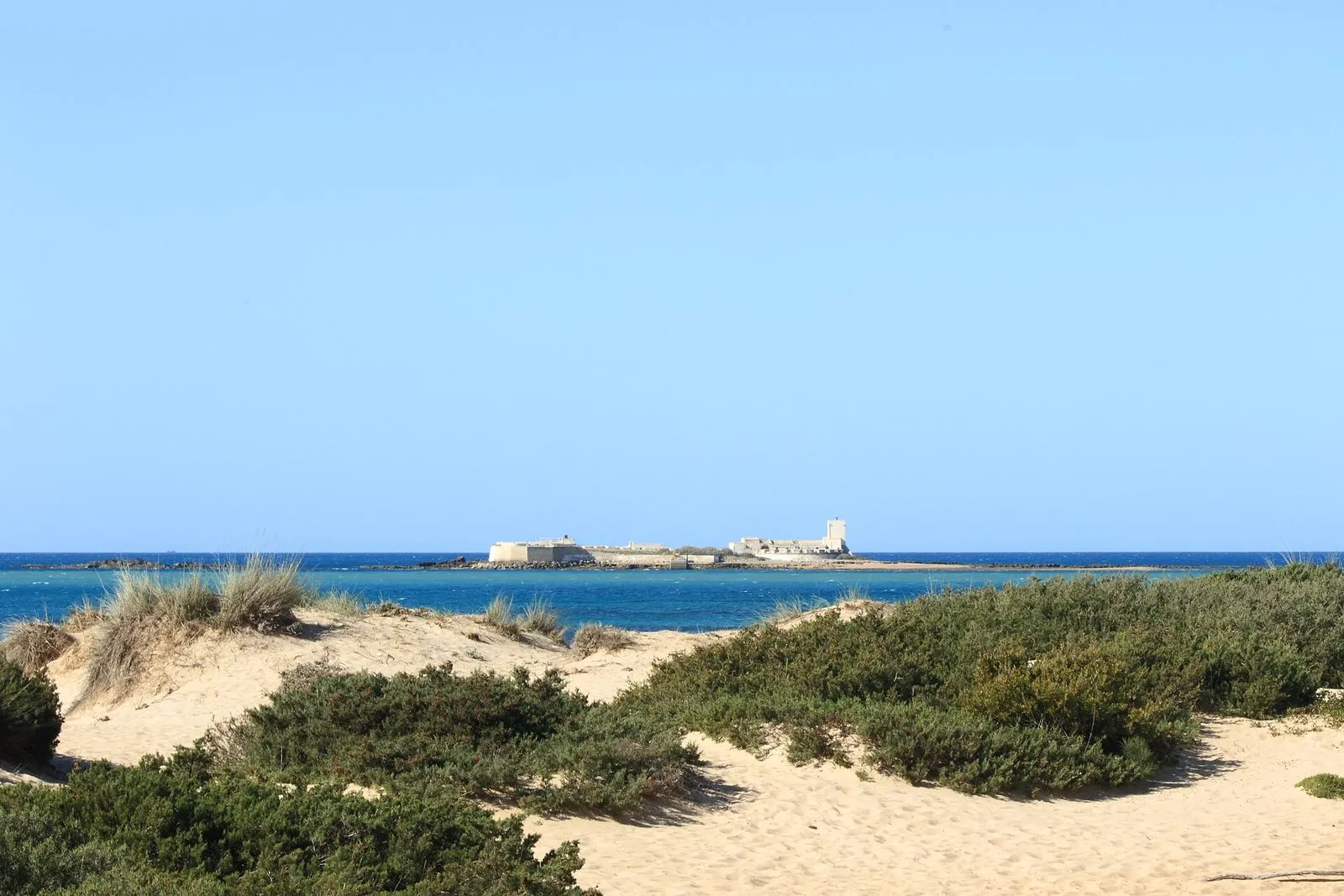
La Barrosa, Chiclana’s beach, is about 8 km of fine sand and one of the longest in the province. Behind it, Novo Sancti Petri is the most resort-like part of the coast, with large four- and five-star hotels, golf courses and all-inclusive packages. At the northern end, the old fishing village of Sancti Petri looks out to a castle on a rocky islet, reached only by boat. The town of Chiclana itself is a few kilometres inland. Good for families who want pools and a long beach. See our Chiclana guide.
9. Cádiz
One of the oldest cities in Europe, on a narrow peninsula almost surrounded by the sea. It has an atmospheric old town, the cathedral, markets and tapas bars, and proper city beaches: La Caleta in the old town and the long Playa de la Victoria in the modern city. It is the only place on the coast where you need no car at all, with trains to Jerez and Seville. See the Cádiz travel guide, things to do in Cádiz and where to stay in Cádiz.
10. El Puerto de Santa María
Across the bay from Cádiz, about 30 minutes by catamaran. One of the three sherry towns, with bodegas to visit, a lively seafood scene and big beaches such as Valdelagrana and La Puntilla. Spanish families fill it in summer. A practical base for Cádiz, Jerez and Sanlúcar without a car, as it also has a train station.
11. Chipiona
A traditional Spanish seaside resort at the mouth of the Guadalquivir, with sandy beaches, old stone fish traps (corrales) at low tide, and the lighthouse of Chipiona, about 69 metres high and the tallest in Spain. Tower visits are booked through the tourist office, but they are often suspended: we’d call before you go. Simple, good-value, and very Spanish; few foreign visitors. See the full Chipiona guide.
12. Sanlúcar de Barrameda
The home of manzanilla, the dry sherry aged by the sea, and of the prawns (langostinos) served in the restaurants of Bajo de Guía, on the riverfront. From here, the Real Fernando boat sails up the Guadalquivir into the Doñana National Park, a trip of about 2 h 30–2 h 45 including a stop of about an hour in the park; book ahead with the operator. In August, horses race along the beach at low tide, a tradition dating back to 1845. See the full Sanlúcar de Barrameda guide.
13. The Huelva coast
North-west of the Guadalquivir, the Costa de la Luz continues through Huelva province with more than 120 km of very long beaches backed by dunes and pine woods. There is no road across Doñana: from Sanlúcar to Matalascañas, only about 30 km along the coast, you drive round via Seville, which takes 2 h 30 or more.
- Matalascañas: a 1960s–70s resort on the edge of Doñana, with the park’s wild beach stretching away to the south. The most built-up spot on the Huelva coast.
- Mazagón: a quieter village with a long beach below sandy cliffs and pines.
- Punta Umbría: the beach town of Huelva city, busy with local families in summer, with the sandspit of El Rompido further west.
- Islantilla and Isla Cristina: a resort with a golf course, and a fishing town known for its fish auction and Carnival.
- Ayamonte and Isla Canela: on the Guadiana, facing Portugal, about 45 minutes from Faro airport.
The Huelva coast works well combined with the Algarve or Seville, less well with Tarifa and Cádiz. For Doñana, the Columbus sites and the Sierra de Aracena, see our Huelva guide.
The best beaches of the Costa de la Luz
- Bolonia: the giant dune, Roman ruins and clear water. We think it is the most beautiful bay on the coast.
- Valdevaqueros and Punta Paloma: a huge beach with a dune, north-west of Tarifa. The kitesurf hub, and very windy on levante days.
- Los Lances (Tarifa): several kilometres of sand from the edge of town, with beach bars and kite schools.
- Zahara and the Atlanterra coves: a long open beach, plus Playa de los Alemanes and El Cañuelo.
- Los Caños de Meca: coves under cliffs, and the beach by the Trafalgar lighthouse.
- El Palmar: surf, space and sunsets.
- Conil’s calas: Cala del Aceite and the coves of Roche, sheltered on some wind days.
- La Barrosa: long and gently shelving, good for children, with every service.
- La Caleta (Cádiz): a small city beach between two castles, best at sunset.
- Doñana’s beach from Matalascañas: kilometres of empty sand, but no services once you leave town.
The Atlantic has real tides: coves shrink or disappear at high tide, and on some beaches you can walk far out at low tide. We’d check the tide times before a cove walk, and swim near the lifeguards on beaches with waves.
The levante and the poniente: what they mean for a beach day
Two winds rule the southern Costa de la Luz:
- Levante (east): hot, dry and often strong, it funnels through the Strait and is at its most frequent from spring to late summer. It can blow for three or four days in a row, sometimes longer. Around Tarifa, Bolonia and Zahara it drives sand across the open beaches and makes sunbathing unpleasant. Because it blows offshore on the west-facing beaches, the sea can turn noticeably colder, but flatter and clearer.
- Poniente (west): cooler and more humid, from the Atlantic, and usually gentler. It brings waves and sometimes seaweed, and is the better wind for learning to kite.
How to plan around it: check a wind forecast every evening. On a strong levante day, head north to the beaches of Cádiz, Chiclana or El Puerto, where the wind is usually weaker, or to sheltered spots such as the coves of Roche near Conil and the southern end of Zahara, or spend the day in Vejer, Cádiz or Jerez. On poniente days, the Tarifa beaches are at their best. The wind drops sharply north of Cádiz, and the Huelva coast is much calmer than the Strait.
Water temperature and when to go
Average sea temperatures near Cádiz:
| Month | Sea | Air (daily high) | Notes |
|---|---|---|---|
| January–March | about 15–16 °C | 16–19 °C | Mild, quiet, many beach bars closed |
| April–May | about 17–19 °C | 20–23 °C | Good for walks and towns; sea cold |
| June | about 21 °C | about 25 °C | Warm and not yet crowded |
| July–August | about 23 °C | 28 °C | Peak season, prices highest |
| September | about 22 °C | 26 °C | The best month for most people |
| October | about 21 °C | 23–24 °C | Quieter, often still warm enough to swim |
Those are averages: near Tarifa the water is often a few degrees colder, especially after days of levante. The Mediterranean at Málaga is only slightly warmer on average, but more constant.
- Best overall: June and September, warm with fewer people and lower prices.
- July and August: hot, busy and expensive. Much of Spain holidays here, so we’d book early.
- Spring: Easter and the May and June almadraba tuna season are good for food trips.
- Winter: sunny but windy, with many beach hotels and bars closed. Cádiz, Jerez and Vejer stay open all year.
For the month-by-month detail, see Cádiz weather by month and the best time to visit Andalusia.
Getting there and around
Airports
| Airport | Best for | Drive to Cádiz | Drive to Tarifa |
|---|---|---|---|
| Jerez (XRY) | Cádiz, El Puerto, Sanlúcar, Conil | about 40 min | about 1 h 30 |
| Seville (SVQ) | Cádiz province and Huelva, most flights | about 1 h 30 | about 2 h 15 |
| Málaga (AGP) | Tarifa and the south, most flights | about 2 h 30 | about 1 h 45–2 h |
| Faro (FAO) | The Huelva coast | about 2 h 45–3 h | about 3 h 30 |
| Gibraltar (GIB) | Tarifa, flights from the UK | about 1 h 45 | about 45 min |
Jerez is the closest airport to most of the coast, with a train station at the terminal (about an hour to Cádiz on the C1 line). In summer it has direct flights from several UK and German cities; the rest of the year the choice is small. Seville and Málaga have many more flights all year. Faro, in Portugal, is under an hour from Ayamonte and Isla Cristina.
Car hire
A car is strongly advised: the best beaches, Vejer and Bolonia are spread along the N-340 and the buses are infrequent, especially outside summer. Compare prices at Jerez airport, Seville airport, Málaga airport or Faro airport. If you pick up in Portugal and drop off in Spain, expect a one-way fee. Read our car hire guide first. In July and August, arrive at the popular beaches before about 11:00 to find parking.
Trains, buses and boats
- Trains: Seville to Cádiz via Jerez and El Puerto (see Seville to Cádiz). Nothing south of Cádiz. Seville to Huelva city is also by train.
- Buses in Cádiz province: Transportes Generales Comes links Cádiz, Seville and Algeciras with Chiclana, Conil, Vejer, Barbate, Zahara and Tarifa, a few times a day. Compare times: Seville to Conil, Seville to Tarifa, Seville to Cádiz.
- Buses in Huelva: Damas runs from Seville and Huelva city to Matalascañas, Mazagón, Punta Umbría, Isla Cristina and Ayamonte, with more services in summer.
- Catamaran: across the bay from Cádiz to El Puerto (about 30 minutes).
Where to base yourself
- One base for a week, with a car: Vejer or Conil, in the middle of the best beaches, about an hour from Cádiz, Tarifa and Jerez airport. Browse hotels in Conil or hotels in Vejer.
- Without a car: Cádiz or El Puerto de Santa María, with trains, city beaches and boats. Browse hotels in Cádiz’s old town or hotels in El Puerto de Santa María.
- For kitesurfing and nightlife: Tarifa. Browse hotels in Tarifa’s old town.
- For a quiet beach village: Zahara de los Atunes. Browse hotels in Zahara.
- For a resort with pools: Novo Sancti Petri on La Barrosa. Browse hotels in Sancti Petri.
- For food and Doñana: Sanlúcar de Barrameda. Browse hotels in Sanlúcar.
For named hotel picks, see each town guide. To add Seville, Ronda and the white villages, build the coast into an Andalusia road trip, or compare bases in where to stay in Andalusia and the best places to visit in Andalusia.
FAQ
Where does the Costa de la Luz start and end?
It runs from Tarifa, at the Strait of Gibraltar, to Ayamonte on the Guadiana river, the border with Portugal. It covers the Atlantic coasts of Cádiz and Huelva provinces; the Mediterranean coast east of Tarifa is the Costa del Sol.
Which is the best town to stay in on the Costa de la Luz?
Conil or Vejer for a first visit with a car, Cádiz without one, Tarifa for kitesurfing and a lively evening, and Zahara de los Atunes for a quiet beach village with excellent fish.
Is the Costa de la Luz too windy?
Some days, yes, especially around Tarifa, Bolonia and Zahara when the levante blows. The wind is weaker north of Cádiz and on the Huelva coast, and on most days you can find a sheltered beach within half an hour’s drive.
Is the sea colder on the Costa de la Luz than on the Costa del Sol?
A little. The average near Cádiz is about 23 °C in August against about 24 °C at Málaga, but the Atlantic varies more, and after a few days of levante the water near Tarifa can be much colder.
Do you need a car on the Costa de la Luz?
For the beaches between Chiclana and Tarifa, yes: buses run only a few times a day. Without a car, stay in Cádiz or El Puerto de Santa María, which have trains, city beaches and a boat across the bay.