Some links on this page are affiliate links. If you book through them we may earn a commission, at no extra cost to you.
The short answer
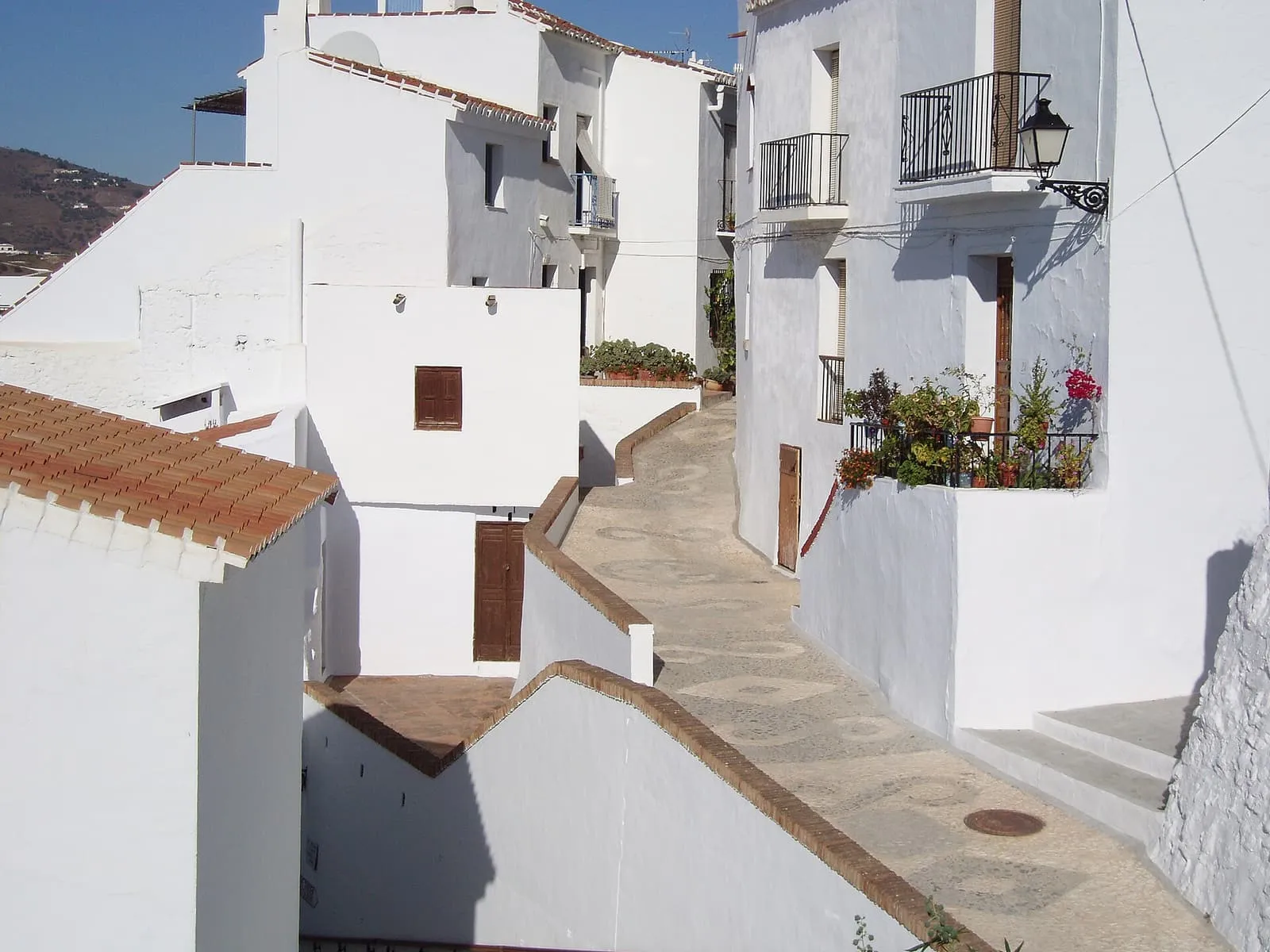
Frigiliana is a white village of about 3,400 people in the hills 6–7 km above Nerja, at the eastern end of Málaga province. Its Moorish old quarter, a maze of steep whitewashed lanes, steps and flowerpots, is one of the best preserved in Andalusia, and the village belongs to the Los Pueblos más Bonitos de España association.
- Is it worth it? Yes, especially combined with Nerja. It is small, easy to reach and very pretty, but busy at midday in summer.
- Time needed: 2–3 hours for the old quarter, the church and the viewpoints. Half a day with lunch.
- Cost: free, including the small village museum.
- Getting there: 10–15 minutes by car or 15–20 minutes by local bus from Nerja; about an hour by car from Málaga.
What to see in Frigiliana
The village has two parts: the newer streets along the road, where you arrive and park, and the Barrio Morisco-Mudéjar above them, also called Barribarto. Everything is a short, steep walk apart.
The Barrio Morisco-Mudéjar
This is the reason to come. The old quarter keeps the layout of the Moorish village: narrow, twisting lanes, many of them stepped, cobbles laid in patterns, white houses with brightly painted doors, and pots of geraniums and bougainvillea on every wall. There is no set route: start at Plaza del Ingenio, climb to the top of Barribarto and come back down a different way.
The tile panels of the 1569 revolt
On the walls of the old quarter, 12 ceramic tile panels tell the story of the Morisco revolt of 1569, part of the Alpujarras rebellion against Philip II. The Moriscos, Muslims forced to convert to Christianity, rose up and took refuge on the rocky summit above the village, El Peñón or El Fuerte. Royal troops took it on 11 June 1569, and many of the defenders were killed or enslaved. Soon afterwards the Moriscos were expelled from the kingdom of Granada.
The panels are in Spanish and read in order, from Calle Hernando el Darra to the end of Calle El Garral. Following them is a good way to find your way through the lanes.
Iglesia de San Antonio de Padua
The parish church, on Calle Real, was built in 1676, after the Moriscos had gone, by the lords of the village, the Manrique de Lara family. It is plain inside, with three naves, and there is no ticket.
El Ingenio: the cane honey mill
The large stone building at the foot of the old quarter, on Plaza del Ingenio, is the Palacio de los Condes de Frigiliana, a 16th-century palace that became a sugar mill. Sugar cane was grown on this coast for centuries, and the mill, the Ingenio Nuestra Señora del Carmen, still produces miel de caña, a dark cane syrup similar to molasses. It is a working factory, not a museum, but the syrup is sold in the village shops. Try it on fried aubergines (berenjenas con miel de caña), a classic Málaga tapa.
Casa del Apero and the Fuente Vieja
Just below the old quarter, the Casa del Apero houses the tourist office and a small, free archaeological museum. Nearby is the Fuente Vieja, a stone fountain from 1640.
The viewpoints
From the highest lanes of Barribarto, near the site of the old Moorish castle (only traces remain), you look down the valley to Nerja and the sea, and up to the mountains. The light is best in the late afternoon, when the day-trippers leave.
Festival de las Tres Culturas
Every year, usually over the last weekend of August (Thursday to Sunday), the Festival Frigiliana 3 Culturas celebrates the village’s Christian, Muslim and Jewish past with a craft and food market, a tapas route, concerts and talks. It is free, but the village gets very busy and parking is difficult. The town hall announces each year’s dates.
Walks into the natural park
Frigiliana sits at the foot of the Sierras de Tejeda, Almijara y Alhama natural park, and several marked paths start in the village. The best known climbs to El Fuerte, where the Moriscos made their last stand: about 7.4 km there and back from Plaza del Ingenio, around 4 hours, with a climb of nearly 700 metres to a summit at 963 metres and a 360-degree view of the mountains and the coast. The path is rocky with almost no shade: go outside summer, start early and bring water. In summer, paths in the park can be closed when the fire risk is high; ask at the tourist office.
Where to eat
Most restaurants and bars are along Calle Real and around the church, many with terraces over the valley. Look for berenjenas con miel de caña and the sweet wine of the Axarquía. In summer, arrive before 14:00 for lunch.
Tips for your visit
- Go early or late. Tour groups fill the old quarter from late morning to mid-afternoon.
- Wear good shoes. The lanes are steep and stepped, and hard going with a pushchair.
- Avoid midday in summer: there is little shade. Spring and autumn are best.
- Combine it with Nerja: the Balcón de Europa, the beaches and the caves are 10–15 minutes away. See our guides to Nerja and the beaches near Málaga.
Getting there and parking
| From | Car | Bus |
|---|---|---|
| Nerja | 10–15 min (6–7 km) | 15–20 min, about hourly Mon–Sat, fewer on Sundays |
| Málaga | about 1 h | bus to Nerja (1 h–1 h 30), then the local bus |
| Granada | about 1 h 30 | via Nerja; slow, a tour is easier |
- By car: take the A-7 motorway east from Málaga and leave at the Nerja/Frigiliana exit. Park in the covered municipal car park at the entrance to the village (about €1–1.50 an hour) or in the free spaces along the ring road, which fill quickly in summer. Don’t drive into the old quarter: the lanes are steep, narrow and partly pedestrian. Car hire at Málaga airport; see also our Málaga airport car hire guide.
- By tour: day trips from Málaga usually combine Nerja, the caves and Frigiliana: Nerja and Frigiliana day trip from Málaga. From Granada: Nerja and Frigiliana day trip from Granada. More ideas in our day trips from Málaga.
Where to stay
Most visitors come for a few hours, but the village is lovely in the evening, once the groups have gone.
- Hotel Villa Frigiliana: in the village, within walking distance of the old quarter.
- La Posada Morisca: a small hotel with a pool on the hillside outside the village, with views to the sea. You need a car.
- More options: hotels and rooms in Frigiliana.
To be by the sea, stay in Nerja and come up for an afternoon: the Parador de Nerja, above Burriana beach, or the Hotel Balcón de Europa, next to the promenade.
Frigiliana is one of the white villages of Andalusia easiest to reach from the coast.
FAQ
Is Frigiliana worth visiting?
Yes. It is one of the prettiest and best-kept white villages in Andalusia, and only 10–15 minutes from Nerja, so it is easy to add to a day on the coast.
How long do you need in Frigiliana?
Two to three hours for the old quarter, the tile panels, the church and the viewpoints. Allow half a day with lunch, or a full day to hike to El Fuerte.
How do you get from Nerja to Frigiliana?
By car it takes 10–15 minutes. A local bus runs from Nerja about every hour from Monday to Saturday (fewer on Sundays) and takes 15–20 minutes.
Can you do Nerja and Frigiliana in one day?
Yes. Many visitors see Nerja and the caves in the morning and Frigiliana in the afternoon. By car or on a tour from Málaga it makes a comfortable full day.