Some links on this page are affiliate links. If you book through them we may earn a commission, at no extra cost to you.
The short answer
If you only do five things in Cádiz: climb the cathedral tower, see the city from the Torre Tavira camera obscura, have lunch around the Mercado Central or in the Barrio de la Viña, spend the afternoon on La Caleta beach between its two castles, and walk the Campo del Sur sea wall at sunset. Almost nothing needs booking ahead, except hotels during Carnival and on summer weekends.
| # | What | Price (approx.) | Time | Book ahead? |
|---|---|---|---|---|
| 1 | Cathedral and Torre de Poniente | about €7–8 | 1 h | No |
| 2 | Torre Tavira | about €7–8 | 45 min | No |
| 3 | Mercado Central | Free | 1 h | No |
| 4 | La Caleta and its castles | Free | 1–3 h | No |
| 5 | Barrio de la Viña | Price of the food | A meal | No |
| 6 | El Pópulo and the Roman theatre | Free | 1 h | No |
| 7 | Campo del Sur | Free | 30 min | No |
| 8 | Parque Genovés | Free | 30 min | No |
| 9 | Alameda Apodaca | Free | 30 min | No |
| 10 | Playa de la Victoria | Free | Half a day | No |
The list
1. The cathedral and the Torre de Poniente
The Catedral Nueva, with its gold-tiled dome, took more than a century to build (1722–1838), so it starts Baroque and ends Neoclassical. Go down to the crypt, where the composer Manuel de Falla is buried, then climb the Torre de Poniente, one of the two bell towers, by a ramp and a few stairs, for a view over the rooftops and the ocean. About €7–8 with the crypt and the tower, 1 hour. Buy at the door or on the official website. Next to it, the Iglesia de Santa Cruz is the old cathedral, rebuilt after the Anglo-Dutch raid on the city in 1596.
2. Torre Tavira and the camera obscura
In the 18th century, Cádiz merchants built watchtowers on their houses to look out for their ships; more than a hundred still rise above the rooftops. The Torre Tavira, at the highest point of the old town, was the official lookout of the port. At the top, a camera obscura projects a live, moving image of the city onto a white dish while a guide points out the sights. Sessions run in turns in Spanish and English, so check the next one when you arrive. Then step out onto the terrace. About €7–8, 45 minutes.
3. The Mercado Central
The covered market, opened in the 1830s, is one of the oldest in Spain. Come in the late morning to see the fish stalls: tuna, prawns, cuttlefish and fish you won’t know the names of. Around the outside, food stands serve oysters, sushi, fried fish and tapas. Nearby, the Plaza de las Flores has flower stalls and Freiduría Las Flores, where you can take away a paper cone of fried fish. Free. Closed on Sundays.
4. La Caleta and its two castles
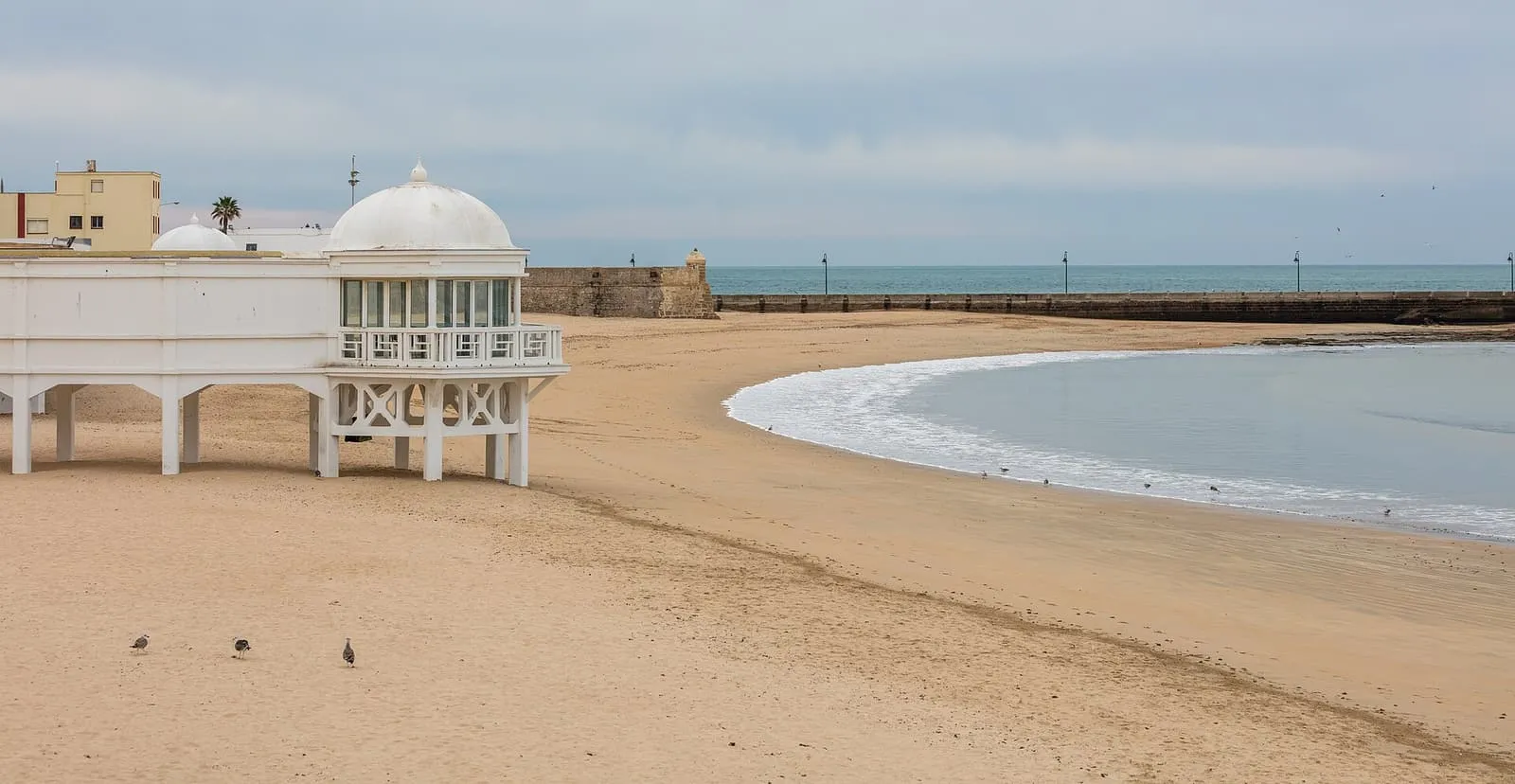
The small beach of the old town sits in a cove between two forts, with fishing boats pulled up on the sand and the white, early-20th-century bath house of La Palma in the middle. It appears in the James Bond film Die Another Day, standing in for Havana. It is the best place in Cádiz to watch the sunset.
- Castillo de Santa Catalina: a star-shaped fortress from the end of the 16th century, built after the 1596 raid. It is usually free, with exhibitions and a terrace over the sea.
- Castillo de San Sebastián: on a rocky island at the end of a long causeway, with a lighthouse. Access to the causeway and the castle has been limited in recent years, so check locally.
5. The Barrio de la Viña and its fried fish
The old fishermen’s quarter, between the market and La Caleta, is the heart of Carnival and of Cádiz cooking. Along Calle Virgen de la Palma, bars and restaurants serve pescaíto frito (fried fish), tortillitas de camarones (crisp shrimp fritters), cazón en adobo (marinated dogfish) and chicharrones de Cádiz (slow-cooked pork belly). Classic addresses include Casa Manteca, a tiny bar covered in bullfighting and flamenco posters, and El Faro, a long-established seafood restaurant.
6. El Pópulo and the Roman theatre
The oldest quarter, just behind the cathedral, was the walled medieval town. You enter through 13th-century gates such as the Arco del Pópulo and the Arco de la Rosa. Here too is the Roman theatre, built in the 1st century BC and one of the largest in Roman Spain. It lay hidden under houses until a fire uncovered it in 1980. A visitor centre explains it, and you can walk into part of the tunnel under the seating. Free, 45 minutes. Usually closed on Mondays.
7. The Campo del Sur
The sea wall on the southern side of the old town, with coloured houses facing the Atlantic and the cathedral dome at the end. It is often compared to the Malecón in Havana. Walk it in the evening, when the light falls on the façades, or on a stormy day when the waves break over the wall. Free.
8. The Parque Genovés
A garden on the north-west tip of the old town, next to the Parador, with clipped trees in odd shapes, a small waterfall and a pond, and palm trees along the sea wall. A good place for a shady break between La Caleta and the Alameda. Free.
9. The Alameda Apodaca
A promenade along the bay on the north side of the old town, with tiled benches, huge old ficus trees and views across the water to El Puerto de Santa María. It ends at the Baroque Iglesia del Carmen. Quieter than the Atlantic side, and pleasant late in the afternoon. Free.
10. Playa de la Victoria
The main city beach, a long, wide strip of fine sand in the modern part of Cádiz, about 3 km long, with a promenade, beach bars and hotels behind it. It is 10 minutes from the old town by bus or taxi, or a long walk. The water is the Atlantic, so fresher than the Mediterranean. Closer to the old town, Playa de Santa María del Mar is smaller and just as good. Free.
11. The Oratorio de San Felipe Neri
In this oval Baroque church, the Cortes of Cádiz met during the Napoleonic siege and approved Spain’s first constitution in 1812, nicknamed La Pepa. Plaques from Spanish and Latin American countries cover the outside wall. Inside, look for the painting of the Immaculate Conception by Murillo on the high altar. About €5, 30 minutes.
12. The Museo de Cádiz
On the Plaza de Mina, the city museum shows the finds from Phoenician Gadir, above all two white marble Phoenician sarcophagi carved with human faces, plus Roman statues and a fine collection of paintings by Zurbarán. Free for EU citizens, a small fee otherwise; 1 hour. Usually closed on Mondays.
13. The Carnival (February)
The most famous Carnival in Spain is less about parades than about words: groups called chirigotas and comparsas write satirical songs about politics and the year’s news, compete at the Gran Teatro Falla, and then sing in the streets. The whole city dresses up. The main days fall around Ash Wednesday, which is on 10 February in 2027; the programme is confirmed by the city each year. Hotels sell out months ahead, so book early or stay in Jerez or Seville. See our Cádiz guide.
14. The catamaran to El Puerto de Santa María
A commuter catamaran crosses the bay from the port of Cádiz to El Puerto de Santa María in about 30 minutes, with a good view back to the city. El Puerto has sherry bodegas, a castle and a riverfront lined with seafood bars. Cheap, easy and a small trip in itself. A few euros each way.
15. Day trip: Jerez de la Frontera
About 40 minutes by train. Visit a sherry bodega such as Tío Pepe (González Byass) or Lustau, and see the horse show of the Royal Andalusian School of Equestrian Art, held on certain mornings of the week. Jerez is also a centre of flamenco. Sherry bodega tours in Jerez. Staying in Seville? See the Cádiz and Jerez day trip.
16. Day trip: Sanlúcar de Barrameda
About an hour by road, at the mouth of the Guadalquivir. Sanlúcar makes manzanilla, the lightest sherry, which you can taste at bodegas such as Barbadillo. Eat prawns (langostinos) at the restaurants of Bajo de Guía on the river, and take a boat across to the Doñana National Park on the other side. In August, horse races are run on the beach at low tide.
17. Day trip: Vejer and the Costa de la Luz beaches
South of Cádiz, the Costa de la Luz has some of the best beaches in Spain, long and open to the Atlantic. Vejer de la Frontera, a white village on a hill about 50 minutes away by car, is the most beautiful stop, with a Moorish-looking old town and good restaurants. Below it are the beaches of Conil and Zahara de los Atunes, the dunes of Bolonia with the Roman town of Baelo Claudia, and Tarifa, the windsurfing capital of Europe. A car makes this much easier. See the white villages and hotels in Vejer.
If you only have one day
Morning: the cathedral and the Torre de Poniente, then El Pópulo and the Roman theatre. Walk to Torre Tavira for the camera obscura, and on to the Mercado Central for a late-morning snack. Lunch: fried fish in the Barrio de la Viña. Afternoon: La Caleta and the Castillo de Santa Catalina, then the Parque Genovés and the Alameda Apodaca. Evening: sunset over La Caleta or the Campo del Sur, and dinner in the old town. In summer, swap the afternoon sights for the beach.
Free things to do
La Caleta and Playa de la Victoria, the Castillo de Santa Catalina, the Mercado Central, El Pópulo and the Roman theatre, the Campo del Sur, the Parque Genovés and the Alameda Apodaca. EU citizens also enter the Museo de Cádiz free.
Where to stay nearby
The old town puts you within walking distance of everything on this list; the streets near La Caleta are best for sunsets, and Playa de la Victoria for a beach stay. The Parador de Cádiz is by the Parque Genovés, with sea views and a pool. Or browse hotels in Cádiz old town and hotels by Playa de la Victoria. More in our Cádiz guide.
FAQ
What is Cádiz best known for?
Its age (it is one of the oldest cities in Western Europe), its old town almost surrounded by the sea, its Carnival in February, and its seafood, especially fried fish.
Is one day enough for Cádiz?
One day is enough for the cathedral, Torre Tavira, the market and La Caleta. Stay two if you want time on the beach and a relaxed evening, or longer to visit Jerez and the Costa de la Luz.
What is the best beach in Cádiz?
La Caleta for atmosphere and sunsets in the old town; Playa de la Victoria for space and a long walk on the sand. For wilder beaches, go south to Bolonia or Zahara de los Atunes.
Can you visit Cádiz as a day trip from Seville?
Yes. Direct trains take about 1 hour 45 minutes, and the main sights fit into a day. See our Seville to Cádiz guide and all day trips from Seville.