Some links on this page are affiliate links. If you book through them we may earn a commission, at no extra cost to you.
The short answer: best areas
For a first visit, stay in Santa Cruz or the Centro, between the cathedral and the Setas. Everything you came to see is a short walk away, and you won’t need a bus or taxi at all.
- Best for first-timers: Santa Cruz, next to the Alcázar and the cathedral
- Best all-rounder: Centro and Alfalfa, the busy, central grid of shopping streets and tapas bars
- Best for a local feel: Triana, across the river, with the market, ceramics and flamenco bars
- Best for nightlife and a younger crowd: Alameda de Hércules
- Best for walking to the river and the bullring: El Arenal
Avoid staying far out (Nervión, the airport or the Cartuja business hotels) unless the price gap is big. The historic centre is compact and the magic of Seville is walking home at midnight through its lanes.
The areas at a glance
| Area | Walk to the cathedral | Best for | Watch out for |
|---|---|---|---|
| Santa Cruz | 0–10 min | First visit, couples | Busiest with tour groups by day, rooms can be small |
| Centro and Alfalfa | 5–15 min | Everyone, shopping, tapas | Some streets are noisy on weekend nights |
| El Arenal | 5–10 min | River walks, the bullring | Fewer budget options |
| Triana | 15–25 min | Local life, food, flamenco | Longer walk to the main sights |
| Alameda de Hércules | 20–25 min | Bars, a younger crowd, lower prices | Late-night noise around the square |
Santa Cruz: for the sights and the romance
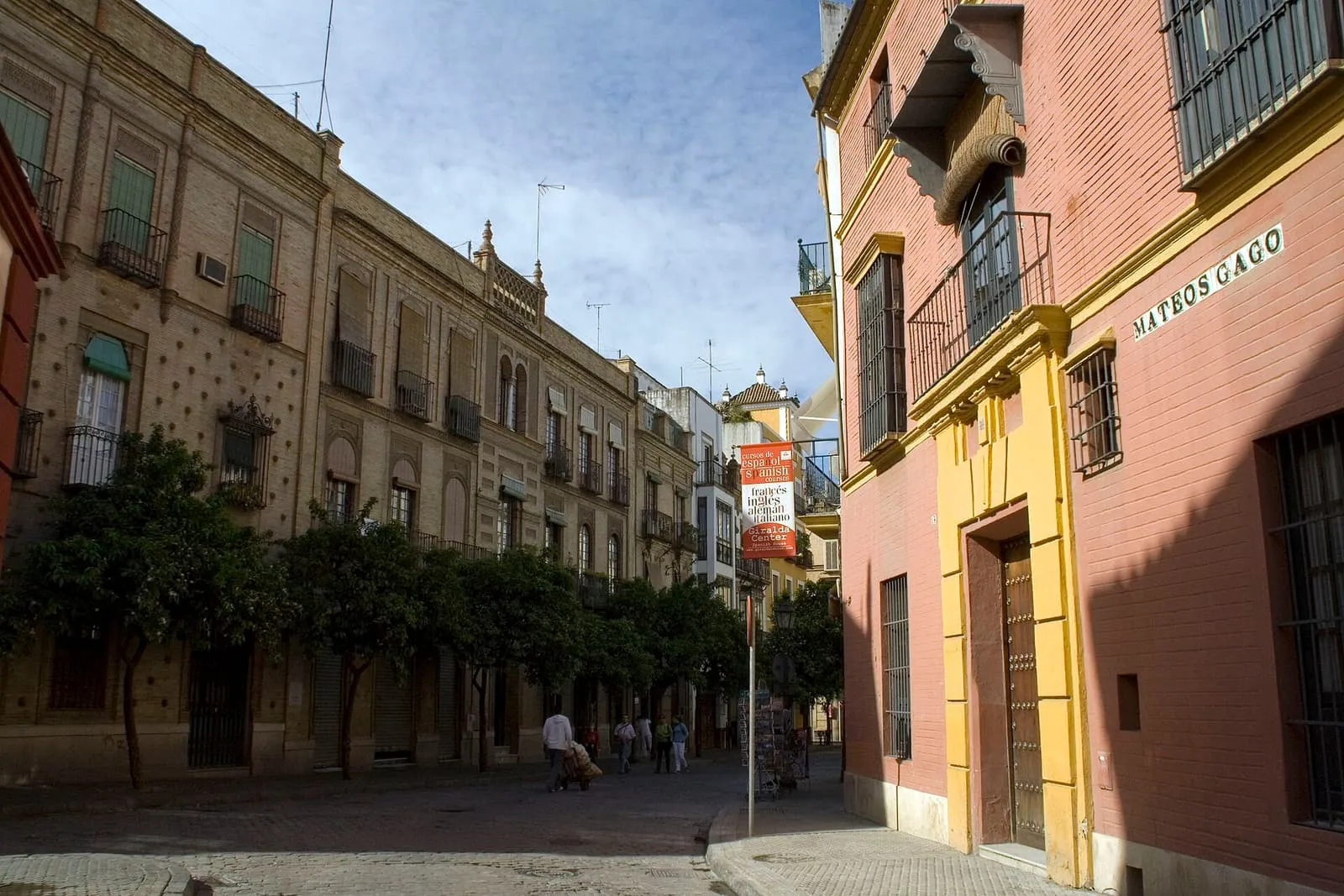
The old Jewish quarter is a maze of whitewashed lanes, orange trees and tiny squares, wrapped around the walls of the Real Alcázar and a few steps from the cathedral. It is the Seville of postcards, and it is where most visitors want to wake up.
The downside is that the same lanes fill with groups from about 10:00 to 18:00, and many hotels are converted old houses, so rooms around the central patio can be small or dark. Ask for an upper floor.
- Budget: Hotel Alcántara: simple rooms in an old house, right by the Alcázar gardens
- Mid-range: Las Casas de la Judería: a set of connected palaces with patios and a rooftop pool
- Top: EME Catedral Mercer: rooftop bar and pool looking straight at the Giralda
Centro and Alfalfa: for tapas, shopping and convenience
North of the cathedral, the Centro is the grid of pedestrian shopping streets (Sierpes, Tetuán), squares like Plaza Nueva and Plaza del Salvador, and the Alfalfa area, one of the best places in town for tapas. From here you can walk to everything: Santa Cruz, the Setas, Triana and the Alameda.
- Budget: Hotel Simón: a classic 18th-century house with a tiled patio, between the cathedral and the river
- Mid-range: Hotel Inglaterra: on Plaza Nueva, reliable and well located
- Top: Corral del Rey: a small, stylish boutique hotel in a 17th-century house in Alfalfa
El Arenal: for the river and the bullring
Between the cathedral and the Guadalquivir, the Arenal is home to the Maestranza bullring, the Torre del Oro and some of the most traditional bars in the city. It is calmer at night than the Centro and a good choice if you want to jog or stroll along the river.
- Budget to mid-range: Hotel Adriano: a small rooftop pool, a short walk from the bullring
- Mid-range: Hotel Bécquer: modern rooms, a rooftop terrace and pool
- Top: Hotel Mercer Sevilla: an intimate luxury hotel in a restored mansion
Triana: for a local feel across the river
Triana is the old sailors’, potters’ and flamenco neighbourhood on the west bank. It has its own market, ceramics workshops, Calle Betis with its riverside terraces, and a real neighbourhood life that the centre has lost. You pay for it with a 15–25 minute walk to the cathedral, which is a lovely walk across the Isabel II bridge.
- Budget: Hotel Monte Triana: good value, on the far side of Triana
- Mid-range: Hotel Ribera de Triana: on the river, with a rooftop pool facing the old town
- Top: Triana House: a small boutique guesthouse with a lot of character
Alameda de Hércules: for nightlife and a younger crowd
The long tree-lined Alameda square is the centre of Seville’s alternative scene, with bars, cafés and a lively LGBTQ+ friendly crowd. Prices are lower than in Santa Cruz. It is 20–25 minutes on foot from the cathedral, passing the Setas on the way.
- Budget: Oasis Backpackers’ Palace: a well-run hostel with private rooms, towards the Setas
- Mid-range: Hotel Sacristía de Santa Ana: an 18th-century house on the square itself
- Top: Hospes Las Casas del Rey de Baeza: a restored 18th-century house with patios and a rooftop pool, a short walk from the Alameda
Hotels with a pool
Seville is often above 35 °C from June to September, and a rooftop pool changes the trip. Among the hotels above, Las Casas de la Judería, EME Catedral Mercer, Hotel Adriano, Hotel Bécquer and Hotel Ribera de Triana all have one. See our full list of hotels with a pool.
Semana Santa, Feria and prices
Seville has two weeks a year when hotel prices double or triple and the best places sell out months ahead:
- Semana Santa 2027: Palm Sunday 21 March to Easter Sunday 28 March 2027. Processions pass through the centre day and night, so a Santa Cruz or Centro hotel puts you in the middle of it (and makes some streets hard to cross). See our Semana Santa guide.
- Feria de Abril 2027: usually two to three weeks after Easter. The fairground is in Los Remedios, south of Triana, so the Arenal and Triana are handy. See our Feria guide.
Outside these weeks, a double room in a good central hotel typically costs around €90–150 in winter and €130–250 in spring and autumn. July and August are the cheapest months because of the heat.
Book early for spring. March to May and October are high season, and the best-value rooms in Santa Cruz go first. Book with free cancellation and check again a few weeks before your trip.
Apartments or a hotel?
An apartment makes sense for families, groups and stays of four nights or more, and many are in restored houses around a shared patio. Seville regulates tourist apartments strictly and is limiting new licences in the centre, so check that the listing shows its official registration number. See apartments in Seville.
FAQ
What is the best area to stay in Seville for the first time?
Santa Cruz or the Centro. Both put the cathedral, the Alcázar and the best tapas bars within a ten-minute walk, which matters in a city you will explore on foot.
Is Triana a good place to stay?
Yes, if you prefer a local neighbourhood with great food and don’t mind a 15–25 minute walk to the main sights. It is also convenient for the Feria.
Which areas should I avoid?
There are no dangerous areas for visitors in the centre. The only real mistake is staying far out to save a little: you lose time and the evening walks that make Seville special. Some outer neighbourhoods such as Polígono Sur have social problems, but visitors have no reason to go there.
How many nights do I need in Seville?
Three nights (two full days and a half) is the sweet spot for a first visit. See how many days in Seville.
Do I need a hotel with parking?
Only if you arrive by car. Most of the historic centre is closed to non-resident traffic and parking costs around €20–30 a day. If you are on a road trip, pick up the car on the day you leave Seville.