
Some links on this page are affiliate links. If you book through them we may earn a commission, at no extra cost to you.
The short answer
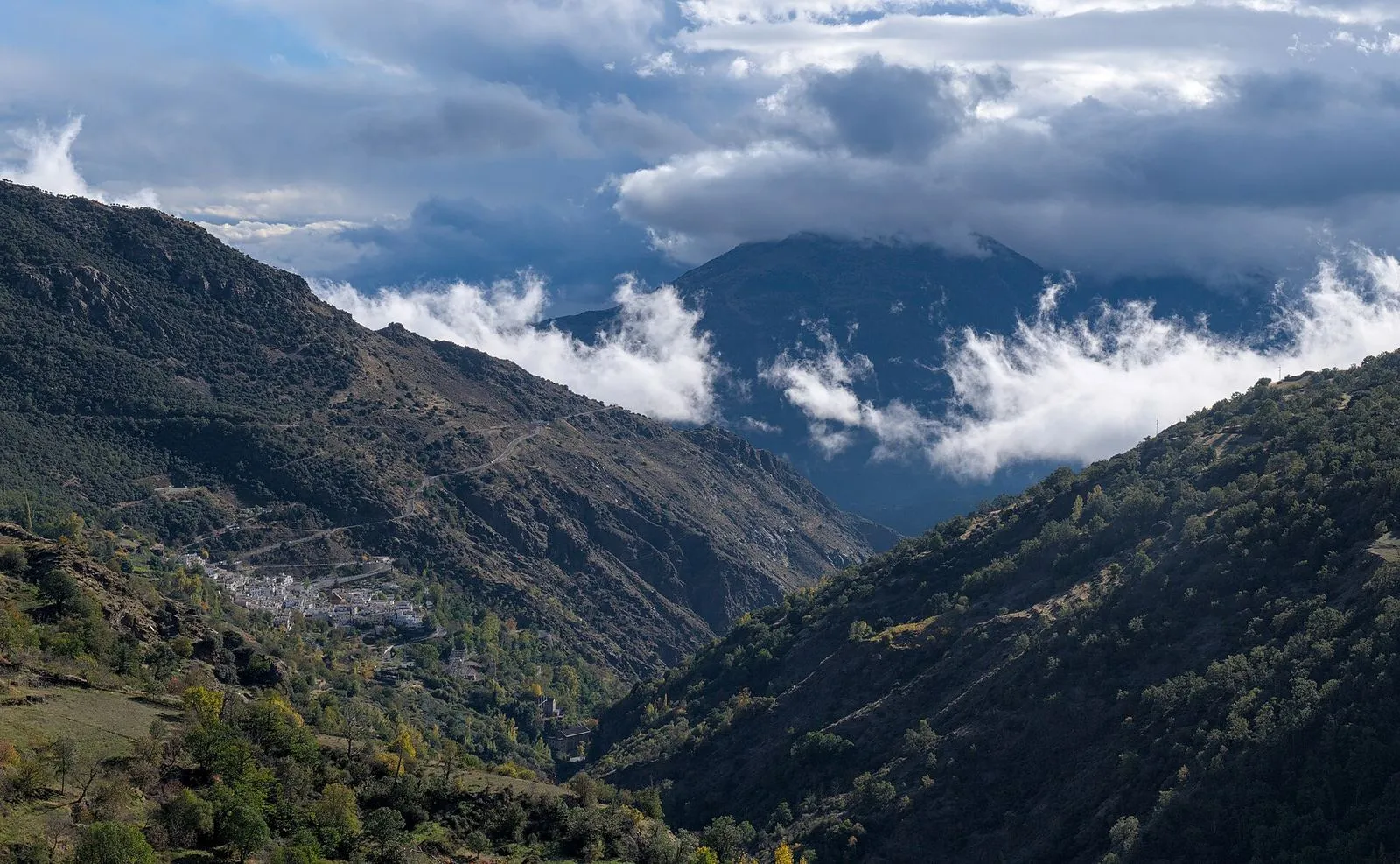
The Alpujarras (in Spanish, La Alpujarra) are the valleys on the southern slopes of the Sierra Nevada, in the provinces of Granada and Almería. White villages with flat grey roofs and round chimneys cling to steep hillsides, above terraced fields, irrigation channels and chestnut woods. The villages sit at about 1,000 to 1,500 metres, so it is cooler and greener here than anywhere else in southern Andalusia.
- The best villages: Pampaneira, Bubión and Capileira in the Poqueira gorge, then Pórtugos, Busquístar and Trevélez, famous for its ham.
- From Granada: about 1 h 15–1 h 30 by car to Pampaneira and Capileira, about 2 hours to Trevélez. Alsa buses run a few times a day.
- Time needed: a day trip covers the Poqueira villages. Stay two or three nights to walk and to see Trevélez and the villages further east.
- Do you need a car? It helps a lot, and we’d bring one. Without one, take a tour or the bus and stay the night.
What the Alpujarra is
The Alpujarra lies between the Sierra Nevada and the lower Contraviesa and Lújar ranges towards the sea. Most visitors mean the Alpujarra Granadina, below the Mulhacén. The Alpujarra Almeriense, around Laujar de Andarax, is quieter still (see our Almería guide).
The Moriscos and the revolt of 1568
After Granada fell in 1492, many of its Muslims withdrew to these mountains. Forced to convert, the Moriscos kept their language and customs until Philip II banned them, and at Christmas 1568 the Alpujarra rose in revolt. The war lasted until 1571, with great cruelty on both sides; the Moriscos were then deported and settlers from northern Spain took over. Their terraces, irrigation channels and houses remain.
The houses
The architecture looks more North African than Andalusian, and in our view it is the reason to come.
- Flat roofs (terraos): wooden beams covered with a thick layer of launa, a grey clay that packs down and keeps out the rain.
- Chimneys: round and whitewashed, topped with a slate cap and a stone to hold it down in the wind.
- Tinaos: covered passages where the upper floor of a house bridges the street, used as porches and for shade.
The three Poqueira villages were declared a protected historic site in 1982.
The Poqueira gorge: Pampaneira, Bubión and Capileira
The Barranco de Poqueira is a steep valley that runs down from the Mulhacén and the Veleta. Its three villages are only a few kilometres apart, stacked one above the other on the same slope.
Pampaneira
The lowest and most visited of the three, at about 1,050 metres. Park at the entrance and walk up to the main square and the 16th-century Iglesia de la Santa Cruz. Pampaneira is the place to buy jarapas, the striped rag rugs of the Alpujarra, woven on looms from strips of cloth: several workshops still weave them, and you can often watch. There is also a chocolate shop, plenty of cured-ham counters, and a stream of water running down the middle of the lanes.
Bubión
The middle village, at about 1,300 metres, is the quietest. Next to the church, the Museo Casa Alpujarreña is a traditional house kept as it was, with its kitchen, stable and tools; visits are guided and cost about €2. We think Bubión is a good place to see the terraos up close.
Capileira
The highest, at about 1,440 metres, with the best views of the gorge and the peaks. See the Museo Pedro Antonio de Alarcón, a folk museum named after the writer of La Alpujarra (1874). The park minibus for the Mulhacén leaves from here in summer (see the Sierra Nevada guide).
O Sel Ling
Above Soportújar, just west of the gorge at about 1,600 metres, O Sel Ling is a Tibetan Buddhist retreat centre founded in 1980. It opens to visitors free for a couple of hours in the afternoon. The last stretch is a slow dirt track, or about two hours on foot from Soportújar. We’d come quietly.
Further east: Pórtugos, Busquístar and Trevélez
Past Pitres, the A-4132 contours round into the Trevélez valley.
- Pórtugos: stop at the Fuente Agria, an iron-rich spring with fizzy, rust-tasting water pouring from several spouts below the Ermita de la Virgen de las Angustias. Nearby, about 80 steps lead down to El Chorreón, a small waterfall over rocks stained orange by the iron.
- Busquístar: a small village on the road to Trevélez, with valley views and far fewer visitors than the Poqueira.
- Trevélez: at about 1,476 metres, often called the highest village in Spain, though Valdelinares in Teruel is higher by the usual measure. Of its three quarters, the upper one, above 1,600 metres, keeps the most traditional houses. Trevélez is known above all for its ham, dried in the cold, dry mountain air.
Lanjarón and Órgiva
Both are on the way in from Granada, on the A-348.
- Lanjarón, the gateway to the Alpujarra, is a spa town whose mineral water is sold all over Spain. The Balneario de Lanjarón offers thermal baths and treatments.
- Órgiva, the market town, is the setting of Chris Stewart’s Driving Over Lemons and home to many foreign settlers. Its Thursday morning market, with local produce and crafts, is the liveliest in the area.
Yegen and Gerald Brenan
The British writer Gerald Brenan lived in Yegen, in the eastern Alpujarra, from 1920 and wrote about it in South from Granada (1957), still the classic account of village life here. A plaque marks his house off the main square, and the old inn where he first lodged has been restored as a small museum. Yegen is about an hour’s drive east of Trevélez, so it suits a longer stay.
Walks
Old mule paths link the villages, making this one of the best walking areas in Andalusia.
| Walk | Distance | Time | Notes |
|---|---|---|---|
| Pueblos del Poqueira circuit | about 9.4 km | about 3 h 30 | Official circular path linking Pampaneira, Bubión and Capileira; steep in places |
| Capileira–La Cebadilla and the Río Poqueira | about 8 km | about 3–3 h 30 | Up the gorge to an old power station hamlet, back along the river |
| GR-7 | stages of 10–20 km | a day each | The long-distance path crosses the Alpujarra from west to east, village to village |
We’d carry water, as shade is scarce, and wear good shoes: the paths are stony and steep. For the Mulhacén from Capileira, see the Sierra Nevada guide.
Food and wine
Alpujarra food is mountain food, made for walkers.
- Plato alpujarreño: the dish you will see on every menu: patatas a lo pobre (potatoes fried with onion and peppers), fried eggs, ham, chorizo and black pudding.
- Jamón de Trevélez: a protected ham (PGI) made without additives, cured for at least 17 months in drying rooms above 1,200 metres in Trevélez and a few neighbouring villages. We’d buy it by the slice in Trevélez or Pampaneira.
- Wine: the Contraviesa hills, south of the valley, have some of the highest vineyards in Europe. Look for wines under the Granada designation, and the rustic vino de la costa in village bars.
- Also: chestnuts, honey, trout and migas.
When to go
- Spring (April to June): green terraces, flowers and full streams. In our view, the best walking season.
- Summer: cooler than Granada, with the high paths and the Mulhacén open. Busy in August.
- Autumn (October and November): the chestnut woods turn gold and the harvest is in.
- Winter: cold nights and snow on the peaks, sometimes in Trevélez and Capileira too. Check the forecast and carry chains. See Granada weather by month.
Day trip from Granada or stay a few nights?
A day trip works for the Poqueira villages: leave early, walk between the three, have lunch and drive back. Adding Trevélez makes a long day on winding roads.
We’d stay two or three nights if you can. The villages empty out in the evening, and you have time to walk the gorge and reach Trevélez, Pórtugos or Yegen. The Alpujarra also fits well between Granada and the coast on a road trip: the Costa Tropical is less than an hour below Lanjarón.
For other options, see our day trips from Granada.
Getting to the Alpujarras
| From | By car | By bus |
|---|---|---|
| Granada | Pampaneira about 1 h 15, Capileira about 1 h 30, Trevélez about 1 h 45–2 h | Alsa, a few a day, about 2–2.5 h to the Poqueira villages |
| Málaga | about 1 h 45–2 h to Pampaneira | change in Granada or Motril |
| Motril (Costa Tropical) | about 35 minutes to Lanjarón, 1 h to Pampaneira | limited |
- By car: from Granada take the A-44 south towards Motril, leave at exit 164 onto the A-348 through Lanjarón towards Órgiva, then turn up the A-4132 to Pampaneira, Capileira and Trevélez. The last stretch is narrow and winding, with village car parks at the entrances. Hire a car in Granada or at Málaga airport; see our car hire guide.
- By bus: Alsa runs from Granada bus station to Lanjarón and Órgiva several times a day, and a few times a day on to Pampaneira, Bubión, Capileira, Pitres, Pórtugos and Trevélez. Check times on alsa.es and book ahead in summer.
- On a tour: the simplest option without a car: Alpujarras day trip from Granada.
Where to stay
- Estrella de las Nieves (Pampaneira): a rural hotel of about 20 rooms with balconies, an outdoor pool and views over the gorge. About 9.2 on Booking.com.Check prices
- Finca Los Llanos (Capileira): a rural hotel open since 1990, with a summer pool and a restaurant, handy for the walks and the Mulhacén bus. About 9.2 on Booking.com.Check prices
- Hotel La Fragua II (Trevélez): a mountain hotel in the old centre, with a pool looking over the valley; the La Fragua restaurant is a minute away. About 9.0 on Booking.com.Check prices
- More options: hotels and rural houses in the Alpujarras. Rural cottages (casas rurales) are the other classic choice, especially for families and longer stays.
To sleep in the city and visit for the day, see where to stay in Granada. For more mountain villages across the region, see the white villages of Andalusia.
FAQ
Which is the most beautiful village in the Alpujarras?
Most people choose Capileira for the views or Pampaneira for the lanes and crafts. Busquístar and the villages around Pitres are quieter.
Can you visit the Alpujarras as a day trip from Granada?
Yes. By car, the Poqueira villages are about 1 h 15–1 h 30 away. By bus it is tight, so take a tour or stay a night.
Is Trevélez the highest village in Spain?
It is often called that, at about 1,476 metres, but by the usual measure Valdelinares in Teruel is higher.
How do you get to the Alpujarras without a car?
Alsa buses from Granada reach the Poqueira villages and Trevélez a few times a day, in about 2–3 hours. We think a guided tour is easier.
What is the best time to visit the Alpujarras?
We’d say spring and autumn, for walking and the chestnut woods. Summer is cooler than the lowlands.