Some links on this page are affiliate links. If you book through them we may earn a commission, at no extra cost to you.
The short answer
Almería is the sunny, dry, far-eastern corner of Andalusia. The city has a real, lived-in centre, one of the biggest Moorish fortresses in Spain and a strong tapas culture. Around it are two landscapes you won’t find anywhere else in the region: the volcanic coast and empty beaches of Cabo de Gata and the Tabernas desert, where the spaghetti westerns were filmed.
- Why go: the Alcazaba, the wild beaches of Cabo de Gata, the desert and its film sets, and mild, sunny winters.
- Time needed: one day for the city; three to four days to add Cabo de Gata and Tabernas.
- Cost: the Alcazaba is free for EU citizens and very cheap for others. The film-set parks cost about €23–27.
- Getting there: it is far from the other cities: about 2 hours by car from Granada and 2 h 15 from Málaga. A car is strongly recommended for the province.
Things to do in Almería city
The old centre is compact: the Alcazaba sits on the hill above it, with the cathedral, the Paseo de Almería and the main tapas streets below. You can see the city in a full day.
| Sight | Price (approx.) | Time needed |
|---|---|---|
| Alcazaba | free for EU citizens, about €1.50 for others | 1 h 30–2 h |
| Cathedral | about €6 | 45 minutes |
| Refugios de la Guerra Civil | about €3 (guided visit) | about 1 h 15 |
The Alcazaba of Almería
The Alcazaba was founded in the 10th century, when Almería was the main port of the Caliphate of Córdoba, and it is one of the largest Moorish fortresses in Spain. Its walls run along the whole ridge above the old town. Inside there are three enclosures: gardens and water channels in the first, the remains of the Moorish palace and houses in the second, and a castle built by the Catholic Monarchs after the conquest of 1489 in the third. The views over the city, the port and the sea are wide, and from the top you can see the Muralla de Jayrán, a line of walls climbing the next hill to the Cerro de San Cristóbal.
EU citizens get in free with ID. It is closed on Mondays, and in summer it closes in the middle of the day, so go early. There is little shade on the upper levels. If you have seen the Alcazaba of Málaga, Almería’s is much bigger and emptier, with less of the palace left and more of the fortress.
The fortress-cathedral
The Cathedral of the Incarnation was begun in the 16th century, after an earthquake destroyed the earlier building, at a time when Berber pirates raided the coast. So it was built like a fortress, with thick walls, towers and battlements. Inside it is a Gothic and Renaissance church with a carved choir. Hours are shorter than in Seville or Granada, so check before you go.
The Civil War shelters
During the Spanish Civil War, Almería was bombed and shelled many times, and the city dug more than 4 km of tunnels under the streets to protect its people. The Refugios de la Guerra Civil can be visited on guided tours of about an hour, through a section of the tunnels with an operating theatre and store rooms. Groups are small, so buy tickets in advance, at the ticket office on Plaza Manuel Pérez García or online.
Tapas in Almería
Like Granada, Almería still gives you a free tapa with each drink in most traditional bars, and here you can often choose it from a list. A few drinks make a light dinner. The bars around the Paseo de Almería and the Puerta de Purchena are the easiest places to start. Try the local red prawns (gamba roja).
Cabo de Gata-Níjar natural park
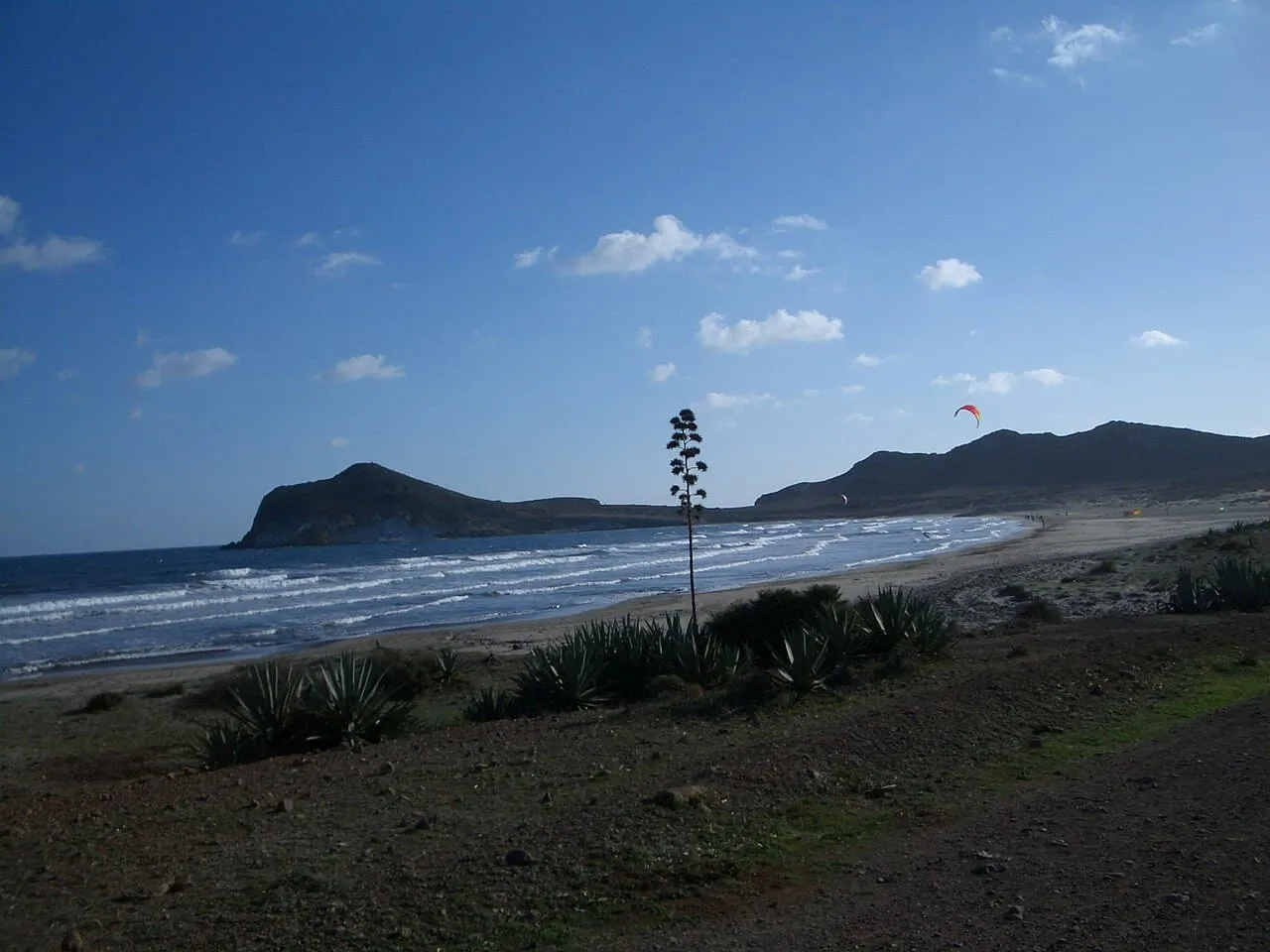
About 40 minutes east of the city, Cabo de Gata-Níjar is a natural park of volcanic hills, dry valleys and cliffs over a clear sea. It is the least built-up stretch of coast in Andalusia, and many of its beaches have no buildings at all.
- San José: the main village, with a small beach, a marina, most of the hotels and restaurants, and the boat and kayak trips. The best base for the park.
- Playa de los Genoveses and Playa de Mónsul: two wide sandy bays south of San José, reached on a dirt road. Mónsul has a large dune and a rock in the sea that you may recognise from Indiana Jones and the Last Crusade. In summer, car access is limited and a shuttle bus runs from San José, so go early.
- Playa de los Muertos: a long beach of pale pebbles and very clear water near Carboneras, reached on a steep path of about 15 minutes. No shade and no services: bring water.
- Las Negras: a relaxed fishing village with a dark volcanic beach. From here you can walk about an hour along the coast, or take a boat taxi, to Cala de San Pedro, a cove with no road.
- Cabo de Gata lighthouse: at the southern tip of the park, with a viewpoint over the Arrecife de las Sirenas, volcanic reefs in the sea. On the way, the salt flats near San Miguel de Cabo de Gata often have flamingos.
- Rodalquilar: an old gold-mining village with the ruins of the mine works above it and a small visitor centre about the volcanoes.
Seeing the coast from the sea is the best way to reach the coves: boat trips in Cabo de Gata. Paddling is also popular: kayak tours in Cabo de Gata.
The Tabernas desert and the western film sets
About 30 minutes north of the city, the Tabernas desert is a landscape of dry gullies and bare hills, often described as the only desert in Europe. In the 1960s and 1970s it stood in for the American West and Mexico in dozens of films, including Sergio Leone’s westerns, and some of the sets are still standing as theme parks.
| Park | What it is | Price (approx.) |
|---|---|---|
| Oasys MiniHollywood | the largest, with a western town, shows and a zoo | from about €27 |
| Fort Bravo (Texas Hollywood) | a working film set with shows and carriage rides | about €23 |
| Western Leone | a smaller set in the desert | check locally |
The parks have shows at set times, so plan your visit around them. In summer the heat is intense in the middle of the day. A tour saves you the drive and often adds the desert landscape: Tabernas desert tours.
Mojácar
Mojácar is a white hill town about an hour north-east of Almería, with steep lanes, viewpoints over the coast and a long beach area below it, Mojácar Playa. See our white villages guide for more towns like it.
When to go
Almería is one of the sunniest and driest places in Europe. Spring (April to June) and autumn (September to October) are the best times: warm days, a warm sea from late summer and quiet beaches outside August. Summer is very hot, especially in the Tabernas desert, and the beaches of Cabo de Gata are at their busiest in July and August. Winter is mild and sunny, good for the city and coastal walks, though too cool to swim. See our best time to visit Andalusia.
Getting to Almería
| From | Car | Bus | Train |
|---|---|---|---|
| Granada | about 2 h | about 2–2 h 30, several a day | few, not faster |
| Málaga | about 2 h 15 | 3 h 30 or more | not practical |
| Madrid | about 5 h 30–6 h | long | a couple of direct trains a day, 6–7 h |
- By plane: Almería airport is about 10 km east of the city, with flights from Madrid, Barcelona and some seasonal routes from the UK and the rest of Europe. A city bus runs to the centre.
- By bus: the easiest way without a car from Granada and Málaga. The bus and train stations share one building near the centre. Compare times: Granada to Almería by bus.
- By train: the high-speed line has not reached Almería yet, so trains from Madrid are slow: Madrid to Almería by train.
A car is strongly recommended. Buses reach San José and Mojácar, but not often, and the best beaches, the lighthouse and the film sets need a car. You can pick one up at the airport: car hire at Almería airport. See our car hire guide, and our Andalusia road trip for how to fit Almería into a longer route.
Where to stay
| Base | Best for |
|---|---|
| Almería city | the Alcazaba, tapas and travelling without a car |
| San José | the beaches of Cabo de Gata |
| Mojácar | a beach holiday and the north of the province |
- Almería city: stay in the centre, near the cathedral or the Paseo, so you can walk to the Alcazaba and the tapas bars. Hotel Catedral Almería is next to the cathedral. More options: hotels in Almería city centre.
- San José: the best base for Cabo de Gata, with small hotels and apartments and no high-rises. MC San José is a small hotel in the village. More options: hotels in San José.
- Mojácar: the Parador de Mojácar is on the beach below the town. More options: hotels in Mojácar.
A good plan is one night in the city and two or three in San José. Almería is too far from Granada for a comfortable day trip: see day trips from Granada for closer options, and our Granada guide if you are coming from there.
FAQ
Is Almería worth visiting?
Yes, if you like beaches and landscapes as much as monuments. The city has one of the largest Moorish fortresses in Spain, and Cabo de Gata has some of the wildest beaches on the Mediterranean. See the other best places in Andalusia.
Is the Alcazaba of Almería free?
It is free for EU citizens, who need to show ID, and costs about €1.50 for other visitors. It is closed on Mondays.
Can you visit Almería as a day trip from Granada?
It is possible by car, but it means about four hours of driving for one day. Almería and Cabo de Gata are much better with at least two nights.
What are the best beaches in Cabo de Gata?
Playa de los Genoveses and Playa de Mónsul, near San José, are the best-known sandy beaches. Playa de los Muertos, near Carboneras, is known for its very clear water, and Cala de San Pedro can only be reached on foot or by boat.
Do you need a car in Almería?
In the city, no. For Cabo de Gata, the desert and Mojácar, yes: buses are infrequent and the best beaches are at the end of dirt roads.