Some links on this page are affiliate links. If you book through them we may earn a commission, at no extra cost to you.
The short answer
Málaga has more than a dozen city beaches on both sides of the port, all public and free, with grey-brown sand, promenades and beach restaurants. The best one depends on what you want:
- Closest to the old town: La Malagueta, 15 minutes’ walk from the cathedral
- Calm water for children: Pedregalejo, where breakwaters make small, sheltered bays
- Espetos and a local feel: Pedregalejo and El Palo, the old fishing districts
- Space and fewer visitors: La Misericordia, on the west side
- Sunset with a view of the city: Baños del Carmen
- Clear water and cliffs: Maro, just east of Nerja, about an hour away
- A long sandy resort beach by train: Torremolinos, 20 minutes on the C1
Málaga beaches compared
| Beach | Where | Sand | Best for | From the centre |
|---|---|---|---|---|
| La Malagueta | Next to the port | Grey-brown sand | A swim between sights | 15 min on foot |
| La Caleta | East of La Malagueta | Grey-brown sand | A quieter city beach | 20–25 min on foot |
| Baños del Carmen | Start of Pedregalejo | Rocks and small patches of sand | Sunset, a drink | 35–40 min on foot |
| Pedregalejo | 4 km east | Sand, small bays | Families, fish restaurants | 15 min by bus or taxi |
| El Palo | 5–6 km east | Sand and some shingle | Espetos, local life | 20–30 min by bus |
| San Andrés, Huelin, La Misericordia | West of the port | Grey-brown sand | Space, locals | 30–45 min on foot, or metro |
| Torremolinos | Costa del Sol, west | Wide, sandy | A full beach day | 20 min by train |
| Benalmádena | Costa del Sol, west | Sand | Marina, families | 25–30 min by train |
| Nerja (Burriana) | 50 km east | Darker sand, some pebbles | A day trip with the caves | About 1 h by car |
| Maro | East of Nerja | Pebbles, coarse sand | Clear water, snorkelling | About 1 h by car |
| Marbella | 60 km west | Sand | Beach clubs, old town | About 1 h by bus |
The city beaches, from the centre east
The seafront promenade runs without a break from the port to El Palo, so you can walk or cycle from one beach to the next.
1. La Malagueta
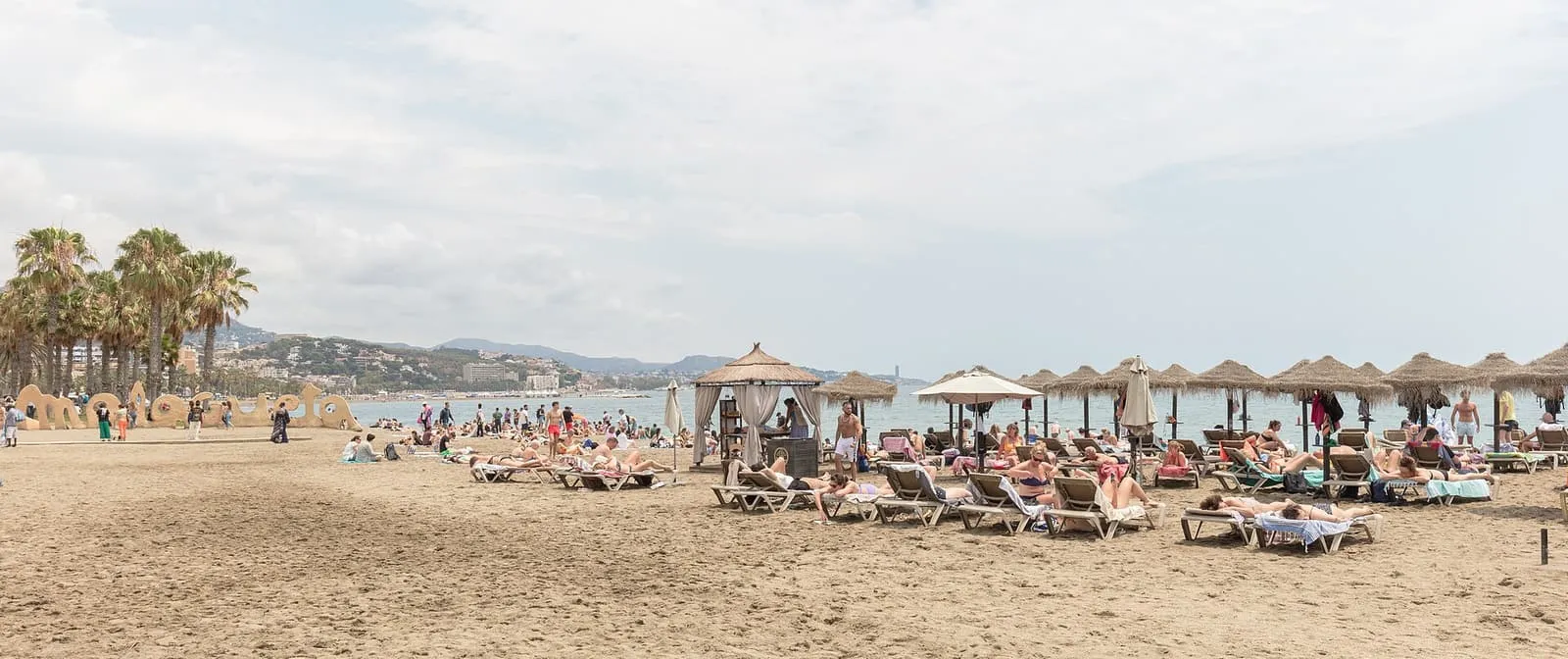
The city beach, right next to the port and the Muelle Uno promenade, and 15 minutes’ walk from the cathedral. It has sunbeds, showers, toilets, lifeguards in season and a line of chiringuitos (beach restaurants) along the Paseo Marítimo. It is the easiest beach to combine with sightseeing, and the busiest: on summer weekends, go early or walk further east. Behind it is the La Malagueta district, with the bullring and seafront apartment blocks.
2. La Caleta
La Caleta continues east from La Malagueta along the Paseo Marítimo Pablo Ruiz Picasso. Breakwaters divide it into shorter stretches, and it is usually a little less crowded, with the villas and gardens of El Limonar on the hill behind. It has the same services as La Malagueta.
3. Baños del Carmen
A historic seaside bathing establishment from the early 20th century, at the western end of Pedregalejo. The shore is mostly rocks with small patches of sand, so it is not the best place for a swim, but the terrace under the trees is one of the most loved spots in Málaga for a drink at sunset, looking back at the city and the port.
4. Pedregalejo
Pedregalejo is a former fishing village about 4 km east of the centre, now part of the city. Its beach is a row of small bays between stone breakwaters, with calm, shallow water that suits children. The promenade behind it is lined with fish restaurants and beach bars, many with an espeto boat grilling sardines on the sand. It is busy in the evening, when people come for dinner by the sea.
5. El Palo
El Palo carries on east from Pedregalejo and feels more working-class and local. The beach is longer, with sand and some shingle, big beach restaurants and the jábegas, the traditional rowing boats of Málaga, pulled up on the sand. It is the classic place for espetos and fried fish on a Sunday. See things to do in Málaga for more on the old fishing districts.
The west side
West of the port and the Guadalmedina riverbed, a long stretch of beaches runs past residential neighbourhoods towards the mouth of the Guadalhorce river. Visitors rarely come here, which is the point: there is plenty of space, the promenade is newer and the beach bars serve locals.
6. La Misericordia and Huelin
The widest and longest beaches in the city, backed by a promenade with palm trees, playgrounds and a cycle lane. Along the way you pass the Chimenea de los Guindos, a tall brick chimney from a former lead foundry. The sand is the same grey-brown as in the east, and there is plenty of room even in August. Walk 30–45 minutes along the seafront from the centre, or take Metro line 2 to Princesa-Huelin and walk down to the sea.
7. San Andrés
The part of the western seafront nearest the port, a practical beach for anyone staying in Soho or near the train station. It is quieter than La Malagueta and has the usual showers and beach bars, but less character than the eastern beaches.
Beach day trips on the coast
For clearer water, longer beaches or a change of scene, the Costa del Sol and the coast east of Málaga are an easy day trip. See also day trips from Málaga.
8. Nerja: Burriana, Calahonda and the Balcón de Europa
Nerja, about an hour east, is the prettiest small town on the Málaga coast. Start at the Balcón de Europa, a promenade on a headland above the sea. Below it, Calahonda is a small cove with fishing boats, reached by steps. Burriana, a 15–20 minute walk east, is the main beach: longer, with darker sand and some pebbles, beach restaurants, water sports and sunbeds. Combine Nerja with the Nerja caves and the white village of Frigiliana (see the white villages). Without a car, a Nerja and Frigiliana day trip from Málaga covers the town, the caves and the village.
9. Maro and the Maro-Cerro Gordo cliffs
A few kilometres east of Nerja, the village of Maro sits above the protected cliffs of the Maro-Cerro Gordo natural area. Playa de Maro is a cove at the bottom of a steep lane, with clear, green water, pebbles and coarse sand. Further east, smaller coves such as Las Alberquillas and El Cañuelo are reached by tracks down the cliffs. This is the best stretch near Málaga for snorkelling and kayaking; a kayak tour along the Maro cliffs takes you to caves and a waterfall that falls straight into the sea. Access and parking are restricted in summer, so check the rules before you go.
10. Torremolinos
The first resort west of Málaga, 20 minutes by train. Its beaches, from Playamar and El Bajondillo to La Carihuela, are wide and sandy, slope gently and are lined with sunbeds and beach restaurants. La Carihuela, the old fishermen’s quarter, is famous for fried fish. If you want a full beach day without a car, this is the easiest choice.
11. Benalmádena
Next along the coast, Benalmádena has a busy marina, Puerto Marina, with beaches on both sides, and a promenade that passes the Castillo de Bil-Bil, a red neo-Moorish building by the sea. It is popular with families. The train station (Benalmádena-Arroyo de la Miel) is uphill from the coast.
12. Marbella
About an hour west, Marbella’s town beaches, such as La Venus and La Fontanilla, are a few minutes’ walk from the whitewashed old town. Puerto Banús and the beach clubs along the coast are where Marbella’s glamour is, and where sunbeds cost much more. Go for the old town and a swim, not for the beaches alone.
Sand, sea temperature and the beach season
Málaga’s beaches are sand, not pebbles, but the sand is grey-brown and fairly coarse, not white. Much of it is topped up after winter storms. East of Nerja, the coves are pebbly: bring water shoes.
| Season | Sea (approx.) | Daytime air (approx.) | On the beach |
|---|---|---|---|
| Winter (Dec–Feb) | 15–16 °C | 16–18 °C | Walks, lunch in the sun; few swimmers |
| Spring (Mar–May) | 15–18 °C | 19–24 °C | Sunbathing; the sea is cold |
| Summer (Jun–Aug) | 20–23 °C | 28–31 °C | Full season, busy, all services |
| Autumn (Sep–Nov) | 18–22 °C | 20–27 °C | Warm sea, fewer people: the best time |
The sea here is cooler than further east in the Mediterranean, because Atlantic water enters through the Strait of Gibraltar, and some summer days bring a sudden drop in temperature. The beach season, with lifeguards and all services, runs roughly from mid-June to mid-September. For the weather month by month, see the best time to visit Andalusia.
Winter sun: beach walks from November to March
Málaga has one of the mildest winters of any city in mainland Europe, with many sunny days around 16–18 °C. That makes it perfect for a winter beach walk: follow the promenade from La Malagueta to El Palo (about 5 km), stop for espetos at a beach restaurant, and have lunch on a terrace in a T-shirt in January. Many chiringuitos stay open all year. Swimming is for the brave.
Chiringuitos and espetos
A chiringuito is a beach restaurant, and on the Málaga coast most of them grill espetos: sardines threaded on a cane skewer and cooked over an olive-wood fire, often in an old boat filled with sand. The local saying is that sardines are best in the months without an “r”, from May to August. Order a few espetos per person with a salad and some fried fish, and expect the terraces to fill up from 14:00 and again from 21:00.
How to get to the beaches
- On foot: La Malagueta (15 minutes from the cathedral), La Caleta and even Pedregalejo (45–60 minutes) along the seafront. The western beaches are 30–45 minutes away.
- City bus: EMT line 11 runs from the centre along the seafront to Pedregalejo and El Palo. A taxi takes about 15 minutes.
- Metro: line 2 to Princesa-Huelin, for Huelin and La Misericordia.
- Train: the Cercanías C1 runs from Málaga Centro-Alameda and María Zambrano to Torremolinos (about 20 minutes), Benalmádena (about 25–30 minutes) and Fuengirola (about 45 minutes), about every 20 minutes. It also stops at the airport.
- Bus along the coast: buses leave the main bus station, next to María Zambrano, for Nerja and Marbella, taking about an hour or a little more.
- Car: not worth it for the city beaches, where parking is hard in summer. For Nerja, Maro and the quieter coves, a car makes the day much easier: see car hire at Málaga airport or compare prices on DiscoverCars.
Practical tips
- Blue Flag: several city beaches and many on the Costa del Sol usually fly the Blue Flag, a European award for clean water and services. The list changes every year.
- Lifeguards and flags: lifeguards work in the main season, roughly mid-June to mid-September. Green flag: safe; yellow: take care; red: no swimming.
- Sunbeds: about €6–10 per sunbed per day on the city beaches and in Torremolinos, with a parasol extra. You can always lay your own towel for free. Beach clubs in Marbella cost far more.
- Heat: in July and August, avoid the midday sun and bring shade. On days of terral, the hot, dry wind from inland, temperatures can pass 40 °C: go early in the morning.
- Valuables: don’t leave phones and bags alone on the busy city beaches.
- Noche de San Juan (23 June): thousands of people gather on the city beaches for bonfires and a midnight dip. Fun, but crowded.
Where to stay near the beach
To combine the beach with the old town, stay at La Malagueta. For a seaside neighbourhood, choose Pedregalejo or El Palo; for a beach holiday, the Costa del Sol.
- Gran Hotel Miramar: Málaga’s 1920s palace hotel, on the seafront between La Malagueta and La Caleta, with gardens and a pool
- Hotel MS Maestranza: a large, practical hotel next to the bullring, a few minutes from La Malagueta
- Apartments and small hotels in La Malagueta
- La Chancla: a small hotel on the promenade in Pedregalejo, right on the beach
- Apartments in Pedregalejo and El Palo
- Hotel Pez Espada: a 1950s landmark on the beach in Torremolinos, or search hotels in Torremolinos
- Holiday World: a big family resort with pools in Benalmádena
- Parador de Nerja: on the cliff above Burriana beach, with gardens and sea views, or Hotel Balcón de Europa, next to the famous viewpoint
- Hotel El Fuerte Marbella: between Marbella’s old town and the beach
For all areas, see where to stay in Málaga and the best hotels in Málaga. For the rest of the city, see our Málaga travel guide.
FAQ
Does Málaga have good beaches?
Yes, for a city. The beaches are clean, sandy and well equipped, with promenades and beach restaurants, but the sand is grey-brown rather than golden. For clearer water, go to Nerja and Maro.
What is the best beach in Málaga city?
La Malagueta is the most convenient, 15 minutes from the cathedral. Pedregalejo is better for children and for dinner by the sea, and La Misericordia has the most space.
Can you swim in Málaga in October?
Usually, yes. The sea is still around 20 °C in early October and the days are warm. From November to May the water is 15–18 °C, which most people find cold.
How do I get from Málaga to the beaches of Torremolinos?
Take the Cercanías C1 train from Málaga Centro-Alameda or María Zambrano: about 20 minutes to Torremolinos, then a short walk downhill to the sea.
Which beach near Málaga has the clearest water?
The coves of the Maro-Cerro Gordo cliffs, east of Nerja. The water is clear and good for snorkelling, but the beaches are pebbly and access is limited in summer.