Some links on this page are affiliate links. If you book through them we may earn a commission, at no extra cost to you.
The short answer
Tarifa is a small, relaxed surf town at the southernmost point of mainland Europe, in the province of Cádiz, where the Atlantic meets the Mediterranean and Morocco is about 14 km away across the Strait of Gibraltar. It is famous above all for its wind, which made it Europe’s capital of kitesurfing and windsurfing and keeps the long beaches around it wild.
- Why go: some of the best beaches in Spain, kitesurfing and windsurfing, whales and dolphins in the Strait, a walled old town, and a ferry to Tangier.
- Time needed: one full day for the town and a beach; two to four days to add Bolonia, a whale trip or Tangier; a week or more if you come to kite.
- Best time: June and September. July and August are the busiest months.
- Getting there: no train. By car, about 1 h 15 from Cádiz and 1 h 45–2 h from Málaga; buses run from Cádiz, Seville, Málaga and Algeciras.
The old town and the castle
Tarifa’s old town sits inside its medieval walls, a knot of white lanes, small squares and bars that you can cross in ten minutes. Enter through the Puerta de Jerez, the main surviving gate, and wander towards the Iglesia de San Mateo, the main church. The town comes alive in the evening, when the beaches empty.
Castillo de Guzmán el Bueno
The castle was built in the 10th century by the Caliphate of Córdoba, on the edge of the port. It takes its name from Alonso Pérez de Guzmán, “Guzmán el Bueno”, who held Tarifa for Castile during a siege in 1294. According to the story, the besiegers held his son hostage and threatened to kill him unless the town surrendered; Guzmán threw down his own knife from the walls rather than give up.
Today you walk the walls and towers, with views over the port, the island and the coast of Africa. Entry costs a few euros, a visit takes about an hour, and the castle is closed on some weekdays. Nearby, the Mirador del Estrecho looks straight across to the mountains of Morocco.
Isla de las Palomas and Punta de Tarifa
South of the port, a causeway leads to the Isla de las Palomas (also called Isla de Tarifa). Its tip, Punta de Tarifa, is the southernmost point of mainland Europe. On the causeway, a sign marks the meeting of the two seas: the Mediterranean on one side, the Atlantic on the other.
The island is part of the Parque Natural del Estrecho and a military zone, so access is restricted. You can walk the causeway to the gate, but to go onto the island you need a guided visit booked in advance through the interpretation centre or the tourist office, giving your name and ID number some days before. Visits run only on certain days.
The best beaches near Tarifa
Tarifa sits at the southern end of the Costa de la Luz. The beaches west of town face the Atlantic, backed by dunes and pine woods, along the N-340 road towards Cádiz, so a car or bike helps.
| Beach | From Tarifa | Best for |
|---|---|---|
| Playa Chica | in town, by the causeway | a quick swim near the old town |
| Los Lances | starts at the edge of town | long walks, kitesurfing, sunsets |
| Valdevaqueros | about 10 km | kitesurfing, the big dune |
| Punta Paloma | about 12 km | quieter sand beyond the dune |
| Bolonia | about 25 minutes by car | the dune, Roman ruins, swimming |
Los Lances
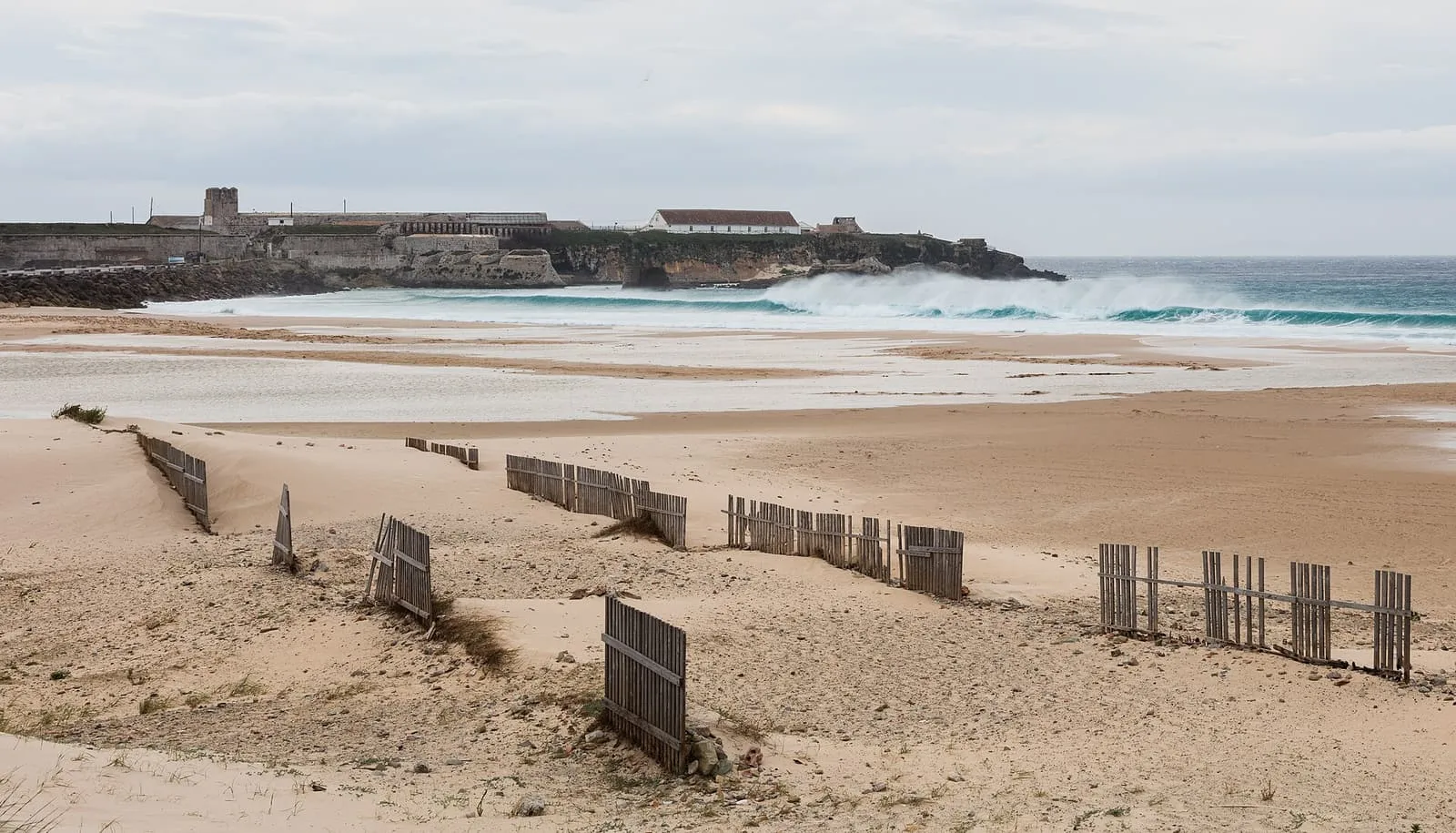
The town beach runs for several kilometres north-west from Tarifa, and much of it is a protected natural area. It is wide, flat and rarely crowded once you walk a little, with kite schools and beach bars further along.
Valdevaqueros, the dune and Punta Paloma
Valdevaqueros is the heart of the kite scene, a big bay that fills with kites on windy days. At its northern end, a huge dune climbs from the beach into the pines: climb it at sunset for the view. Just beyond it, Punta Paloma is quieter, with more space.
Bolonia and Baelo Claudia
About 25 minutes from Tarifa, Bolonia is one of the most beautiful beaches in Andalusia: a wide bay with clear water, a small village and no high-rise buildings. At its western end, the Bolonia dune, a protected natural monument about 30 metres high, slides down into the pines. Stay on the marked paths.
Right behind the beach are the ruins of Baelo Claudia, a Roman town that grew rich on salted fish and garum, the fish sauce the Romans loved. You can see the forum, temples, the basilica, a theatre and the fish-salting factories by the sea, with a small museum at the entrance. Entry is free for EU citizens (bring your ID or passport) and costs very little for others. It is usually closed on Mondays, with shorter hours on Sundays.
Kitesurfing and windsurfing
Tarifa has one of the windiest coasts in Europe, and kitesurfers and windsurfers come from all over the world. Two winds decide everything:
- Levante: the east wind, blowing from the Mediterranean through the Strait. It is dry, hot in summer, often strong and gusty, and can blow for several days in a row. It lifts the sand on the beaches and is best for experienced riders.
- Poniente: the west wind, from the Atlantic. It is cooler, more humid and usually gentler and steadier, which makes it better for learning.
Dozens of kite and windsurf schools work along Los Lances and Valdevaqueros. A beginner course usually runs over two or three days, a few hours a day, with equipment, and the school picks the beach according to the wind. Kitesurfing lessons in Tarifa.
In summer, kites are kept away from the bathing zones on the busiest beaches: follow the flags.
Whale and dolphin watching in the Strait
The Strait of Gibraltar is one of the best places in Europe to see whales and dolphins, and boats leave from Tarifa port for trips of about two to three hours.
- All year: common, striped and bottlenose dolphins, and pilot whales.
- Spring to early summer: sperm whales.
- July and August: the best chance of orcas, which follow the bluefin tuna.
Most operators run from about April to October, and trips are cancelled when the wind is too strong. Whale and dolphin watching in Tarifa.
Day trip to Tangier
From Tarifa port, fast ferries cross to Tangier in Morocco in about one hour, arriving at the city port a short walk from the old medina. That makes a day trip easy.
- Passport: you need a valid passport; an ID card is not enough. Check how long it must be valid and any visa rules for your nationality before you book.
- On your own: buy a return ferry ticket and explore the medina and the kasbah. Allow time for passport control on both sides.
- Organised tour: usually includes the ferry, a guide and lunch, and is the easier option for a first visit. Tangier day trip from Tarifa.
Morocco is on the same time as Spain in winter but one hour behind in summer, so check the ferry times for the return.
When to go
- June and September: warm weather and fewer people than in August. The sea is cooler than on the Mediterranean side.
- July and August: hot, lively and crowded, with high hotel prices. Book early.
- Spring and autumn: good for kitesurfing and whale watching, and quiet.
- Winter: mild, very calm in town, and many beach bars close.
The wind can blow in any season. On days of strong levante, sunbathing on the open beaches is unpleasant: spend the day in the old town, at Baelo Claudia or in Vejer instead. See our guide to the best time to visit Andalusia.
Getting to Tarifa
There is no train to Tarifa. The nearest station is Algeciras, about 30 minutes away.
| From | Car | Bus |
|---|---|---|
| Cádiz | about 1 h 15 | about 1 h 30–2 h, several a day |
| Seville | about 2 h 15 | about 3 h, a few a day |
| Málaga | about 1 h 45–2 h | about 2 h 30–2 h 45, a few a day |
| Algeciras | about 30 min | about 30–45 min, frequent |
| Gibraltar | about 45 min (plus the border) | via La Línea and Algeciras |
- By car: the best way, as the beaches, Bolonia and the villages are spread along the coast. Pick up a car at Málaga airport or Seville airport, and read our car hire guide. In summer, parking in town and at the beaches is tight.
- By bus: direct buses run from Cádiz, Seville and Málaga, and frequent ones from Algeciras. Compare times: Seville to Tarifa by bus.
- By air: the nearest airports are Gibraltar, Jerez, Málaga and Seville.
Where to stay in Tarifa
Choose between the old town, for restaurants, the evening atmosphere and the port for Tangier and whale trips, and the coast along the N-340, near the kite beaches, where you need a car.
- Hotel Misiana: a small boutique hotel in the old town, close to the port.
- Hurricane Hotel: a long-established hotel with gardens and a pool on the coast road, by the sea a few kilometres from town.
- Beach Hotel Dos Mares: on Los Lances beach, with a kite and windsurf school.
- More options: hotels in Tarifa’s old town.
Nearby: Vejer, Zahara and Gibraltar
- Vejer de la Frontera: one of the most beautiful white villages in Andalusia, on a hill about 45 minutes north-west. See our white villages guide.
- Zahara de los Atunes: a fishing village with a long beach and good tuna restaurants, about 35–40 minutes away.
- Gibraltar: the British territory is about 45 minutes east. Bring your passport or EU ID card for the border. See our Gibraltar guide.
- Cádiz: about 1 h 15 north. See our Cádiz guide.
Tarifa fits well on a longer loop through the south: see our Andalusia road trip and the best places to visit in Andalusia.
FAQ
Is Tarifa worth visiting?
Yes, if you like beaches and the outdoors: wild beaches, a lively old town, whales, Roman ruins and Morocco. If you want a calm sea and no wind, the Mediterranean coast suits you better.
How many days do you need in Tarifa?
One day covers the old town and a beach. Two to four days let you add Bolonia, a whale-watching trip and Tangier. Kitesurfers usually stay a week or more.
Is Tarifa always windy?
Not always, but most days have some wind, and on many days it is strong. The east wind (levante) is the strongest and can last for days; the west wind (poniente) is gentler.
Can you go from Tarifa to Morocco for the day?
Yes. The ferry to Tangier takes about one hour, and you can go on your own or with an organised tour. You need a valid passport.
Can you visit the Isla de las Palomas?
Only on guided visits booked in advance, because the island is a protected natural area and a military zone. You can walk along the causeway to the gate without booking.