Some links on this page are affiliate links. If you book through them we may earn a commission, at no extra cost to you.
The short answer
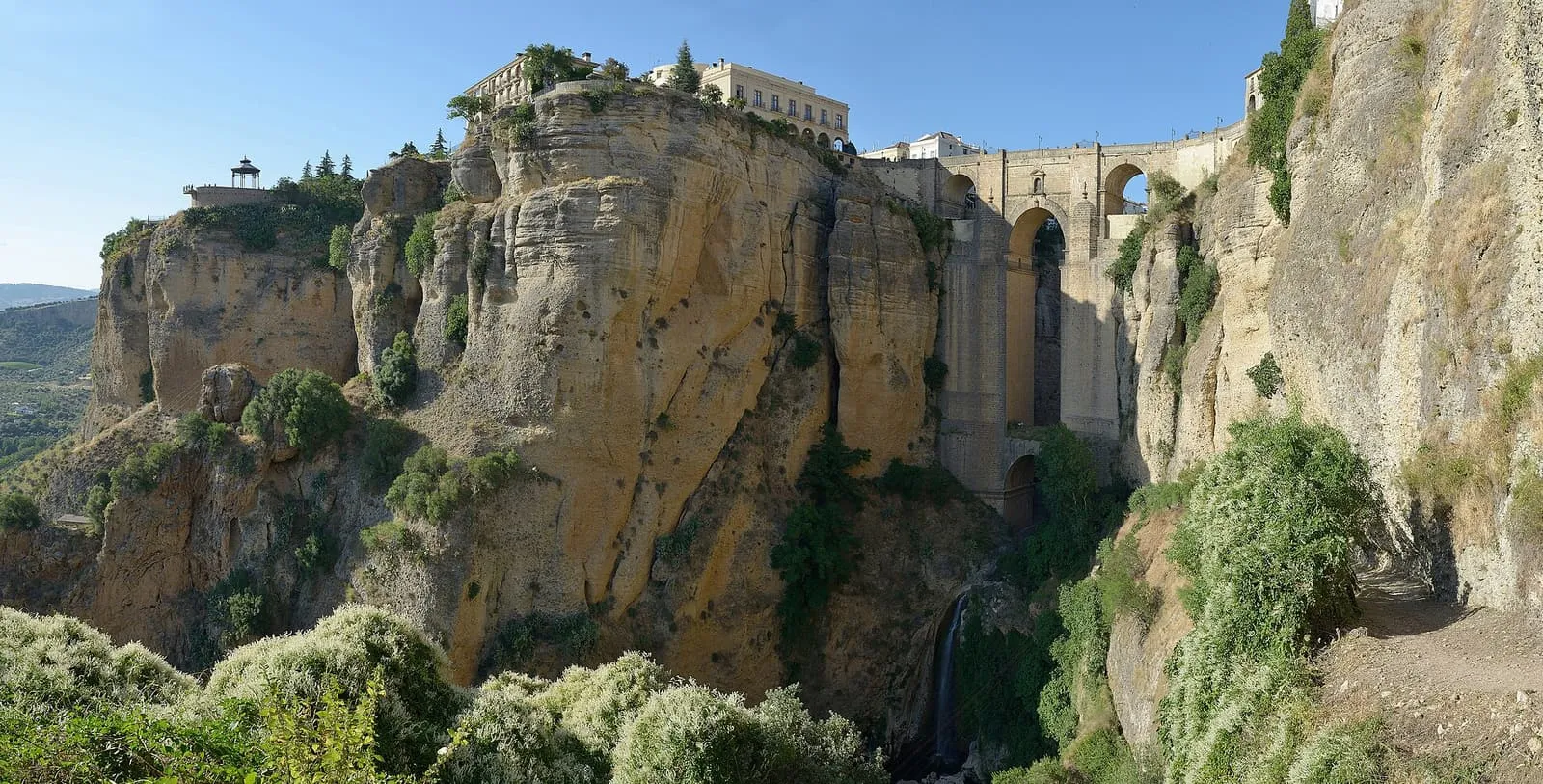
Ronda is a town of about 34,000 people in the mountains of Málaga province, split in two by a gorge (El Tajo) about 100 metres deep and joined by the 18th-century Puente Nuevo. It is one of the most spectacular places in Spain, and the best-known town on the route of the white villages.
- Why go: the bridge and the gorge, the cliff-top viewpoints, a Moorish old town and one of the oldest bullrings in Spain.
- Time needed: 5–6 hours for the main sights; one night to see it properly.
- Cost: the bridge, the viewpoints and the path into the gorge are free. The paid sights cost about €4–10 each.
- Getting there: about 1 h 30–1 h 45 by car from Málaga and 1 h 45–2 h from Seville. Buses run from both; the train from Málaga needs a change.
Day trip or one night?
Stay a night if you can. Ronda is one of the most popular day trips in Andalusia, and from late morning to mid-afternoon the bridge, the bullring and the main streets fill with tour groups from the Costa del Sol and Seville. Once they leave, the town is quiet again, and the gorge is at its best at sunset and in the early morning, when the light is low and the viewpoints are empty.
A night also gives you time for the walk down into the gorge, a winery visit or a white village the next morning, without rushing. If you only have a day, arrive early (before 10:00) or stay until the evening, and do the bullring first, before the groups.
Opening hours and prices
The main paid sights, all with tickets at the door. You don’t need to book ahead, except in the busiest weeks of spring.
| Sight | Price (approx.) | Time needed |
|---|---|---|
| Plaza de Toros (bullring and museum) | €8–10 | 45 minutes |
| Casa del Rey Moro (gardens and water mine) | about €10 | 45 minutes |
| Baños Árabes (Arab baths) | about €4–5 | 30 minutes |
| Palacio de Mondragón (town museum) | about €4–5 | 30–45 minutes |
| Puente Nuevo interpretation centre | a few euros | 15 minutes |
Most sights open every day from about 10:00 until the early evening, with longer hours in summer. Ask at the tourist office about a combined ticket for the municipal sights.
What to see in Ronda
The town has two halves: El Mercadillo, the “new” town that grew after the Christian conquest of 1485, with the bullring, the shops and most restaurants, and La Ciudad, the old Moorish town on the other side of the gorge. The route below takes a day at an easy pace.
Puente Nuevo and El Tajo
The Puente Nuevo (“new bridge”), finished in 1793, spans the narrowest point of the gorge of the Guadalevín river and rises nearly 100 metres from the bottom. It is the image of Ronda on every postcard. Walk across it and look down from both sides, then visit the small interpretation centre in the chamber above the central arch, which was once used as a prison.
Ronda has two older bridges further down: the Puente Viejo (17th century) and the Puente Árabe (or Puente de San Miguel), next to the Arab baths.
The viewpoints
- Mirador de Ronda and the Paseo de los Ingleses: iron balconies on the edge of the cliff, behind the Parador, with views over the valley to the mountains.
- Alameda del Tajo: a shady 19th-century park next to the bullring, with a cliff-edge balcony. The cliff-top path named after Ernest Hemingway, who spent long stays in Ronda, links it to the Parador.
- Jardines de Cuenca: small terraced gardens on the Mercadillo side, with the best view of the Puente Nuevo from above.
- Plaza de María Auxiliadora: in the old town, looking out over the valley, where the path down into the gorge begins.
The path down: the bridge from below
The classic photo of the Puente Nuevo is taken from below. From Plaza de María Auxiliadora in the old town, a path leads down past the old town walls to viewpoints facing the bridge and the waterfall under it. It takes about 15–20 minutes down and a little longer back up. The path is steep and partly unpaved, with no shade: wear good shoes, go early or late in summer, and bring water. The light on the bridge is best in the afternoon.
La Ciudad, the old town
Cross the bridge into a quiet grid of white streets and palaces. Look for the Iglesia de Santa María la Mayor, built on the site of the main mosque; the Minarete de San Sebastián; and the old gates and walls, such as the Puerta de Almocábar at the southern end.
Baños Árabes
At the bottom of the old town, by the Puente Árabe, the Arab baths date from the 13th century and are among the best preserved in Spain. You walk through the cold, warm and hot rooms under brick vaults with star-shaped skylights.
Casa del Rey Moro and the water mine
Despite the name, the house is from the 18th century and is not open. What you visit are the terraced gardens, designed in the early 20th century by the French landscape architect Jean-Claude Forestier, and the water mine (La Mina): a long, steep stairway cut into the rock in Moorish times, used to bring water up from the river during sieges. It ends at a platform at the bottom of the gorge. The steps are damp and uneven, and you must climb all the way back up.
Palacio de Mondragón
A palace with Moorish and Mudéjar courtyards and a small garden on the edge of the cliff. It houses the town museum (Museo Municipal), with archaeology from the Serranía de Ronda. Worth it for the courtyards and the view alone.
Plaza de Toros and museum
The bullring of the Real Maestranza de Caballería de Ronda, from 1785, is one of the oldest in Spain, and Ronda is often called the birthplace of modern bullfighting on foot, thanks to the Romero family of bullfighters. You can walk onto the sand, see the stables and the pens, and visit the museum, with costumes, posters and a collection of historic weapons. There are very few bullfights here: the main one is the Corrida Goyesca in early September, in 18th-century costume, during the Feria de Pedro Romero. The ring closes to visitors on those days.
Guided tours and day trips
You can see Ronda on your own: the sights are close together and signposted. A guide adds the stories behind the bridge, the bullring and the Moorish town.
- Walking tour in Ronda: usually about 2 hours, covering both sides of the gorge. Ronda walking tours.
- Day trip from Málaga or the Costa del Sol: most include free time in Ronda, and some add Setenil de las Bodegas. Ronda day trip from Málaga.
- Day trip from Seville: usually with one or two white villages on the way. Ronda and white villages day trip from Seville. See our guide to the Ronda day trip from Seville.
For other ideas, see all day trips from Málaga and day trips from Seville.
Wine in the Serranía de Ronda
Ronda has made wine since Roman times, and today the Serranía de Ronda is a sub-zone of the Sierras de Málaga designation of origin, with many small wineries around the town. The altitude gives cool nights and fresh, structured reds. Several wineries offer tours and tastings, usually by appointment: for example Descalzos Viejos, in an old convent below the town walls, Cortijo Los Aguilares and Bodega F. Schatz. Book ahead, and don’t drive after a tasting: a tour with transport is the easy option. Ronda winery tours.
For a special meal, Bardal, in the new town, is one of the best restaurants in Andalusia, with Michelin stars. For something simpler, try the local rabo de toro (oxtail stew) in the Mercadillo.
Tips for your visit
- Beat the groups: see the bullring and the bridge before about 11:00, and the old town in the afternoon.
- Best seasons: spring and autumn. Ronda is at about 750 metres, so it is cooler than Seville or Málaga in summer, but cold at night in winter.
- Shoes: the old town is hilly and cobbled, and the paths into the gorge are steep.
- Driving: park in one of the underground car parks in the new town. The old town streets are narrow and partly restricted to residents.
Getting to Ronda
| From | Car | Bus | Train |
|---|---|---|---|
| Málaga | about 1 h 30–1 h 45 | about 2 h, several a day | 2–3 h, one change |
| Seville | 1 h 45–2 h | 2–2 h 30 (Damas), a few a day | 3 h or more, one change |
| Marbella | about 1 h (mountain road) | about 1 h 15–1 h 30 | none |
| Madrid | about 6 h | long, not recommended | a few direct trains a day, about 4 h |
- By car: the easiest way, and it lets you add the white villages. From Málaga, pick up a car at the airport: car hire at Málaga airport. See our car hire guide for insurance and driving tips.
- By bus: direct buses run from Málaga’s bus station and, less often, from Seville. Ronda’s bus station is in the new town, about 15 minutes’ walk from the bridge. Compare times: Málaga to Ronda by bus or train.
- By train: there is no direct regular train from Málaga. Ronda is on the line from Algeciras to Antequera and Bobadilla, so you change at Antequera (Santa Ana) or Bobadilla, and connections are few. The bus is usually simpler. The train works best from Madrid or Córdoba. The station is in the new town.
Where to stay
Stay close to the bridge, on either side of the gorge, so you can walk out to the viewpoints at sunset and before breakfast.
- Parador de Ronda: in the former town hall, right next to the Puente Nuevo and on the edge of the gorge. The best location in town.
- Hotel Montelirio: a small hotel in an old mansion in La Ciudad, with views of the gorge and the bridge.
- Hotel Catalonia Ronda: a modern hotel next to the bullring, a few minutes’ walk from the bridge.
- More options: hotels in Ronda’s old town.
Nearby: white villages and the Caminito del Rey
Ronda is the natural base for the white villages of the Serranía de Ronda and the Sierra de Grazalema. Setenil de las Bodegas, with houses built under the rock, is about 20 minutes away; Zahara de la Sierra and Grazalema are 40–50 minutes. Closer still, the Cueva de la Pileta near Benaoján has prehistoric cave paintings, seen on small guided visits. See our white villages guide.
The Caminito del Rey, the walkway through the gorge of El Chorro, is about an hour’s drive from Ronda. It needs a ticket for a set time, so book it first and plan Ronda around it. See our Caminito del Rey guide or Caminito del Rey tours.
Ronda fits well on a driving loop between Málaga and Seville: see our Andalusia road trip.
FAQ
Is Ronda worth visiting?
Yes. The Puente Nuevo over the gorge is one of the great sights of Spain, and the old town, the viewpoints and the bullring make a full day. It is worth the drive from Málaga or Seville.
How long do you need in Ronda?
One full day for the main sights, or five to six hours at a push. One night is better: you avoid the tour groups, see the gorge at sunset and have time to walk down under the bridge.
Can you get from Málaga to Ronda by train?
Not directly. You change at Antequera or Bobadilla, and the trip takes two to three hours with few connections. Direct buses from Málaga are usually simpler, and driving is fastest.
Can you walk to the bottom of the Ronda gorge?
Yes. A free path from Plaza de María Auxiliadora leads down to viewpoints below the Puente Nuevo, about 15–20 minutes each way. The Casa del Rey Moro water mine (paid) also takes you to the river.
Can you do Ronda and the Caminito del Rey in one day?
It is possible by car, but it makes a long day: the Caminito takes about three to four hours, plus an hour’s drive each way. It is better to sleep in Ronda and do the Caminito the next morning.