Some links on this page are affiliate links. If you book through them we may earn a commission, at no extra cost to you.
Why visit, and how many days you need
Córdoba sits on the Guadalquivir river, halfway between Seville and Madrid. In the 10th century it was the capital of the Caliphate of Córdoba and one of the largest cities in Europe, and it still has the greatest monument of that time: the Mezquita-Catedral, a vast mosque of striped arches with a Renaissance cathedral built in its centre.
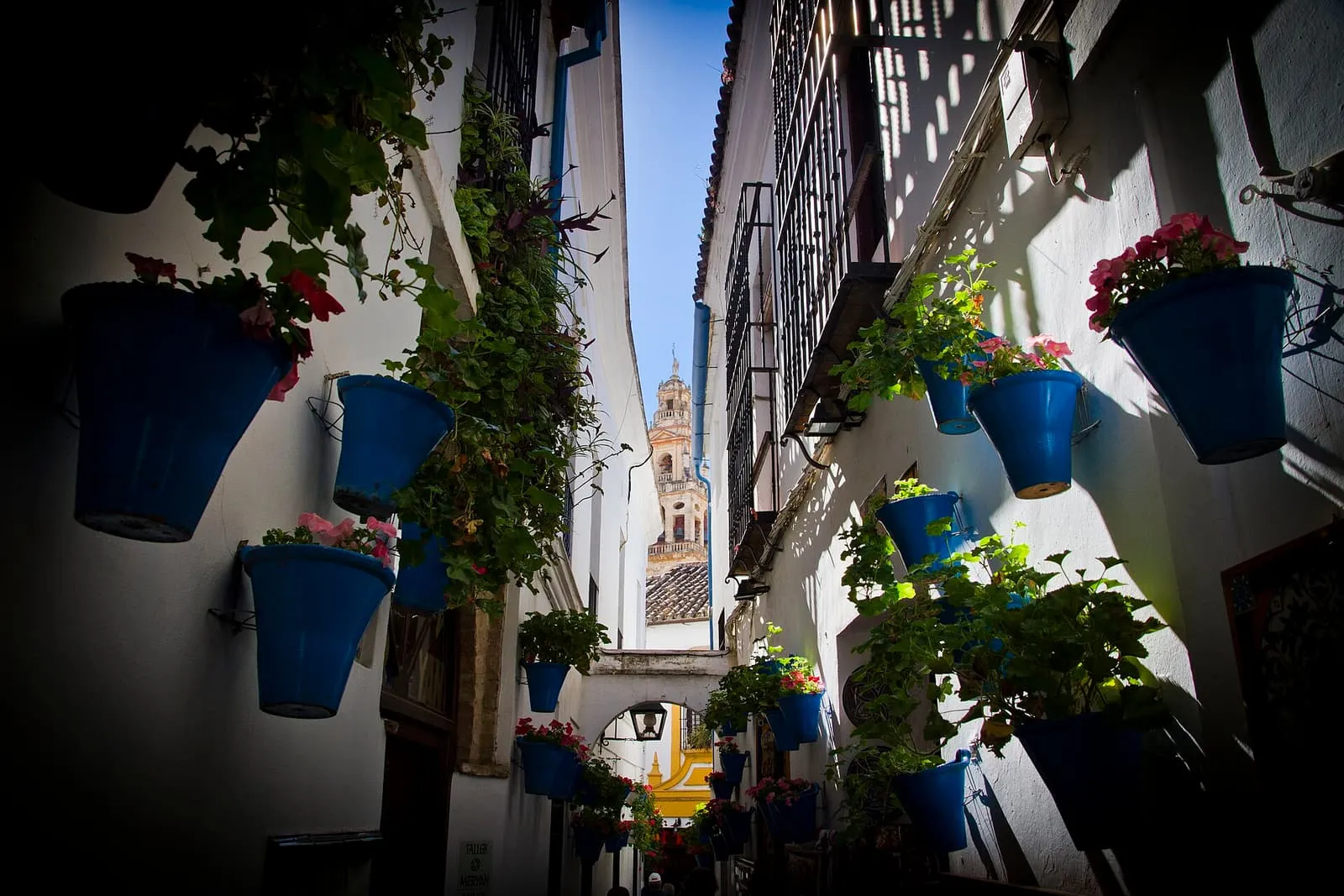
Around it, the Judería (the old Jewish quarter) is a maze of white lanes, flowerpots and small squares. The Roman bridge crosses the river in front of the Mezquita, and 8 km west of the city lie the ruins of Medina Azahara, the caliphs’ palace city. In May, residents open their flower-filled courtyards for the Festival de los Patios.
Plan one or two days. One full day covers the Mezquita, the Judería, the Alcázar and the Roman bridge. With a second day, or a night in between, add Medina Azahara, the Palacio de Viana and the quieter neighbourhoods north of the centre, and see the old town in the evening when the day-trippers have gone.
Many visitors come on a day trip from Seville, only 45 minutes away by high-speed train. That works well, but a night makes the visit much more relaxed, and Córdoba is a natural stop between Seville and Granada.
Plan around the heat. Córdoba is one of the hottest cities in Europe. In July and August the afternoon temperature often passes 40°C, so sightsee early, rest after lunch and go out again in the evening.
Where to stay
- The Judería and around the Mezquita for the atmosphere and to walk everywhere. Busy by day, very quiet at night. Hotels in Córdoba’s old town.
- San Basilio (also called the Alcázar Viejo), next to the Alcázar, for some of the prettiest patios in the city and a more residential feel, still 5–10 minutes from the Mezquita.
- The centre around Plaza de las Tendillas for shops, bars and restaurants, slightly cheaper hotels and a shorter walk from the train station.
A few hotels to start with:
- Hospes Palacio del Bailío: a 17th-century palace with Roman remains under a glass floor, a garden pool and a spa, north of the Judería.
- Hotel Balcón de Córdoba: a small boutique hotel a few steps from the Mezquita, with a roof terrace.
- NH Collection Amistad Córdoba: two old mansions on Plaza de Maimónides, in the heart of the Judería, with a rooftop pool.
Top sights
- The Mezquita-Catedral: the forest of red-and-white arches, the gilded mihrab and the cathedral in the middle. About €15; free early entry Monday to Saturday (about 8:30–9:30, last entry about 9:20).
- The Judería: the Calleja de las Flores, the 14th-century synagogue and the statue of Maimonides, the Jewish philosopher born here.
- The Alcázar de los Reyes Cristianos: a fortress-palace with terraced gardens, pools and Roman mosaics.
- The Roman bridge and the Calahorra tower: best at sunset, looking back at the Mezquita.
- Medina Azahara: the ruins of the 10th-century palace city, a UNESCO World Heritage site since 2018.
- The Palacio de Viana: a noble house with 12 patios, open all year.
- The patios in May: private courtyards covered in geraniums, open to visitors for the festival.
Full list: things to do in Córdoba.
Neighbourhoods at a glance
| Neighbourhood | What it’s like |
|---|---|
| Judería | The old Jewish quarter around the Mezquita: white lanes, souvenir shops, busy by day |
| San Basilio | Quiet lanes behind the Alcázar, known for its patios in May |
| Centro (Tendillas) | The modern centre: shops, cafés and tapas bars around Plaza de las Tendillas |
| Santa Marina and San Lorenzo | Local districts north of the centre with medieval churches and patios, home to the Palacio de Viana |
| La Ribera and the Plaza del Potro | The riverside east of the Mezquita, with the Posada del Potro and two art museums |
When to go
Spring (March to May) and autumn (late September to November) are the best seasons. May is Córdoba’s big month: the Cruces de Mayo (flower crosses in the squares) at the start, the Festival de los Patios, usually in the first two weeks, and the Feria at the end of the month. Hotels fill up and prices rise, so book early.
Summer is very hot, with afternoons often above 40°C in July and August. Winter is mild and sunny by day but cool at night, and it is the quietest time for the Mezquita. See the best time to visit Andalusia.
Getting there and around
- By train: Córdoba is on the Madrid–Seville high-speed line, with many trains a day run by Renfe (AVE and Avant), Iryo and Ouigo. Madrid about 1 h 45, Seville about 45 minutes, Málaga about 1 hour, Granada about 1 h 30. See Seville to Córdoba and compare times on Omio.
- From the station: the Mezquita is a 20–25 minute walk south through the centre, or a short bus or taxi ride.
- By plane: Córdoba airport has no regular scheduled flights. The closest big airports are Seville (about 1 h 30 by car or train) and Málaga (about 1 hour by train from the city).
- By car: easy on the A-4 from Seville and Madrid, but the Judería is closed to most traffic. Park in a public car park at the edge of the old town, or at your hotel if it has parking.
- In the city: walk. The old town is compact and flat, and almost every sight on the list is within 20 minutes on foot. Medina Azahara needs a car, a taxi, the tourist bus or a tour.
Córdoba in a wider trip
Most people combine Córdoba with Seville and Granada: it is 45 minutes from one and about 1 h 30 from the other. See where to base yourself in Andalusia, our Andalusia road trip and all day trips from Seville.
FAQ
Is Córdoba worth visiting?
Yes. The Mezquita-Catedral is one of the most extraordinary buildings in the world, and the Judería, the Roman bridge and the patios make Córdoba one of the most beautiful cities in Andalusia.
How many days do you need in Córdoba?
One full day for the Mezquita, the Judería, the Alcázar and the Roman bridge. Two days, or one night, if you want to add Medina Azahara and the Palacio de Viana at a relaxed pace.
Can you visit Córdoba as a day trip from Seville?
Yes. High-speed trains take about 45 minutes, so you can be at the Mezquita by 9:30. See our Córdoba day trip guide.
What is the best month to visit Córdoba?
May, for the patios, the flower crosses and the Feria, although it is also the busiest month. April, October and November are quieter and still warm.
Is Córdoba too hot in summer?
In July and August it is one of the hottest cities in Spain, often above 40°C in the afternoon. Visit early in the morning and in the evening, and choose a hotel with a pool.