
Some links on this page are affiliate links. If you book through them we may earn a commission, at no extra cost to you.
The short answer
Huelva is the far western province of Andalusia, between Seville and the Portuguese border. It is not a place of great monuments. People come for Doñana, one of Europe’s most important wetlands, the Columbus sites where the 1492 voyage began, the green hills and ham villages of the Sierra de Aracena, the red landscapes of the Riotinto mines, and more than 120 km of long, sandy Atlantic beaches.
- Who it suits: nature lovers and birdwatchers, walkers, food travellers, and families who want a Spanish beach holiday rather than an international resort. Less so first-time visitors who want the big cities and famous monuments.
- Time needed: a day trip from Seville covers one area (Doñana, Aracena or the Columbus sites). Three to five days let you combine the coast, Doñana and the sierra.
- Getting there: Seville is about an hour by car, and Faro airport in Portugal about an hour too. Huelva has no airport of its own, and we’d really recommend a car to see the province.
Huelva’s sights at a glance
| Sight | Area | Price (approx.) | Time needed |
|---|---|---|---|
| Doñana 4x4 tour | Matalascañas or El Rocío | about €30–35 | about 4 h |
| El Acebuche and La Rocina visitor centres | Doñana | free | 1–2 h each |
| El Rocío village | Doñana | free | 1 h |
| Monasterio de La Rábida | Palos de la Frontera | about €3 | 1 h |
| Muelle de las Carabelas | Palos de la Frontera | about €3.60 | 1 h 30 |
| Gruta de las Maravillas | Aracena | about €12.50–15 | 1 h |
| Riotinto Mining Park and train | Minas de Riotinto | about €12–19 | half a day |
Doñana National Park
Doñana is a huge protected area of marshes, pine and cork-oak woods, shifting dunes and empty beach where the Guadalquivir reaches the sea. It is a UNESCO World Heritage Site and a stopover for hundreds of thousands of migrating birds. Most of the national park itself is closed to independent visitors: you see its heart on a guided tour, and the edges from the visitor centres and their trails.
How you can visit Doñana
- Visitor centres (free): El Acebuche, about 4 km from Matalascañas, is the main centre, with an exhibition and a boardwalk to hides over small lagoons. La Rocina, just outside El Rocío, has the Charco de la Boca trail (about 3.8 km of flat paths) with bird hides over the stream, and nearby is the Palacio del Acebrón, a mid-20th-century house in the woods with a short lakeside path. The José Antonio Valverde centre overlooks the open marsh in the north; it has some of the best birdwatching in the park, but it is reached on long dirt tracks.
- 4x4 tours from El Acebuche: the official route, run by a local cooperative, crosses about 70 km of beach, dunes, woods and marsh in about four hours, in off-road buses with a guide. It costs about €35 per adult. There are usually two departures a day, early morning and afternoon, and one day a week without tours. We recommend booking ahead on the operator’s website or by phone: places are limited and fill up in spring and at Easter.
- 4x4 tours from El Rocío: several operators run tours of about four hours into the marsh and woods north of the park, from about €30 per adult. These focus on the marsh and the birds and do not reach the beach.
- The boat from Sanlúcar de Barrameda: the Real Fernando sails from Bajo de Guía, in Cádiz province, up the Guadalquivir along the edge of the park, with a short walk on the far bank. A combined boat and 4x4 option also exists. See our Sanlúcar de Barrameda guide for times and prices.
- From Seville: a full-day tour saves you the drive and usually combines El Rocío, a walk at La Rocina and a 4x4 trip: Doñana tours from Seville.
What you’ll see, and when to go
On a good day: flamingos, spoonbills, herons and storks, red and fallow deer, wild boar, and with luck a Spanish imperial eagle. Doñana is one of the last refuges of the Iberian lynx, but sightings are rare. We think the best seasons are spring (March to May), when the marshes are full and the birds are breeding, and autumn and winter, when geese and ducks arrive from northern Europe. By late summer the marsh is often dry and dusty and the wildlife is harder to find. We’d bring binoculars, water and insect repellent.
El Rocío
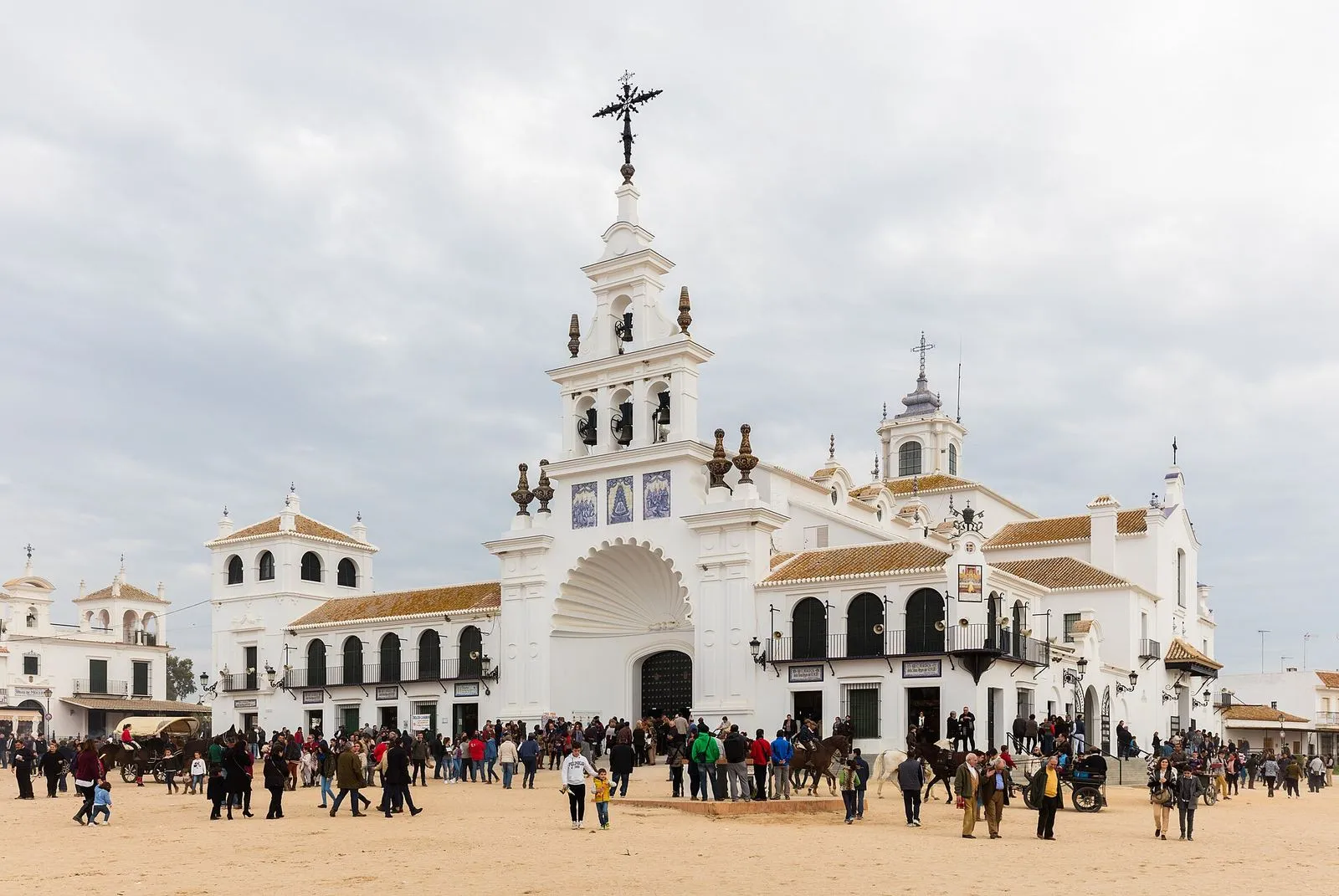
El Rocío looks like a film set: sandy streets instead of asphalt, hitching rails for horses, low white houses with verandas, and the large white Ermita del Rocío facing the marsh. From the promenade in front of the village you can often see flamingos and horses grazing in the water. Most of the houses belong to religious brotherhoods (hermandades) and stay closed for most of the year.
Once a year, at Pentecost, around a million people arrive on foot, on horseback and in decorated wagons for the Romería del Rocío, one of the largest pilgrimages in Spain. It peaks when the image of the Virgin is carried out of the hermitage in the early hours of Whit Monday. In 2027, Pentecost Sunday is 16 May. We think it is an extraordinary sight, but the village is packed, beds are booked a year ahead, and the Doñana tours do not run. Outside the pilgrimage, the village is quiet and makes a good base.
The Columbus sites
Christopher Columbus sailed from Palos de la Frontera, on the Río Tinto estuary, on 3 August 1492. The places connected to the voyage are close together, about 15–20 minutes from Huelva city, and make an easy half day.
- Monasterio de La Rábida: the small Franciscan monastery where Columbus stayed and where the friars helped him win the support of the Catholic Monarchs. It has a Mudéjar cloister, a chapel and a room of 1930 murals by Daniel Vázquez Díaz telling the story of the voyage. Entry is about €3, with an audio guide. Closed on Mondays.
- Muelle de las Carabelas: a few minutes’ walk below the monastery, full-size replicas of the Santa María, the Pinta and the Niña, which you can board, with a small museum and a short film. About €3.60. Closed on Mondays. In our view the best stop for children.
- Palos de la Frontera: the town that supplied the Pinzón brothers and many of the crews. The church of San Jorge is where the royal order to provide ships was read, and the medieval well of La Fontanilla is where the ships took on water.
- Moguer: a pretty white town a few kilometres further on, where some of the sailors came from. It is best known as the home of the poet Juan Ramón Jiménez, winner of the 1956 Nobel Prize and author of Platero y yo, and his house is now the Casa Museo Zenobia y Juan Ramón Jiménez. The convent of Santa Clara, where Columbus is said to have prayed after returning from the first voyage, is also here.
Both La Rábida and the Muelle close on Mondays, so plan the Columbus sites for another day.
Huelva city
The provincial capital is a working port and industrial city, not a major sight, and most visitors only pass through. If you have a few hours:
- Barrio Reina Victoria: the “English quarter”, a neighbourhood of British-style terraced houses built for workers of the Rio Tinto Company in the early 20th century.
- Recreativo de Huelva: founded by the British in 1889, it is the oldest football club in Spain, and the city calls itself the birthplace of Spanish football.
- Monumento a la Fe Descubridora: a tall Columbus monument at Punta del Sebo, where the Tinto and Odiel rivers meet, a gift from the United States in 1929. You see it from the road to La Rábida.
- Food: the city is a good place to try the local white prawns and fried choco (cuttlefish) in the tapas bars of the centre.
The Sierra de Aracena
In the north of the province, about 1 h 15 from Seville, the Sierra de Aracena y Picos de Aroche natural park is a surprise for anyone who thinks of Andalusia as dry: rolling hills of cork oak, chestnut woods, streams and stone villages, with cool evenings even in summer.
- Gruta de las Maravillas: a cave right under the town of Aracena, visited on guided tours of about 50 minutes past lakes and forests of stalactites. Entry is about €12.50, a little more in summer. Visitor numbers are limited each day, so we recommend you buy tickets online in advance at weekends and in holiday periods.
- Aracena castle: the ruins of a medieval castle on the hill above the town, with the Gothic church of the Priory beside them and views over the sierra.
- Jabugo and the ham: the sierra is the home of jamón de Jabugo, acorn-fed Iberian ham from pigs that roam the oak woods. The village of Jabugo is full of drying sheds (secaderos), and several producers offer visits and tastings.
- Walking villages: Alájar, below the rock of the Peña de Arias Montano, Linares de la Sierra, with pebble mosaics outside its front doors, Castaño del Robledo and Fuenteheridos are linked by old mule paths, making easy walks of one to three hours between them. Almonaster la Real has a small 10th-century mosque on the hill above the village.
For a day trip without a car, tours combine Aracena with Riotinto: Aracena and Riotinto tours from Seville.
Minas de Riotinto
About 35 minutes south of Aracena, the Riotinto mines have been worked for thousands of years and were run by a British company from 1873. The river runs red and orange from the minerals in the water, a landscape so strange that scientists study it to understand conditions on Mars.
The Parque Minero de Riotinto has a mining museum, a reconstructed Victorian house (Casa 21) in the old British quarter of Bellavista, the open-pit mine of Peña de Hierro and the huge crater of Corta Atalaya. The highlight is the tourist mining train, which runs in old carriages for about 22 km (return) along the red river. Tickets are sold as packages: the museum alone costs about €5, the museum and train about €12, and all the sections together a little more. A half day is enough. We’d check the train times in advance and book at weekends.
The beaches of Huelva
The Huelva coast, part of the Costa de la Luz, is one long line of sand, dunes and pine woods from Doñana to the Portuguese border. It is calmer and less windy than the coast around Tarifa, and in summer it is mostly Spanish families from Seville and Huelva.
| Beach | What it’s like | Best for |
|---|---|---|
| Matalascañas | a built-up 1960s–70s resort on the edge of Doñana | families, Doñana tours |
| Mazagón | a quiet village, beaches below sandy cliffs and pines | couples, nature, quiet |
| Punta Umbría | Huelva city’s beach town, busy in summer | a lively Spanish beach holiday |
| El Rompido and the Flecha | a fishing village facing a long sandspit | wild beach by boat, sailing |
| Isla Cristina and Islantilla | a fishing town; a golf resort next to it | food, families, golf |
| Isla Canela and Ayamonte | resort hotels by the Guadiana, facing Portugal | trips to the Algarve |
- Near Mazagón, the beach of Cuesta Maneli is reached by a boardwalk through the pines to a wild stretch of sand below the Asperillo cliffs.
- The Flecha del Rompido is a sandspit several kilometres long, reached in summer by a small boat from El Rompido; it has no buildings or services.
- Matalascañas is the place for Doñana: its beach continues south into the national park, kilometres of empty sand with no services.
What to eat and drink
- Gambas de Huelva: the white prawns of the Huelva coast, simply boiled, among the most prized in Spain.
- Jamón de Jabugo: acorn-fed Iberian ham from the sierra, best tried in Aracena or Jabugo.
- Strawberries: Huelva grows most of Spain’s strawberries; the season runs roughly from late winter to early summer.
- Choco: cuttlefish, fried or stewed with broad beans (choco con habas). People from Huelva are nicknamed choqueros.
- Also try: mojama (cured tuna) from Isla Cristina, clams (coquinas) from the coast, and the wines of the Condado de Huelva, including the sweet orange wine (vino naranja).
When to go
We think spring (March to May) is the best time for most visitors: Doñana is at its best, the sierra is green and full of flowers, and it is warm but not hot. Autumn (October and November) is good too, with mushrooms and chestnuts in the sierra and the first wintering birds in Doñana. Summer is beach season: the coast is lively and busy with Spanish families in July and August, while inland it is very hot, except in the sierra. Winter is mild on the coast and cold in the sierra, with many beach hotels closed but good birdwatching in Doñana. We’d avoid El Rocío and Doñana over the Pentecost weekend unless you are going for the pilgrimage. See our best time to visit Andalusia.
Getting to Huelva
| From | By car | Other options |
|---|---|---|
| Seville (to Huelva city) | about 1 h | train about 1 h 30; buses |
| Seville (to El Rocío) | about 1 h | buses to El Rocío and Matalascañas |
| Seville (to Aracena) | about 1 h 15 | buses, few a day |
| Faro airport (to Huelva city) | about 1 h | buses, few a day |
- By plane: Huelva has no airport. The closest are Seville and Faro, in Portugal. We’d choose Faro for the western beaches (Ayamonte, Isla Cristina) and Seville for Doñana, the sierra and the Columbus sites. See our Seville to Faro guide.
- By train or bus: trains run from Seville to Huelva city (Seville to Huelva), and Damas buses link Seville and Huelva with the beach towns, El Rocío and Aracena. They are fine for one base, not for touring. For times and stations, see Huelva to Seville and back.
- By car: the province needs one. The sights are spread out, and the sierra villages, the Doñana visitor centres and the Columbus sites are poorly served by buses. Compare car hire at Seville airport or car hire at Faro airport, and read our car hire guide (a one-way fee applies if you cross the border).
Remember there is no road across Doñana: from Sanlúcar de Barrameda or Jerez to Matalascañas you drive round via Seville. To fit Huelva into a longer route, see our Andalusia road trip.
Where to stay
| Base | Best for |
|---|---|
| El Rocío | Doñana tours and birdwatching |
| Mazagón | beaches, Doñana and the Columbus sites |
| Aracena or Alájar | the sierra, walking, ham and the caves |
| Isla Cristina or Ayamonte | the western beaches and the Algarve |
- El Rocío: Hotel La Malvasía is a small hotel in a traditional house on the edge of the marsh, with views of the birds from some rooms. More options: hotels in El Rocío.
- Mazagón: Parador de Mazagón stands in pine woods on the cliffs above the beach, about half an hour from both Doñana and La Rábida.
- Aracena: Hotel Convento Aracena is a former convent in the town, with a pool and a spa, walking distance from the caves. More options: hotels in Aracena.
- Alájar: Finca La Fronda is a small country house in the hills near Alájar, for a quiet stay among the walking paths.
Our suggestion for three or four days: two nights near Doñana or the coast (El Rocío or Mazagón), then one or two in Aracena, with Riotinto on the way. Huelva also works as a set of day trips from Seville: see day trips from Seville and our Seville guide.
FAQ
Is Huelva worth visiting?
The province, yes, for Doñana, the Sierra de Aracena, Riotinto and its long, quiet beaches. The city of Huelva itself is worth a short stop at most. See the other best places in Andalusia.
Can you visit Doñana National Park on your own?
Only the edges. The visitor centres of El Acebuche and La Rocina and their trails and bird hides are free and open to everyone, but the core of the park can only be entered on a guided tour, such as the 4x4 tours from El Acebuche or El Rocío.
Can you visit Doñana as a day trip from Seville?
Yes. El Rocío and the visitor centres are about an hour’s drive from Seville. Book a 4x4 tour for the morning or afternoon, or take a full-day guided tour from Seville that includes the transport.
When is the El Rocío pilgrimage?
The Romería del Rocío takes place over the Pentecost weekend, seven weeks after Easter. In 2027, Pentecost Sunday is 16 May, and the Virgin’s procession is in the early hours of Monday 17 May.
Is Huelva close to Portugal?
Yes. Ayamonte faces Portugal across the Guadiana river, and a motorway bridge leads straight into the Algarve. Faro airport is about an hour from Huelva city, which makes it a good arrival point for the western beaches.