Some links on this page are affiliate links. If you book through them we may earn a commission, at no extra cost to you.
The short answer
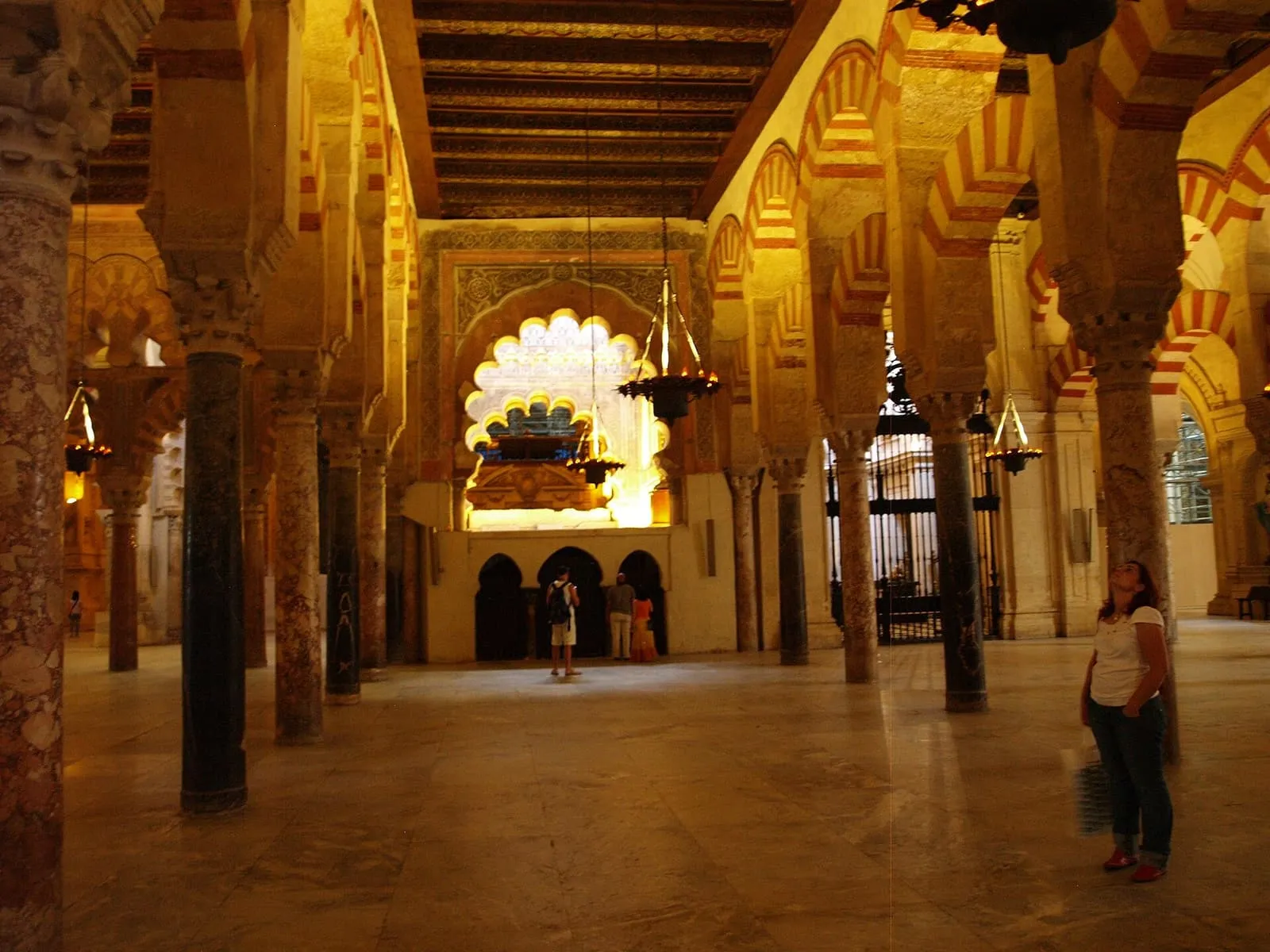
The Mezquita-Catedral of Córdoba is a great mosque of the 8th to 10th centuries, with a forest of red-and-white striped arches, a gilded prayer niche and, since the 16th century, a Renaissance cathedral built right in the middle. It is one of the most extraordinary buildings in the world and the reason most people come to Córdoba.
- Time needed: about 1.5 hours, 2 hours with the bell tower
- Ticket: about €15 on the official website or at the ticket office
- Book ahead? Not usually for the Mezquita itself; yes for the bell tower, which has timed slots and sells out first
- Free entry: Monday to Saturday from 8:30 to 9:30, in silence and without groups
- Best time: at 8:30 for the free entry, or at 10:00 when paid visits start
The Mezquita and the historic centre around it are a UNESCO World Heritage Site.
A short history of the Mezquita
- Before the mosque: a Visigothic church, traditionally dedicated to Saint Vincent, stood on the site. Some of its remains can be seen under a glass floor inside.
- 785: Abd al-Rahman I, the Umayyad prince who escaped to al-Andalus and founded the emirate of Córdoba, began the mosque. It reused Roman and Visigothic columns, topped with the famous double arches.
- 9th and 10th centuries: the mosque was enlarged three times as the city grew. Abd al-Rahman II extended the prayer hall, al-Hakam II added the richest part, with the new mihrab and its mosaics, and Almanzor made the largest extension, to the east, in the late 10th century.
- 1236: Ferdinand III of Castile took Córdoba, and the mosque was consecrated as a cathedral. For almost three centuries, chapels were fitted into the old prayer hall.
- 1523: work began on a Renaissance cathedral nave in the centre of the mosque. It took nearly a century to complete. Charles V is said to have regretted the permission he gave, saying that something unique had been destroyed to build something that could be found anywhere.
That mix is what makes the visit unique: you walk from a mosque into a cathedral without leaving the building.
Opening hours, prices and free entry
| Monday to Saturday, March to October | about 10:00 to 19:00 |
| Monday to Saturday, November to February | about 10:00 to 18:00 |
| Sundays and religious holidays | about 8:30 to 11:30 and 15:00 to 19:00 (18:00 in winter) |
| Free entry | Monday to Saturday, 8:30 to 9:30 (last entry about 9:20) |
| General ticket | about €15 |
| Reduced (over 65, students up to 26) | about €12 |
| Children 10 to 14 | about €8 |
| Children under 10 | Free |
| Bell tower | about €4, timed slots |
| Night show El Alma de Córdoba | about €25 (reduced about €18) |
Ticket sales stop about 30 minutes before closing. The price went up from about €13 to €15 in April 2026, so older guides may show the old price. Buy on the official website, mezquita-catedraldecordoba.es, or at the ticket office in the Patio de los Naranjos. The ticket also gets you into the route of the Fernandine churches, the medieval parish churches around the city.
The free early-morning entry
From Monday to Saturday, the Mezquita is free from 8:30 to 9:30. Access closes at about 9:20, and the building is then cleared for the paid visits. The visit is individual and silent, guided groups are not allowed, and it doesn’t run on days of special religious celebrations. You don’t need to book: just queue at the entrance a few minutes before 8:30.
An hour is enough to walk through the hall of arches and see the mihrab and the cathedral in the quietest, softest light of the day. It is the best way to see the Mezquita, not only the cheapest. If you want the bell tower or a slower visit with an audio guide, buy a normal ticket later instead.
The bell tower (Torre Campanario)
The bell tower, about 54 metres high, was built around the old minaret, which is still inside its walls. It has its own ticket (about €4) with a set entry time, and small groups go up every half hour or so. Places are few, so book the slot online as soon as you know your date. The view over the Mezquita’s roofs, the Judería and the Guadalquivir is the best in Córdoba.
The night show: El Alma de Córdoba
El Alma de Córdoba (“The Soul of Córdoba”) is a night visit of about an hour with light, sound and projections. It starts with a film in the Patio de los Naranjos and continues inside the building, with an audio guide in several languages, including English. There are usually two sessions on most evenings, starting between about 20:00 and 23:30 depending on the season. It is a separate ticket, sold on the official website, and a good reason to stay the night in Córdoba.
Tickets: official or guided?
The official ticket is enough if you read up before you go or hire an audio guide at the San Eulogio information centre next to the Mezquita. A guide helps you tell the three extensions apart and read the Christian and Islamic layers of the building.
- On your own: the official ticket, plus a bell tower slot
- For free: the early-morning entry, Monday to Saturday
- With a guide: a guided tour of the Mezquita, usually with the ticket included; official guides can also be hired on site
- From Seville: a Córdoba day trip from Seville with transport, guide and Mezquita entry
What to see inside: the best route
- The Patio de los Naranjos. The orange-tree courtyard where worshippers washed before prayer. It is free to enter, and the ticket office and the bell tower are here.
- The hall of arches. Go in and let your eyes adjust. More than 850 columns of marble, jasper and granite hold up double tiers of horseshoe and round arches in red brick and white stone. The oldest part, by Abd al-Rahman I, reuses Roman and Visigothic columns with mismatched capitals.
- The Visigothic remains. Look for the glass panels in the floor showing the mosaics of the earlier church.
- The mihrab and the maqsura. At the far (south) wall, in al-Hakam II’s extension. The mihrab is a small octagonal room behind a horseshoe arch covered in gold and glass mosaics, made with the help of craftsmen sent from Byzantium. In front of it, the maqsura, the caliph’s enclosure, has interlaced arches and ribbed domes. This is the finest part of the building.
- The Capilla de Villaviciosa and the Capilla Real. The first Christian chapels, with more interlaced arches and Mudéjar plasterwork.
- The cathedral. In the centre, the Renaissance nave rises above the low roof of the mosque, with a high dome, a marble altarpiece and two pulpits.
- The choir stalls. Carved in mahogany in the 18th century by Pedro Duque Cornejo, with scenes from the Bible. Take your time here.
- Almanzor’s extension. On the east side, the largest part of the mosque: plainer, emptier and often the quietest corner for photos.
Tips for your visit
- Go early. The free hour or the first paid hour at 10:00 are the calmest. Day tours from Seville arrive from late morning.
- Queues: outside the free hour and big holidays, the queue at the ticket office is usually short. Buying online saves time and is essential for the bell tower.
- Dress code: it is a working cathedral. Cover shoulders and avoid very short shorts or skirts, and take off your hat inside.
- Mass: visits pause or parts of the building close during services. On Sundays and religious holidays, the middle of the day is kept for Mass, so visit before 11:30 or in the afternoon. Mass itself is free to attend.
- Light: the hall is dim. Photography without flash is allowed for personal use; tripods are not.
- Summer: the building stays fairly cool, but the walk there does not. Visit in the morning and keep the afternoon for a rest.
Getting there
The Mezquita is in the heart of the old town, just above the Roman bridge.
- From the train station: a 20 to 25 minute walk south through the centre, or a short bus or taxi ride.
- From Seville: high-speed trains take about 45 minutes. See Seville to Córdoba.
- By car: the Judería is closed to most traffic. Use a public car park at the edge of the old town, or your hotel’s parking.
Nearby: combine with, eat, stay
Combine it with
- The Alcázar de los Reyes Cristianos: 5 minutes’ walk, with terraced gardens and pools. About €5.
- The Roman bridge and the Calahorra tower: right in front of the Mezquita. The bridge is free and best at sunset.
- The Judería: the Calleja de las Flores, with its view of the bell tower, and the medieval synagogue.
- Medina Azahara: the ruins of the caliphs’ palace city, 8 km west. Plan half a day.
The full list is in things to do in Córdoba. For food, try salmorejo and flamenquín in the lanes around the Mezquita, and see our Córdoba guide.
Where to stay nearby
The Judería puts you a few minutes from the Mezquita, quiet in the evening and ready for the free early entry.
- Hotel Balcón de Córdoba: a small boutique hotel a few steps from the Mezquita, with a roof terrace.
- NH Collection Amistad Córdoba: two old mansions on Plaza de Maimónides, in the Judería, with a rooftop pool.
- Hospes Palacio del Bailío: a 17th-century palace with Roman remains under a glass floor, a garden pool and a spa, about 15 minutes’ walk north.
Or browse hotels in Córdoba’s old town. If Córdoba is one stop on a longer trip, see where to base yourself in Andalusia and our Andalusia road trip.
FAQ
How much are Córdoba Mezquita tickets?
About €15 for adults, €12 for over-65s and students, €8 for children aged 10 to 14, and free under 10. The bell tower costs about €4 more, and the night show about €25.
Is the Mezquita free in the morning?
Yes, from Monday to Saturday between 8:30 and 9:30, with last entry at about 9:20. It is individual and silent, groups are not allowed, and you can’t climb the bell tower.
Do I need to book Mezquita tickets in advance?
Usually not for the Mezquita, as you can buy at the ticket office. Book online in May, at Easter and on weekends, and always book the bell tower in advance.
How long do you need at the Mezquita?
About an hour and a half for the prayer hall, the mihrab and the cathedral, plus about 30 minutes for the bell tower.
Mezquita or Alhambra: which is better?
They are different visits. The Mezquita is one vast, dim hall you see in under two hours; the Alhambra is a palace city that takes half a day and must be booked weeks ahead. If you can, see both: Córdoba is about 1 h 30 from Granada by train.