
Some links on this page are affiliate links. If you book through them we may earn a commission, at no extra cost to you.
The short answer
Medina Azahara (Madinat al-Zahra, “the shining city”) is the ruined palace city of the caliphs of Córdoba, built in the 10th century on the slopes of the Sierra Morena, 8 km west of the city. It is a UNESCO World Heritage Site and, after the Mezquita, Córdoba’s most important sight. With a second day or a spare morning, we think it is worth it.
- Time needed: about 2.5 to 3 hours for the museum and the site, plus travel
- Price: free for EU citizens, €1.50 for everyone else, plus €3 for the compulsory shuttle bus from the museum to the ruins
- Without a car: the tourist bus from Paseo de la Victoria, at 10:00 or 10:45, about €10 return including the shuttle
- Closed: Mondays (unless the Monday is the day before a public holiday)
- Best time: first thing in the morning, especially from May to September. There is almost no shade on the site
A short history
- About 936 to 940: Abd al-Rahman III, caliph since 929, began a new capital west of Córdoba (sources differ on the year; the site’s own guide says 940).
- 940s and 950s: the court and the government moved in. The city was laid out on terraces: the caliph’s palace (the alcázar) on the upper levels, and the town and the great mosque on the lowest. A wall of about 4.5 km enclosed 112 hectares.
- 1010 to 1013: barely 75 years after its founding, the city was sacked during the civil war that broke up the caliphate. Abandoned, it was stripped of its stone and marble for centuries.
- 1911: excavations began, and they continue today. Only about a tenth of the city has been dug.
- 2018: UNESCO inscribed the “Caliphate City of Medina Azahara” on the World Heritage List.
Opening hours, prices and the shuttle
| Period | Opening hours |
|---|---|
| 21 March to 20 June | Tue to Thu 9:00–18:00; Fri and Sat 9:00–21:00 |
| 21 June to 20 September | Tue to Sat 9:00–14:00, and 19:00–24:00 for night visits to the ruins only |
| 21 September to 20 March | Tue to Sat 9:00–18:00 |
| Sundays and public holidays (all year) | 9:00–15:00 |
| Closed | Mondays, except the day before a holiday; 1 and 6 January, 1 May, 24, 25 and 31 December |
| Ticket | Price | Where to buy | Notes |
|---|---|---|---|
| Entry, EU citizens | Free | Museum reception | Bring a passport or ID card |
| Entry, other nationalities | €1.50 | Museum reception | Covers the museum and the ruins |
| Shuttle bus, museum to ruins and back | €3 (5 to 12 and over 65: €1.50; under 5 free) | Pay on the shuttle | Compulsory, runs every 15 to 20 minutes |
| Tourist bus from Córdoba | €10 (5 to 12: €5; under 5 free) | autobusmedinaazahara.com | Includes the shuttle, not the entry |
| Salón Rico visit | Free | Online booking, opens each Monday at 9:00 | Weekends only, 30 places, until 13 December 2026 |
Individuals and groups of fewer than 10 people don’t need to book: just collect your ticket at the museum reception. The last shuttle up to the ruins leaves 60 minutes before closing, so on a Sunday you need to be on it by 14:00.
How the visit works
Everything starts at the museum and visitor centre, on the A-431 road towards Palma del Río. You park or get off the bus here, collect your ticket, and see the museum. Then a shuttle bus takes you up to the ruins and brings you back. You can’t walk or drive to the ruins themselves.
The museum (45 minutes to 1 hour 15)
Start with the 15-minute film Madinat al-Zahra: la ciudad brillante in the auditorium, then walk through the exhibition on the city’s founding, construction, people, destruction and rediscovery, with carved marble panels, capitals and green-and-purple glazed pottery. We wouldn’t skip it: the ruins are mostly low walls, and the museum makes it much easier to imagine what stood there.
The ruins (1 hour 15 to 2 hours)
The route through the site is signposted and numbered. The main stops:
- The viewpoint and the North Gate. Panels explain the city’s layout; you enter the palace through a bent gateway in the northern wall.
- The Upper Basilical Building. An austere hall of five parallel naves, part of the administrative quarter, with restored arches.
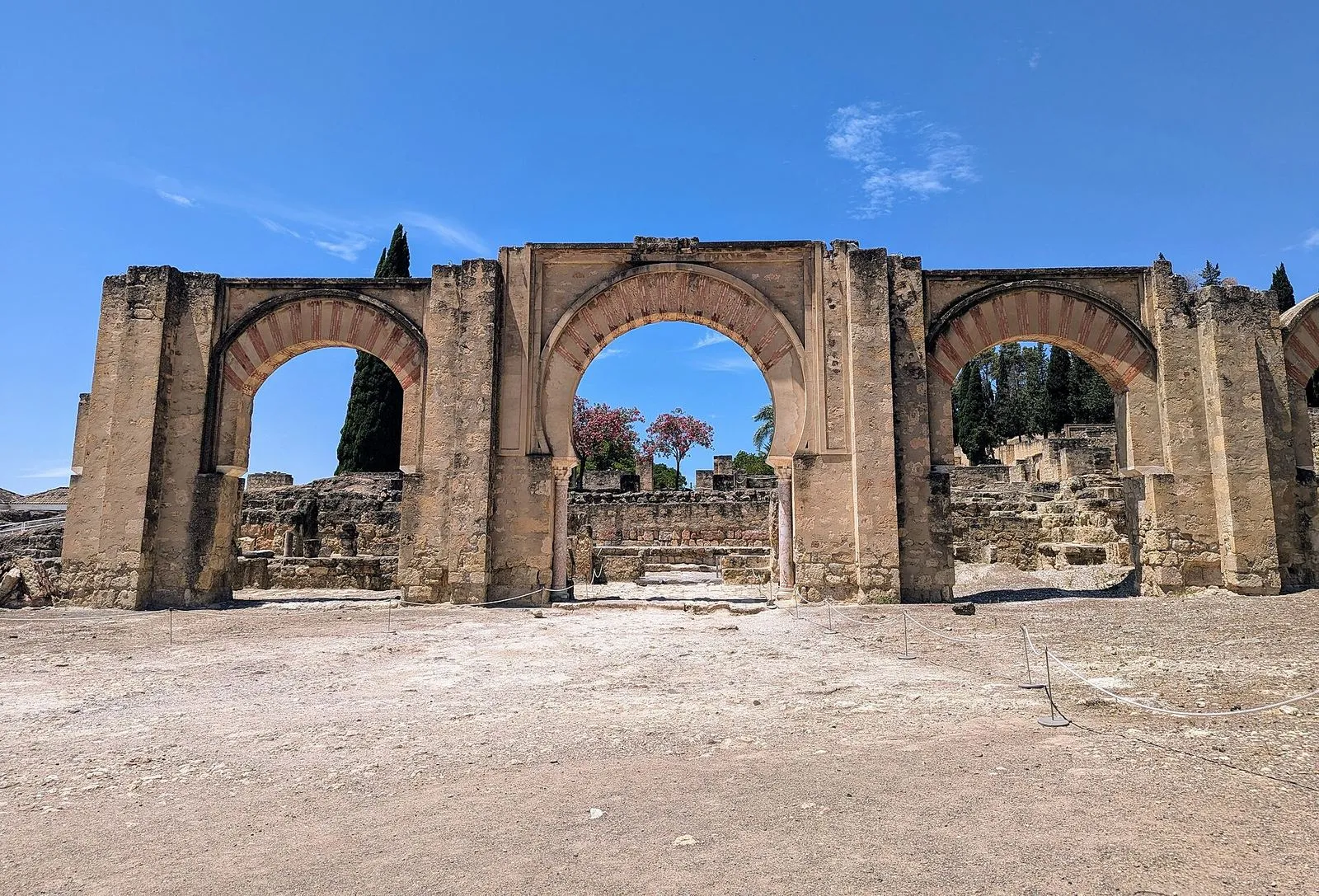
- The ramped street and the Great Portico. A street in two sloping sections leads down to the Gran Pórtico, a long arcade of horseshoe arches that was the ceremonial entrance to the palace. It is the most photographed spot on the site.
- The stables and the House of Ja’far. The residence of a senior official of the caliphate, with a carved stone doorway, next to the servants’ quarters (look for the bread oven) and the guard house.
- The upper buildings. Houses of the court arranged around large square patios.
The caliph’s own residence, the Dar al-Mulk at the highest point, is closed for conservation reasons. From the path down to the next terrace, you look over the remains of the great mosque on the lowest level of the city, turned towards the south-east. The mosque itself is not open to visitors.
The Salón Rico and the upper garden
The Hall of Abd al-Rahman III, known as the Salón Rico (“rich hall”), was the caliph’s reception hall and the finest building in the city. Its walls are covered in carved stone decoration of plants and geometric patterns, reassembled piece by piece from thousands of fragments. In front of it lies the upper garden, a large garden divided in four, with pools around a central pavilion that has since disappeared.
The hall is still under restoration and closed on a normal visit: you see it and the garden from outside. The only way in is a free one-hour guided visit on Saturday and Sunday mornings (11:00 and 12:15), running from 14 March to 13 December 2026. Each takes 30 people; bookings open at 9:00 on the Monday before on conocetupatrimonio.com, two places per person. Take the shuttle (paid as usual) at least 30 minutes early and meet at the Great Portico.
The views
From the terraces you look south over the Guadalquivir valley and the farmland of the campiña, with the Sierra Morena behind you, best in the morning light or on a summer night visit.
How to get there
By tourist bus (the easiest way without a car)
The official tourist bus, run by Autocares Bravo, leaves from Paseo de la Victoria: first from the Glorieta de la Cruz Roja roundabout, then opposite the Mercado Victoria food market. At the museum you change to the shuttle to the ruins; the whole journey takes about 25 minutes.
- Departures: 10:00 (back at 13:30) and 10:45 (back at 14:15), on days when the site is open. In summer there is an extra departure at 21:15 for the night visits.
- Price: €10 for adults and €5 for children aged 5 to 12, return, with the shuttle included. Entry (free or €1.50) is extra.
- Booking: online at autobusmedinaazahara.com, with the ticket sent by email.
The 3.5 hours between departure and return are just enough for the museum and the ruins. Be on time for the bus back: if you miss it, there is no alternative transport.
By taxi
A taxi from the centre takes about 20 minutes. There are set fares to Medina Azahara, which the bus operator lists at about €14 per trip on weekdays and about €18 on weekends and holidays. That makes a taxi cheaper than the tourist bus for three or four people. We’d arrange the return with the driver, or ask at the museum reception to call one.
By car
Take the A-431 towards Palma del Río; the museum is at kilometre 5.5. Its car park is the only place to leave a car, and from there everyone takes the shuttle. A car lets you arrive at 9:00, before the heat.
City bus, walking and cycling
Aucorsa city bus line 1 stops at the Medina Azahara junction, about 700 metres from the museum along a road without a pavement: possible, but unpleasant in the heat or with children. Walking or cycling the 8 km from the city is not advised, for the same reason.
Guided tours
The site is signposted, but the ruins are fragmentary and a guide brings them to life.
- A guided tour of Medina Azahara with transport from Córdoba solves the bus, the tickets and the explanations in one go. Check the duration, the pick-up point and whether entry and the shuttle are included before you book.
- Combine it with a guided tour of the Mezquita on the same day to see how the caliphs built in the city and in their palace.
Tips for your visit
- We’d go early. In summer, Córdoba is one of the hottest cities in Spain, with afternoons often above 40°C. We suggest taking the first shuttle, or using the summer night opening instead.
- Water, hat and sunscreen. We’d stock up at the museum café before the shuttle: the ruins have very little shade.
- Shoes: the paths are uneven, with gravel, stone and ramps.
- Allow enough time. The official estimate is 2.5 to 3 hours for the museum and the ruins. We wouldn’t arrive less than two hours before closing.
- We’d combine it with the Mezquita. The Mezquita’s free entry at 8:30, the 10:45 bus to Medina Azahara, lunch back in the centre, and the Alcázar or the Judería later. More ideas in things to do in Córdoba.
- Coming from Seville? Adding Medina Azahara to a day trip means a very long day; see Seville to Córdoba. We think a tour with transport is the simplest option.
Where to stay
Spending the night in Córdoba makes the early start possible. We’d stay in the Judería or the centre, a few minutes’ walk from the tourist bus stops on Paseo de la Victoria. Our guide to where to stay in Córdoba compares the neighbourhoods, and the best hotels in Córdoba lists our favourites. Or browse hotels in Córdoba’s old town.
If Córdoba is one stop on a longer trip, see our Córdoba guide and the Andalusia road trip.
FAQ
Is Medina Azahara worth visiting?
Yes, in our view, if you like history or have more than a day in Córdoba. Expect ruins rather than intact palaces; allow half a day in total, and see the museum first.
How much does Medina Azahara cost?
Entry is free for EU citizens with ID and €1.50 for others, plus €3 for the compulsory shuttle (€1.50 for children aged 5 to 12 and over-65s). The tourist bus from Córdoba costs €10 including the shuttle.
How do I get to Medina Azahara without a car?
Take the tourist bus from Paseo de la Victoria at 10:00 or 10:45, from Tuesday to Sunday, or a taxi. Guided tours with transport are the easiest option if you come from Seville or want a guide.
Is Medina Azahara open on Mondays?
No, it is closed on Mondays, except when the Monday is the day before a public holiday. On Sundays and holidays it closes at 15:00.
Can you go inside the Salón Rico?
Only on the free guided weekend visits, which must be booked from the Monday before. On a normal visit, you see the hall and the upper garden from outside while restoration continues.
Medina Azahara or the Alhambra?
The Alhambra is a standing palace with its rooms, tiles and gardens intact, and needs booking weeks ahead. Medina Azahara is older and mostly excavated foundations, but it shows a whole caliphal city. They complement each other.