
Some links on this page are affiliate links. If you book through them we may earn a commission, at no extra cost to you.
The short answer
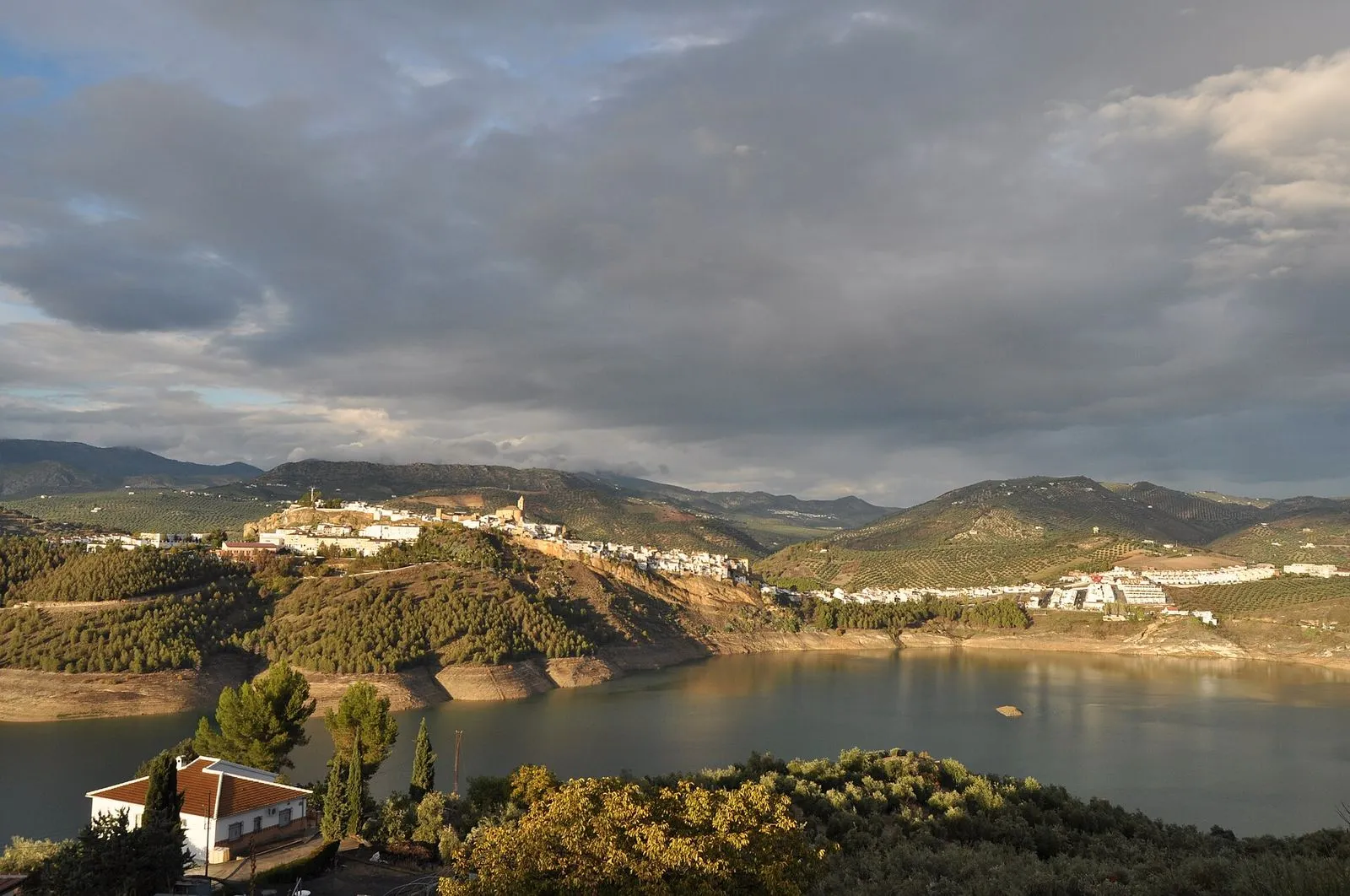
Iznájar is a white village of about 3,700 people in the far south of Córdoba province, built on a ridge that runs out into the Iznájar reservoir, the largest in Andalusia. From the water it looks like an island village: white houses climbing to a Moorish castle and a Renaissance church, with blue water on three sides and olive groves all around.
- Is it worth it? We think so, if you have a car and like quiet places. It is less known to foreign travellers than the villages around Ronda, but hugely popular with Spaniards, especially in summer.
- Time needed: 2–3 hours for the old quarter, the castle and the viewpoints. A full day in summer if you add the lake beach at Valdearenas.
- Cost: the castle is about €2 with an audioguide; most other sights are free.
- Getting there: by car, about 1 hour from Granada, 1 h 15 from Málaga and 1 h 15–1 h 30 from Córdoba. Buses are few and slow.
The “lake of Andalusia”
The reservoir was created in 1969 by a dam on the Genil, the river that flows down from the Sierra Nevada through Granada. With a capacity of about 981 million cubic metres and more than 100 km of shoreline across the provinces of Córdoba, Granada and Málaga, it is the largest reservoir in Andalusia, and locals call it the lago de Andalucía. Farms and hamlets were flooded when it filled. The water level changes a lot from year to year: after dry years the shore retreats, and after the wet winter of 2025–26 it was close to 90% full in summer.
What to see in Iznájar
The old village, the Barrio de la Villa, sits at the top of the ridge. We’d park lower down and walk up: the lanes are steep and narrow.
Castillo de Hisn-Ashar
The castle at the highest point gave the village its name: Hisn Ashar is usually translated from Arabic as “the happy castle”. It dates back to the 8th century, played a part in the 9th-century rebellion of Umar ibn Hafsun against Córdoba, and was rebuilt many times until the Nasrid period. Castile took Iznájar in the 1430s. After years of ruin, the town bought the castle in 1991 and restored it between 2006 and 2008.
You can walk the walls and towers for the best view of the reservoir. It usually opens Tuesday to Sunday from 10:00 to 14:00, plus Friday and Saturday afternoons (later in summer), and a ticket costs about €2 including an audioguide in English.
Iglesia de Santiago Apóstol
Next to the castle stands the 16th-century parish church of Santiago, a Renaissance building attributed to Hernán Ruiz the Younger, the architect of the Giralda’s belfry in Seville. It is usually open only for Mass and for booked group tours. The small square behind it has one of the finest views over the water.
The viewpoints
Iznájar has more miradores than sights, and in our view they are the real reason to come. The best known are the Mirador de la Cruz de San Pedro, which doubles as an open-air theatre, the Mirador del Postigo (with parking nearby), the Mirador de las Tres Cruces and the Mirador de la Puerta del Rey. We think late afternoon light on the water is the best time for photos.
The old quarter
Around the castle, look for the Casa de las Columnas, an 18th-century house with stone columns that housed the administration of the local lords; the Patio de las Comedias, an old medieval courtyard with a corner locals call the Rincón del beso; the Torre de San Rafael, the last surviving tower of the walls; and the orange trees of Plaza Rafael Alberti, named after the poet, who visited in 1920 and again in 1989. The municipal library occupies the 18th-century grain store, the Pósito.
The museums
The Casa de la Juventud holds several small, free museums, including farm tools and popular traditions, and lost trades and crafts. Down by the water, the Centro de Interpretación del Embalse, about 2 km from the village at Valdearenas, explains the building of the dam, the river and the birds of the reservoir. It is closed on Mondays and Tuesdays.
Valdearenas: a beach on the lake
Just over a kilometre below the village, Valdearenas is a sand and grass beach about 1.5 km long on the shore of the reservoir, with the white village and castle as a backdrop. In summer it has showers, shade, picnic areas and two restaurants, and part of the shore is set aside for dogs, which is rare in inland Andalusia.
The calm water suits beginners: a nautical centre by the beach rents kayaks, paddle boards and pedal boats and runs sailing courses, and boat trips on the reservoir run in summer. Swimming is allowed; the water is cold early in the season, and we’d check whether lifeguards are on duty. The small jetty is for boats only.
Walking
You can walk down from the village to Valdearenas and along the shore, and several marked paths lead through the olive groves and along the water. The tourist office has maps. In summer, we’d walk early: there is little shade and inland temperatures often pass 35 °C.
Nearby: Priego, Rute and more
Iznájar sits where Córdoba, Granada and Málaga provinces meet, at the edge of the Sierras Subbéticas, so a lot is within an hour.
Priego de Córdoba
About 40 minutes east, Priego is the capital of Córdoba’s baroque and we think it deserves at least half a day. Its landmark is the Fuente del Rey, a monumental fountain finished in 1803 with three pools and 139 spouts, fed, like the Fuente de la Salud next to it, by the springs that give Priego its nickname, “city of water”. The Barrio de la Villa, the old Moorish quarter by the castle, is a tangle of white lanes covered in flowerpots, and it ends at the Balcón del Adarve, a promenade on the edge of a cliff with views over the valley. Priego’s churches are the other highlight: the chapel of the Sagrario in the Iglesia de la Asunción, an octagonal room covered in white rococo plasterwork by Francisco Javier Pedrajas (1772–1784), is one of the finest baroque interiors in Andalusia. The olive oil from the hills around the town carries its own designation of origin, DOP Priego de Córdoba.
Rute
Twenty minutes north, Rute is the home of Andalusian anís, with distilleries such as Destilerías Duende and its small anise museum. It is also famous for its sweet museums: the Museo del Azúcar, with figures modelled in sugar, and, from autumn to early January, a huge nativity scene made of chocolate by Galleros Artesanos. Entry is a euro or two, often refunded against purchases.
Loja, Zuheros and Antequera
- Loja, about 30 minutes east in Granada province, has a Moorish alcazaba and is the gateway to Granada on the A-92.
- Zuheros, about an hour north, is one of the prettiest villages in the Subbética, with a castle on a rock, the Cueva de los Murciélagos and good local cheese.
- Antequera, about an hour west, has the dolmens and El Torcal.
Iznájar’s own olive oil, mostly from the hojiblanca olive, belongs to the DOP Aceite de Lucena.
When to go
We think spring (April to early June) and autumn (late September to early November) are best for the village, the viewpoints and walking. July and August are hot but the lake makes them the busiest months, with Spanish families at Valdearenas and fully booked rural houses. Winter is quiet and green, with short days and cold nights. See the best time to visit Andalusia.
Getting there
| From | Car | Route |
|---|---|---|
| Granada | about 1 h (85–90 km) | A-92 west to Loja, then north on local roads |
| Málaga | about 1 h 15 (about 100 km) | A-45 north, then east on local roads |
| Córdoba | 1 h 15–1 h 30 (about 110 km) | A-45 south via Lucena |
| Antequera | about 1 h | A-92 east, then local roads |
- By car is the only practical way. Rent at Málaga airport or in Granada; see our car hire guide. We’d park at the entrance of the village or by the viewpoints, not in the old lanes.
- By bus, a few services a day link Iznájar with Córdoba and the towns of the Subbética, taking over two hours from Córdoba. It works for a night or two, not a day trip.
- Iznájar fits well into a road trip through Andalusia between Córdoba and Granada, or as a day out from Málaga. See it on our map of Andalusia.
Where to stay
Iznájar has no big hotels: most beds are in rural houses, apartments and small hotels, many with a pool and a view of the lake. All three below were rated 8.5 or more on Booking.com when we checked.
- Caserío de Iznájar: a hotel with a restaurant right by Valdearenas beach, our pick for a summer stay by the water.
- Iznájar Suites: apartments on the edge of the village, a few minutes’ walk from the castle, with parking.
- Complejo Las Majadillas: a small rural complex with a handful of rooms near the reservoir, about 15 minutes’ walk from the beach.
- More options: rural houses and hotels in Iznájar.
FAQ
Is Iznájar worth visiting?
Yes, for its setting above the largest lake in Andalusia, the castle and the viewpoints. It is a quiet place rather than a sightseeing town, so it suits travellers with a car and a relaxed pace.
What is there to do in Iznájar?
Climb to the castle, walk the old lanes and viewpoints, and in summer swim, kayak or paddle board at Valdearenas beach. Nearby, Priego de Córdoba and Rute make good half-day trips.
Can you swim in the Iznájar reservoir?
Yes. Valdearenas beach, just below the village, is the main bathing area, with showers and restaurants in summer and a separate area for dogs. We’d check whether lifeguards are on duty before you swim.
How far is Iznájar from Granada, Málaga and Córdoba?
By car it is about 1 hour from Granada, about 1 h 15 from Málaga and 1 h 15–1 h 30 from Córdoba. Public transport is limited, so a car is the realistic option.
Is Iznájar one of the white villages?
Yes. It is a whitewashed hill village like those in Cádiz and Málaga, although it lies further east, in Córdoba province. See our guide to the white villages of Andalusia and our pick of the best places to visit in Andalusia.