
Some links on this page are affiliate links. If you book through them we may earn a commission, at no extra cost to you.
The plan at a glance
| Time | What |
|---|---|
| 8:30 | Mezquita-Catedral, free early entry (Monday to Saturday) |
| 9:45 | Breakfast near the Mezquita |
| 10:30 | The Jewish quarter, the synagogue and the Calleja de las Flores |
| 12:30 | Alcázar gardens and the Baños del Alcázar Califal |
| 14:30 | Lunch: salmorejo and flamenquín |
| 16:30 | Palacio de Viana or a rest at your hotel |
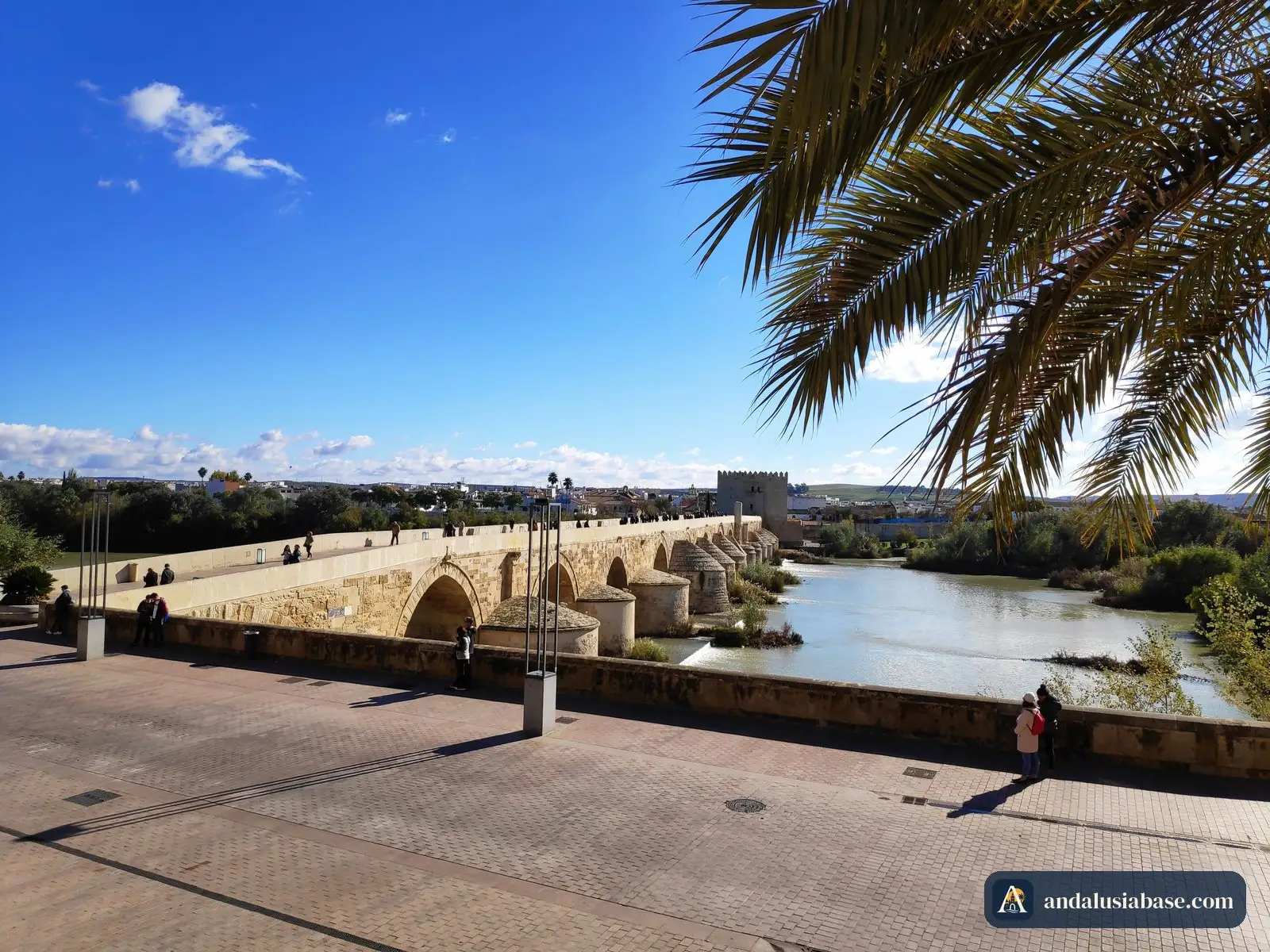
| 19:00 | The Roman bridge and the Calahorra tower at sunset |
| 21:00 | Dinner, or a flamenco show |
Book before you go: your train, a table for dinner in May, and a Mezquita ticket if you can’t make the free entry. Hours change with the season, so check the times of each sight for your date.
The day, step by step
8:30: the Mezquita
Queue a few minutes before 8:30 for the free entry, from Monday to Saturday. You don’t need to book, and access closes at about 9:20. The visit is silent and there are no guided groups, and in our view it is the best way to see the forest of arches, the gilded mihrab and the cathedral in the middle.
If you prefer a slower visit, an audio guide or the bell tower, buy a normal ticket (about €15) for 10:00 instead. A guided tour of the Mezquita explains the building’s layers of history.
10:30: the Jewish quarter
Walk the white lanes of the Judería. Visit the 14th-century synagogue (free, Tuesday to Sunday, 9:00–15:00), then find the statue of Maimonides and the Calleja de las Flores, with its view of the Mezquita’s bell tower.
12:30: the Alcázar gardens
The Alcázar de los Reyes Cristianos has long terraced gardens with pools and orange trees. Only the gardens are open while the building is being restored. The ticket (about €7.50) also covers the nearby Baños del Alcázar Califal. Both are usually closed on Mondays, and in the height of summer the Alcázar opens only in the morning. Allow about 1.5 hours.
14:30: lunch
Try two dishes that come from here: salmorejo, a cold tomato cream, and flamenquín, a fried roll of ham and pork. See where to eat in Córdoba.
16:30: patios or a rest
The afternoon is the hottest part of the day, so we’d rest at your hotel, above all from June to September. If you have the energy, walk north to the Palacio de Viana and its 12 patios (about €8.50 for the patios, usually closed on Mondays). On the way, you can pass the Roman temple. See the rest of the list in things to do in Córdoba.
19:00: the Roman bridge
Walk across the Roman bridge before sunset, when the light turns the Mezquita gold. At the far end, the Calahorra tower has a small museum (€4.50) and a terrace looking back across the river. The time of sunset changes a lot through the year, so move this part earlier in winter.
21:00: dinner or flamenco
Eat in the old town, or see a flamenco show. Shows are smaller here than in Seville, and the walk back through the empty lanes of the Judería is, we think, the reason to stay the night.
Where to stay
We think a night makes Córdoba much more relaxed, and the old town is at its best when the day-trippers have gone.
- Hotel Marisa: simple and good value, facing the north wall of the Mezquita.
- Hotel Balcón de Córdoba: a small boutique hotel a few steps from the Mezquita, with a roof terrace.
- NH Collection Palacio de Córdoba: a five-star hotel on Plaza de Maimónides, in the heart of the Judería.
Variations
- On a day trip by train: high-speed trains from Seville take about 45 minutes, from Málaga about 1 hour and from Madrid about 1 h 45 to 2 h. The Mezquita is a 20–25 minute walk from the station, or a short bus or taxi ride. To make the free entry, you need to arrive by about 8:00, so check the first trains. Otherwise, start with a ticket at 10:00, and end at the Roman bridge before your train back.
- On a Monday: the synagogue, the Alcázar and the Palacio de Viana are usually closed. We’d spend more time on the Mezquita, the lanes of the Judería and the river, or go on a different day if you can.
- On a Sunday: there is no free early entry at the Mezquita, and the hours differ, about 8:30–11:30 and from 15:00. Buy a ticket and plan the Judería around it.
- In summer: in July and August it is often above 40 °C in the afternoon. We’d do everything before 13:00, rest, and go out again after 19:00.
- In May: add a route of the patios festival in the morning or evening, and book your hotel well ahead.
- With a second day: add Medina Azahara, the caliphs’ palace city, in the morning, and the Palacio de Viana and the churches of the north in the afternoon.
FAQ
Is one day enough to see Córdoba?
Yes, for the main sights: the Mezquita, the Jewish quarter, the Alcázar gardens and the Roman bridge. For Medina Azahara or the patios of the Palacio de Viana at a relaxed pace, we’d stay two days.
What should I not miss in Córdoba in one day?
The Mezquita first, then the lanes of the Jewish quarter and the Roman bridge at sunset.
Can I visit Córdoba on a day trip from Seville?
Yes. High-speed trains take about 45 minutes. See our Córdoba day trip guide for the trains and the options.
How much time do I need for the Mezquita?
About 1.5 hours, or 2 hours with the bell tower. The free early entry lasts up to an hour.
What is the best order to visit Córdoba?
We’d start with the Mezquita as early as you can, then the Jewish quarter and the Alcázar before lunch, and finish at the Roman bridge at sunset.