
Some links on this page are affiliate links. If you book through them we may earn a commission, at no extra cost to you.
The short answer
The Judería is the old Jewish quarter of Córdoba, a maze of narrow white lanes, wrought-iron windows and flowerpots that wraps around the north and west of the Mezquita. It is free to walk around, and part of the UNESCO World Heritage site.
- Don’t miss: the 14th-century synagogue, the Calleja de las Flores and the statue of Maimonides.
- Time needed: about 2 hours, or half a day with the Casa de Sefarad and the Mezquita.
- Best time, in our view: early in the morning or after 18:00, when the tour groups have gone.
- Getting there: it starts right next to the Mezquita. Cars are mostly not allowed, so you walk.
A short history
Jewish people lived in Córdoba for centuries before and during Muslim rule. The philosopher and doctor Maimonides was born here in 1138, in the time of al-Andalus, one of the greatest Jewish thinkers of the Middle Ages. After the Christian conquest of 1236, the community remained, and the synagogue was built in 1315. In 1492, Spain expelled the Jews who wouldn’t convert. The synagogue was later used as a hospital and a school.
What to see
The synagogue
The Sinagoga on Calle Judíos is one of only three medieval synagogues left in Spain. It is a single small room with delicate plasterwork and Hebrew inscriptions, and 10–15 minutes is enough. According to the regional government, it is free and open Tuesday to Sunday, 9:00–15:00, and groups of more than six need to book. Other sources give longer hours in some seasons, so check before you plan around an afternoon visit.
Casa de Sefarad
Almost opposite the synagogue, the Casa de Sefarad is a small private museum on the Sephardic Jews of Córdoba, with nine rooms in a house with parts from the late 14th century, around a patio. It lists €5, Tuesday to Saturday, 11:00–18:00 (July and August, 10:00–15:00). Other sites give different hours, so we’d check before you go.
The Calleja de las Flores
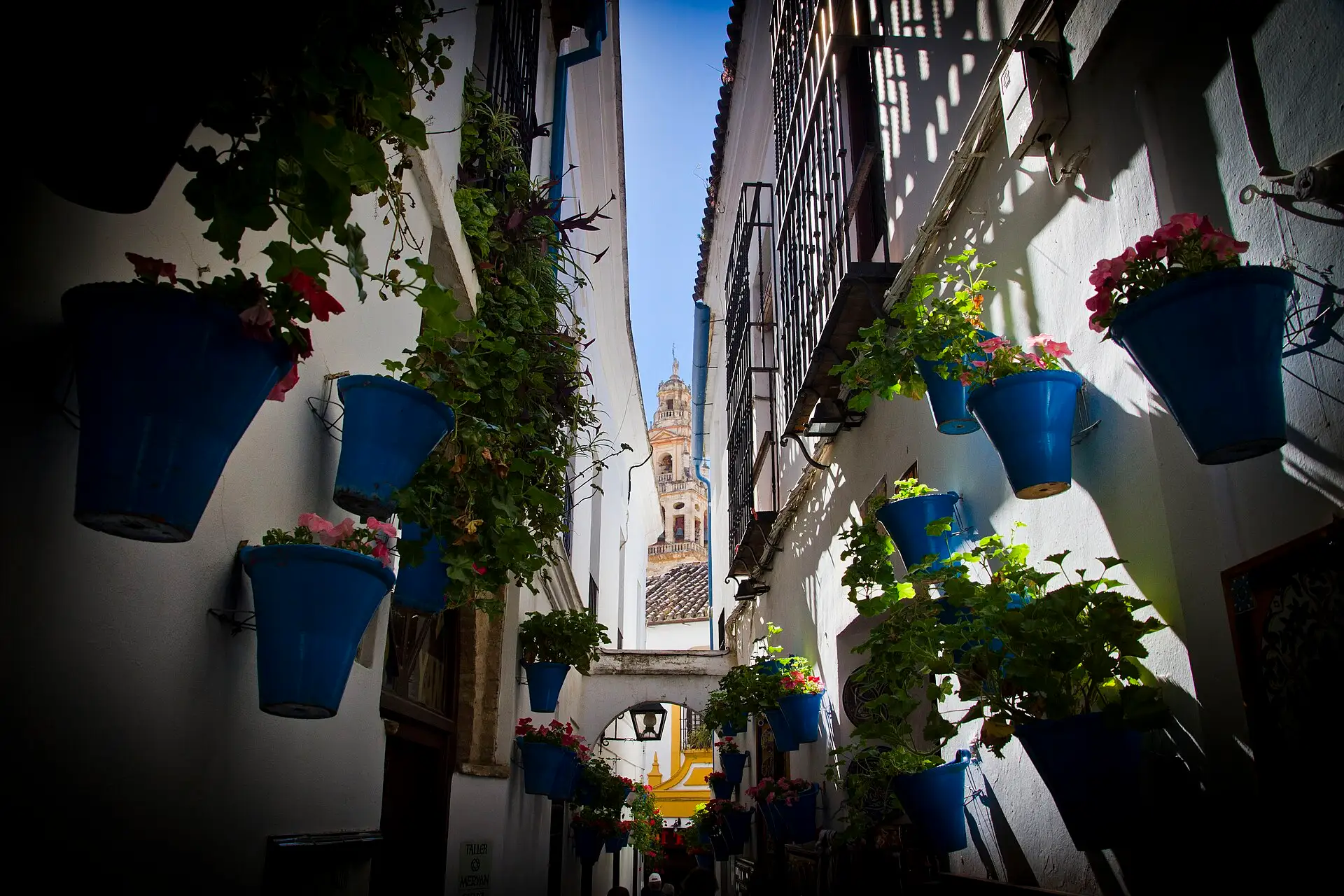
This tiny dead-end lane off Calle Velázquez Bosco is lined with flowerpots. At the end, it opens onto a small square that frames the Mezquita’s bell tower, the most photographed view in Córdoba. It takes five minutes, and we’d go early to have it to yourself.
Statue of Maimonides
The bronze statue of the philosopher sits in a small square, the Plaza de Tiberiades, a few steps from the synagogue. It is said that touching his foot brings luck.
The Puerta de Almodóvar
This medieval gate in the old city wall, at the top of Calle Judíos, is the western entrance to the quarter. Outside, a statue of the Roman philosopher Seneca, who was born in Córdoba, faces the walls and the gardens along them.
The Capilla de San Bartolomé
A small Mudéjar chapel, with tiles and plasterwork, near the Plaza de Maimónides. It is inside a university building, and there is a small fee. Its hours vary, so check at the door or at the tourist office.
The Zoco
Next to the synagogue, the Zoco is a courtyard of craft workshops, a pleasant stop for leather and silver. Look for it off Calle Judíos.
The Calleja del Pañuelo
The name means “handkerchief lane”, because it is said to be as narrow as one at its tightest point. It leads to a tiny square with a fountain, and takes a couple of minutes.
A walking route
- Start at the Puerta de Almodóvar and the statue of Seneca.
- Walk down Calle Judíos to the synagogue, the Casa de Sefarad and the Zoco.
- Find the statue of Maimonides in the Plaza de Tiberiades.
- Continue to the Plaza de Maimónides and the Capilla de San Bartolomé.
- Walk around the Mezquita walls, then look for the Calleja de las Flores.
- End with the Mezquita itself, or the Roman bridge at sunset.
For the whole day, see our one-day plan for Córdoba. Prefer a guide? A Jewish quarter walking tour explains the stories behind the walls, and many include the Mezquita. In May, one route of the patios festival goes through the Judería.
Where to eat
The lanes next to the Mezquita have many tourist menus. We’d try Casa Pepe de la Judería (C/ Romero 1) or Taberna el nº 10, both in the Michelin Guide, or Casa Rubio, near the Puerta de Almodóvar. See where to eat in Córdoba.
Where to stay in the area
The Judería is our first choice for a first visit, for the walk to the Mezquita and the empty lanes at night. Expect small rooms and no cars.
- Budget: Hotel Marisa is simple and good value, facing the north wall of the Mezquita.
- Mid-range: Hotel Balcón de Córdoba is a small boutique hotel with a roof terrace.
- Top: NH Collection Palacio de Córdoba is a five-star hotel on Plaza de Maimónides, with an outdoor pool in a courtyard.
FAQ
Where is the Jewish quarter in Córdoba?
Around the north and west of the Mezquita, between the Puerta de Almodóvar and the river. It is a short walk from every other sight in the old town.
Is the Jewish quarter in Córdoba free?
Yes, the streets are free, and so is the synagogue, according to the regional government. The Casa de Sefarad and the Capilla de San Bartolomé charge a small fee.
Can you visit the synagogue in Córdoba?
Yes. It is usually open from Tuesday to Sunday, from 9:00 to 15:00, and is closed on Mondays. No booking is needed for small groups.
How long do you need in the Jewish quarter?
About 2 hours to walk the lanes and see the synagogue. Allow half a day with the Casa de Sefarad and a long stop for lunch.
Who was Maimonides?
A Jewish philosopher, doctor and scholar born in Córdoba in 1138. His statue stands in the Judería, a few steps from the synagogue.