Some links on this page are affiliate links. If you book through them we may earn a commission, at no extra cost to you.
The short answer
Marbella is the best-known resort on the Costa del Sol, a town of about 150,000 people about 60 km west of Málaga. Behind the high-rise seafront and the famous names, it has a real whitewashed old town, and the Sierra Blanca mountains rise straight up behind it.
- Why go: a pretty old town, a long seafront promenade, good hotels, Puerto Banús, golf, beach clubs and mountain villages a short drive away.
- Who it suits: couples and families on a beach holiday, people who want comfort and good food, and travellers with a car who want a base for the western Costa del Sol.
- Who it doesn’t suit: anyone looking for white sand, empty beaches or low prices. For museums and city life, Málaga is the better base.
- Time needed: half a day for the old town and the seafront; 3–7 nights for a beach holiday.
- Getting there: no train. About 45 minutes by car or direct bus from Málaga airport.
Is Marbella worth it?
Yes, if you know what you are getting. Marbella is not one place but a long, built-up strip of about 25 km of coast: the old town and centre, the Golden Mile of hotels and villas, Puerto Banús with its marina, San Pedro de Alcántara to the west, and quieter beaches and housing estates to the east. The glamour is real in a few places and expensive, but most of the town is an ordinary Spanish resort, busy and friendly.
Things to do in Marbella
Casco Antiguo and Plaza de los Naranjos
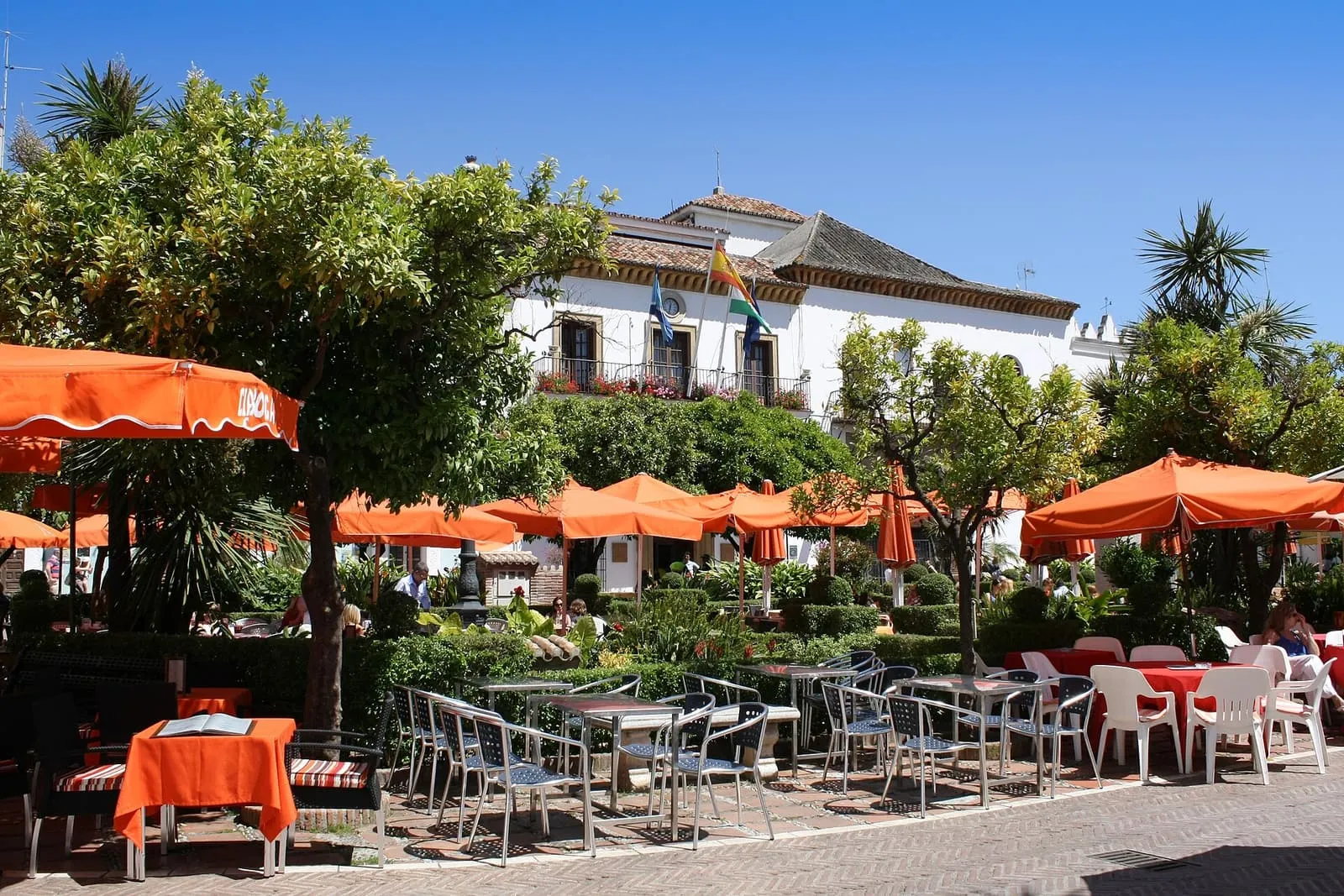
The Casco Antiguo (old town) is a small maze of white lanes, flower pots and tiny squares inside the line of the old Moorish walls. Its heart is the Plaza de los Naranjos, laid out after the Christian conquest of 1485 and planted with orange trees. Around it stand the 16th-century town hall, the stone façade of the Casa del Corregidor and the small Ermita de Santiago, the oldest church in town.
A few streets away, the Iglesia de la Encarnación, the main church, has a carved stone doorway and a large modern organ. Look for stretches of the Moorish castle walls in the upper part of the old town, and the Museo del Grabado Español Contemporáneo, a small museum of modern Spanish prints in a 16th-century building.
The terraces on the Plaza de los Naranjos are lovely but overpriced. For lunch, walk into the side streets. The old town is best early in the morning or in the evening, when the lanes are quiet. A guide adds the history of the town and its jet-set years: Marbella old town walking tour.
The Alameda and Avenida del Mar
Just below the old town, the Alameda is a shady park with tiled benches and a marble fountain. From there, the marble-paved Avenida del Mar runs down to the sea, lined with ten bronze sculptures by Salvador Dalí. It takes five minutes to walk, and it is free.
The Paseo Marítimo and the beaches
The Paseo Marítimo runs along the town beaches, lined with chiringuitos (beach restaurants), and continues west towards Puerto Banús. Walking or cycling the seafront from the old town to Puerto Banús, about 6 km, is one of the best things to do in Marbella: allow about 1 h 15 on foot.
Be honest with yourself about the beaches. This is an urban coastline: the sand is coarse and grey-brown, the beaches are often narrow and divided by breakwaters, and many are topped up with sand after winter storms. The sea is usually calm and clean, and the setting under the mountains is beautiful, but this is not the Caribbean.
- La Venus and La Fontanilla: the town beaches at the end of Avenida del Mar, with every service and sunbeds to hire.
- El Faro and La Bajadilla: east of the centre, near the lighthouse and the fishing port, more local.
- Cabopino: about 15 km east, a beach backed by dunes, with more space and a small marina.
For comparison with the beaches nearer Málaga, see Málaga’s beaches.
Puerto Banús
About 6 km west of the old town, Puerto Banús is the marina that opened in 1970 and made Marbella’s name: superyachts, supercars, designer shops and waterfront restaurants. Walk the quays, look at the boats and have a drink, but expect high prices and crowds on summer evenings. Boat trips along the coast, including dolphin-watching cruises, leave from here: Marbella boat trips.
The Golden Mile
The Milla de Oro (Golden Mile) is the stretch of road and coast between Marbella and Puerto Banús, lined with luxury hotels and walled villas. It began with the Marbella Club Hotel, founded in the 1950s, which turned a fishing village into a jet-set resort. The best way to see it is from the seafront path. Nearby, the Museo Ralli, a free museum of Latin American and European art, is worth a short stop.
San Pedro de Alcántara
West of Puerto Banús, San Pedro de Alcántara is part of Marbella but feels like a separate, quieter town, popular with families. It has a long park (the Bulevar) built over the old coast road, its own promenade, and Roman remains near the beach: the Termas de Las Bóvedas (Roman baths) and the ruins of the Vega del Mar basilica. The Villa Romana de Río Verde, near Puerto Banús, has well-preserved mosaics. All three open only on certain days, often with guided visits: check with the tourist office.
Istán, Ojén and Sierra Blanca
The mountains are the surprise of Marbella. Ojén, about 15 minutes inland, is a white village on the slopes of the Sierra Blanca. Istán, about 20–25 minutes away, sits above the green valley of the Río Verde and the Concepción reservoir. Both are quiet, with village bars and views to the sea. For more villages, see the white villages guide.
The classic hike is La Concha, the peak of about 1,200 metres that you see behind Marbella. Most people start from the Refugio de Juanar above Ojén: allow about 5–6 hours return. The last part follows a narrow, exposed ridge. Go only in good weather, never in summer heat, and carry plenty of water.
Nightlife and beach clubs
Marbella’s nightlife is centred on Puerto Banús, with bars and clubs open until dawn in summer. The old town is calmer, with tapas bars and terraces. Beach clubs such as Nikki Beach Marbella, east of the centre, and Ocean Club Marbella, near Puerto Banús, offer daybeds, music and pool-party afternoons, mostly from spring to autumn. A sunbed there costs many times more than on a town beach, and daybeds much more: book ahead in summer.
When to go
- May, June, September and early October are the best months: warm, the sea is swimmable from June, and prices are lower than in high summer.
- July and August are hot, crowded and at their most expensive. This is the season of the big beach clubs, the Starlite music festival (usually July–August) and busy nights in Puerto Banús.
- Winter is mild, with sunny days that are often around 16–18 °C. The sea is cold, but it is a good time for walking, golf and the old town without crowds.
- The town’s main fair, the Feria de San Bernabé, is usually held in mid-June.
For the whole region, see the best time to visit Andalusia.
Getting to Marbella
Marbella has no train station. The nearest railway is the Cercanías C1 from Málaga, which ends at Fuengirola, about 30 km away. Most people come by bus or car.
| From | Car | Bus |
|---|---|---|
| Málaga airport | about 45 min | about 45 min–1 h, direct |
| Málaga city | 45 min–1 h | 45 min–1 h 15 from the bus station |
| Ronda | about 1 h (mountain road) | about 1 h 15–1 h 30 |
| Gibraltar (La Línea) | about 1 h | a few a day |
| Seville | about 2 h 30 | a few a day, about 3–4 h |
- By bus: Avanza runs direct buses from Málaga airport and from Málaga’s main bus station, next to María Zambrano station. Marbella’s bus station is on the hill above the town, so take a local bus or taxi into the centre with luggage. Compare times: Málaga to Marbella by bus.
- By car: the fastest road is the AP-7 toll motorway; the free A-7 is slower and busier. A car is worth it if you want the mountain villages, Ronda or Gibraltar. See car hire at Málaga airport or compare prices on DiscoverCars. Park in the underground car parks near the seafront; the old town is pedestrian.
Where to stay in Marbella
| Area | Best for | Downsides |
|---|---|---|
| Old town and centre | Walking, restaurants, town beaches | Few big resort hotels |
| Golden Mile | Luxury resorts, quiet beaches | Expensive, you need taxis |
| Puerto Banús | Nightlife, shopping | Noisy and pricey in summer |
| San Pedro de Alcántara | Families, apartments | Far from the old town |
- Hotel El Fuerte Marbella: a classic hotel with gardens and a pool, on the seafront between the old town and the beach. The best location for a first visit.
- Hotel Claude Marbella: a small boutique hotel in an old mansion inside the old town.
- Marbella Club Hotel: the resort that started it all, on the Golden Mile, with gardens down to the beach.
- Puente Romano: a luxury resort on the Golden Mile, with low white buildings in subtropical gardens and a Roman bridge in its grounds.
- More options: hotels in Marbella’s old town and hotels in Puerto Banús.
If you are choosing between the coast and the cities, see where to base yourself in Andalusia and where to stay in Málaga.
Day trips from Marbella
- Ronda: about an hour through the mountains to the gorge and the Puente Nuevo. See our Ronda guide or Ronda day trip from Marbella.
- Gibraltar: about an hour to La Línea, then walk across the border. Bring your passport (EU citizens can use a national ID card). See our Gibraltar guide or Gibraltar day trip from Marbella.
- Málaga: the Alcazaba, the Picasso Museum and the old centre, 45 minutes to an hour away. See the Málaga city guide.
- Estepona: about 30 minutes west, a smaller resort with a flower-filled old town.
Marbella is also a stop on longer routes: see the best places to visit in Andalusia and all day trips from Málaga.
FAQ
Is there a train from Málaga to Marbella?
No. Marbella has no railway. Take the direct Avanza bus from Málaga airport or the Málaga bus station (about 45 minutes to 1 h 15), or drive in about 45 minutes to an hour.
What is there to do in Marbella besides the beach?
Walk the old town and the Plaza de los Naranjos, see the Dalí sculptures on Avenida del Mar, visit the white villages of Ojén and Istán, hike La Concha in the Sierra Blanca, or take a day trip to Ronda or Gibraltar.
Is Marbella or Málaga better for a holiday?
Málaga for a city break with museums, food and trains to the rest of Andalusia. Marbella for a beach holiday with resort hotels, golf and nightlife. Many people combine both.