
Some links on this page are affiliate links. If you book through them we may earn a commission, at no extra cost to you.
The short answer
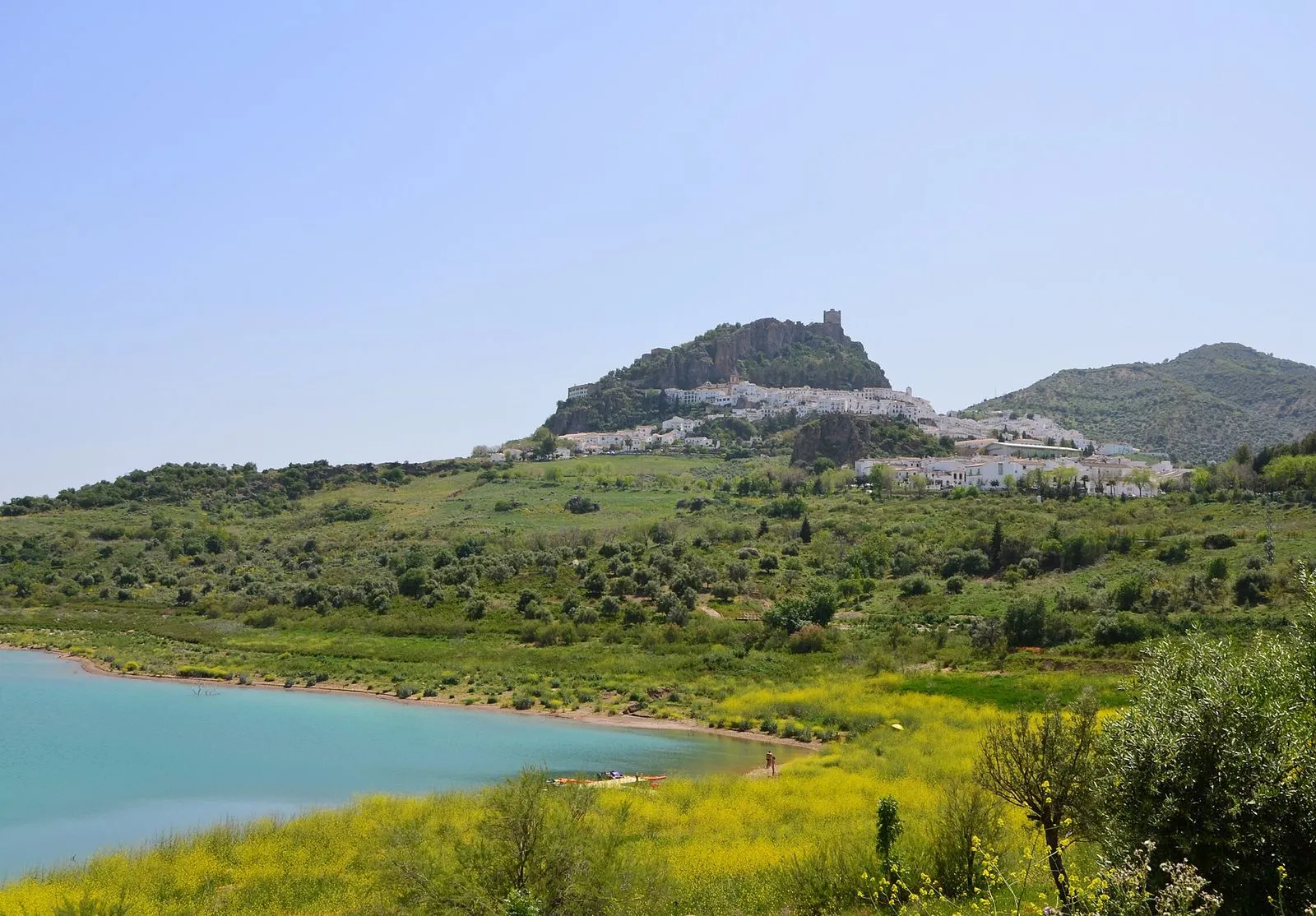
Zahara de la Sierra is a white village of about 1,300 people on a rocky hill in the north of Cádiz province, inside the Sierra de Grazalema Natural Park. A Moorish castle tower crowns the rock, the houses spill down below it, and at the foot of the hill lies the turquoise Zahara–El Gastor reservoir. It is one of the most photographed white villages in Andalusia.
Not the beach town: Zahara de la Sierra is in the mountains. Zahara de los Atunes, the fishing village with a long Atlantic beach, is about two hours south; see our Zahara de los Atunes guide.
- Is it worth it? Yes, we think so. The view from the castle tower, over the lake to Olvera and Algodonales, is one of the best in the white villages.
- Time needed: two to three hours for the village and the castle climb. Half a day or more with a swim in summer, a kayak on the lake or the Garganta Verde gorge.
- Getting there: by car, about 40 minutes from Ronda, 30 minutes from Grazalema and about 1 h 30 to 1 h 45 from Seville.
- Costs: the walk up to the castle through the old medieval villa costs about €3.50; the rest of the village is free.
What to see in Zahara de la Sierra
The village is small and steep. Park at the entrance or in the lower village and walk up.
Plaza del Rey and Santa María de la Mesa
The main square, the Plaza del Rey, is the centre of village life, with the town hall, a couple of bars and a viewpoint over the reservoir. On one side stands the parish church of Santa María de la Mesa, built in the second half of the 18th century. Look for its pinkish stone Baroque doorway and the bell tower capped with blue and white tiles. Inside are a Rococo main altarpiece and an 18th-century organ. The church also houses a small parish museum.
The clock tower and the medieval villa
From the square, lanes climb towards the old walled town, the villa medieval, which stood inside the castle walls from the 13th to the 15th century. On the way you pass the Torre del Reloj, the clock tower, beside the small chapel of San Juan de Letrán; it is one of the village’s symbols. Higher up are the ruins of the old main church, now an interpretation centre about the medieval town.
Tickets for the villa and the tower are sold at the tourist office on Camino Nazarí, at the start of the path.
The castle and the Torre del Homenaje
The Torre del Homenaje, the keep, is the best-preserved part of the Nasrid castle, at about 605 m at the top of the rock. Zahara was a frontier fortress: Castile took it in 1407, the Nasrids of Granada won it back in a surprise attack in 1481, and the Marquis of Cádiz, Rodrigo Ponce de León, retook it in 1483, one of the opening moves of the war that ended with the fall of Granada.
The climb from the square takes about 20–30 minutes on a steep, stony path; wear proper shoes and we’d avoid midday in summer. A staircase leads to the tower roof, with views over the reservoir, the sierra, Olvera and Algodonales. Allow about an hour there and back.
Back down, the village has around a dozen viewpoints, including the Mirador de las Tres Provincias, looking towards the mountains of Cádiz, Málaga and Seville provinces.
The Zahara–El Gastor reservoir and the Playita
The reservoir at the foot of the village is famous for its milky turquoise colour. Its level changes a lot: very low after years of drought, it filled up again with the heavy rains of winter 2026.
The Playita de Arroyomolinos
About 5 km from the village on the road to Ronda, the Área Recreativa de Arroyomolinos has Zahara’s “little beach”: a swimming area on the Arroyomolinos stream, with grass and sand, lifeguards, sunbeds, showers, toilets, a restaurant and a free car park. It opens in summer only; in 2026 the season ran from 13 June to 13 September, and entry cost about €3.50 on weekdays and €4.50 at weekends (less for children). It is a favourite with families, so we’d arrive early in July and August. There is also a zip line of about 136 m over the water and a tree-top adventure course.
The area flooded during the storms of February 2026 but reopened for the summer season.
Kayak and paddle boards
A few active-tourism companies rent kayaks, pedal boats and stand-up paddle boards on the reservoir, and run guided kayak trips, usually from spring to autumn. We’d book ahead in summer and ask where they launch, as it depends on the water level.
Garganta Verde
The Garganta Verde is a narrow limestone gorge, up to about 400 m deep, just south of the village on the road over the Puerto de las Palomas. The path drops about 2.4 km to the Cueva de la Ermita, a huge cave in the canyon floor, passing a large colony of griffon vultures. It is steep, and hard on the way back up: allow about 3 hours there and back.
As on the Grazalema page, the rules are the park’s:
- A free permit is needed, from the El Bosque visitor centre or the Junta de Andalucía’s online system. Daily numbers are limited.
- From 16 October to 31 May you can walk down to the Ermita. From 1 June to 15 October, because of fire risk, you can only go to the first viewpoint, or do the full canyoning descent with a licensed company.
- After the 2026 storms, the canyoning exit by the Arroyo Bocaleones was still closed; access from the Zahara side was open. Check current status before you go.
For the full canyon or a guided walk, see guided hikes in the Sierra de Grazalema.
Puerto de las Palomas to Grazalema
The CA-9104 climbs south from Zahara in tight hairpins to the Puerto de las Palomas, a pass at about 1,350 m, then drops to Grazalema: about 30 minutes of slow, very scenic driving, with the Garganta Verde trailhead on the way. The road was closed for months after the February 2026 storms and reopened at the end of June 2026. It is narrow, with no barriers in places; we’d avoid it in fog, ice or heavy rain, and would check it is open in winter.
El Gastor, the dolmen and the olive mill
- El Gastor (about 15 minutes, across the reservoir): a small white village known as the balcón de la sierra for its views. Above it, a signed path of about 1.5 km leads to the Dolmen del Gigante, a large Copper Age burial chamber.
- Molino El Vínculo: a family olive oil mill just outside Zahara, founded in the 18th century and still working with 19th-century machinery. It offers visits and tastings, best from November to January when the olives are pressed; call ahead. It also rents rural houses with a pool.
- Olvera (about 25 minutes north): castle and church on a hilltop, and the start of the Vía Verde de la Sierra cycling path. See Olvera.
Corpus Christi
Zahara’s big day is Corpus Christi, a Fiesta of National Tourist Interest. Before dawn on the Sunday, locals cover the streets of the procession route in greenery: rushes, eucalyptus, oleander, palms and flowers, with bedspreads and shawls hung from the balconies, turning the white village into a green tunnel. After midday mass, the procession passes small altars along the route. The festivities run over several days. In 2027 the main Sunday should be 30 May; check the programme with the town hall.
When to go
- Spring (March to May): green hills, flowers and full streams, and Garganta Verde open to the Ermita with a permit. Corpus Christi falls in late May or June.
- Summer: hot at midday but good for the Playita and the lake; climb to the castle early or late.
- Autumn (mid-October to November): fewer people, Garganta Verde reopens fully, and the olive harvest starts.
- Winter: quiet, sometimes wet and foggy; mountain roads can close after storms.
Getting to Zahara de la Sierra
| From | By car | Notes |
|---|---|---|
| Ronda | about 40 minutes | along the reservoir via El Gastor or Algodonales |
| Grazalema | about 30 minutes | over the Puerto de las Palomas (CA-9104) |
| Olvera / Setenil | about 25 / 35 minutes | classic white-villages route |
| Seville | about 1 h 30–1 h 45 | via Utrera and Algodonales |
| Málaga | about 1 h 45–2 h | via Ronda |
| Arcos de la Frontera | about 1 hour | via El Bosque and Grazalema, or Algodonales |
- By car: by far the easiest way, and the one we recommend. Hire at Seville airport, Málaga airport or Jerez airport; see our car hire guide. Park on the edge of the village; the upper lanes are very narrow.
- By bus: very limited. Comes runs about one bus a weekday from Ronda (about 45 minutes); from Seville you need to change, usually in Algodonales. Check times before you rely on it.
- On a tour: many white-villages day trips stop in Zahara, from Seville, Málaga and Ronda. See also our Ronda day trip from Seville.
Zahara fits into a white villages loop with Setenil, Olvera and Arcos, or a longer Andalusia road trip. See where it lies on our map of Andalusia.
Where to stay
We recommend a night in Zahara: it means the village to yourself after the day tours leave.
- Hotel Arco de la Villa: a simple hotel on the rock near the path to the castle, with lake and mountain views from the rooms and a restaurant. Rated about 8.9 on Booking.
- Al Lago: a small boutique hotel in the centre, with balconies over the reservoir and a restaurant. Rated about 8.8.
- Finca Soleá: renovated rural apartments a short walk from the village, with an infinity pool and lake views. Rated 9.1.
- More options: places to stay in Zahara de la Sierra, or hotels in Grazalema and Ronda.
FAQ
Is Zahara de la Sierra the same as Zahara de los Atunes?
No. Zahara de la Sierra is a mountain village with a castle in the Sierra de Grazalema. Zahara de los Atunes is a beach village on the Costa de la Luz, about two hours’ drive south.
Is it free to visit Zahara castle?
Not quite. Entry to the medieval villa and the Torre del Homenaje costs about €3.50, paid at the tourist office at the start of the path. The village itself is free.
Can you swim in the lake at Zahara de la Sierra?
The official swimming spot is the Playita at the Arroyomolinos recreation area, open in summer with lifeguards and a small entry fee. On the reservoir itself you can kayak or paddle board.
Do you need a permit for Garganta Verde?
Yes, a free permit from the Sierra de Grazalema park. From 1 June to 15 October you can only go to the first viewpoint on foot, or do the full canyon with a licensed company.
How long do you need in Zahara de la Sierra?
Two or three hours for the village and castle. Add half a day for the Playita, a kayak or Garganta Verde, or stay the night and drive on to Grazalema over the Puerto de las Palomas.