
Some links on this page are affiliate links. If you book through them we may earn a commission, at no extra cost to you.
The short answer
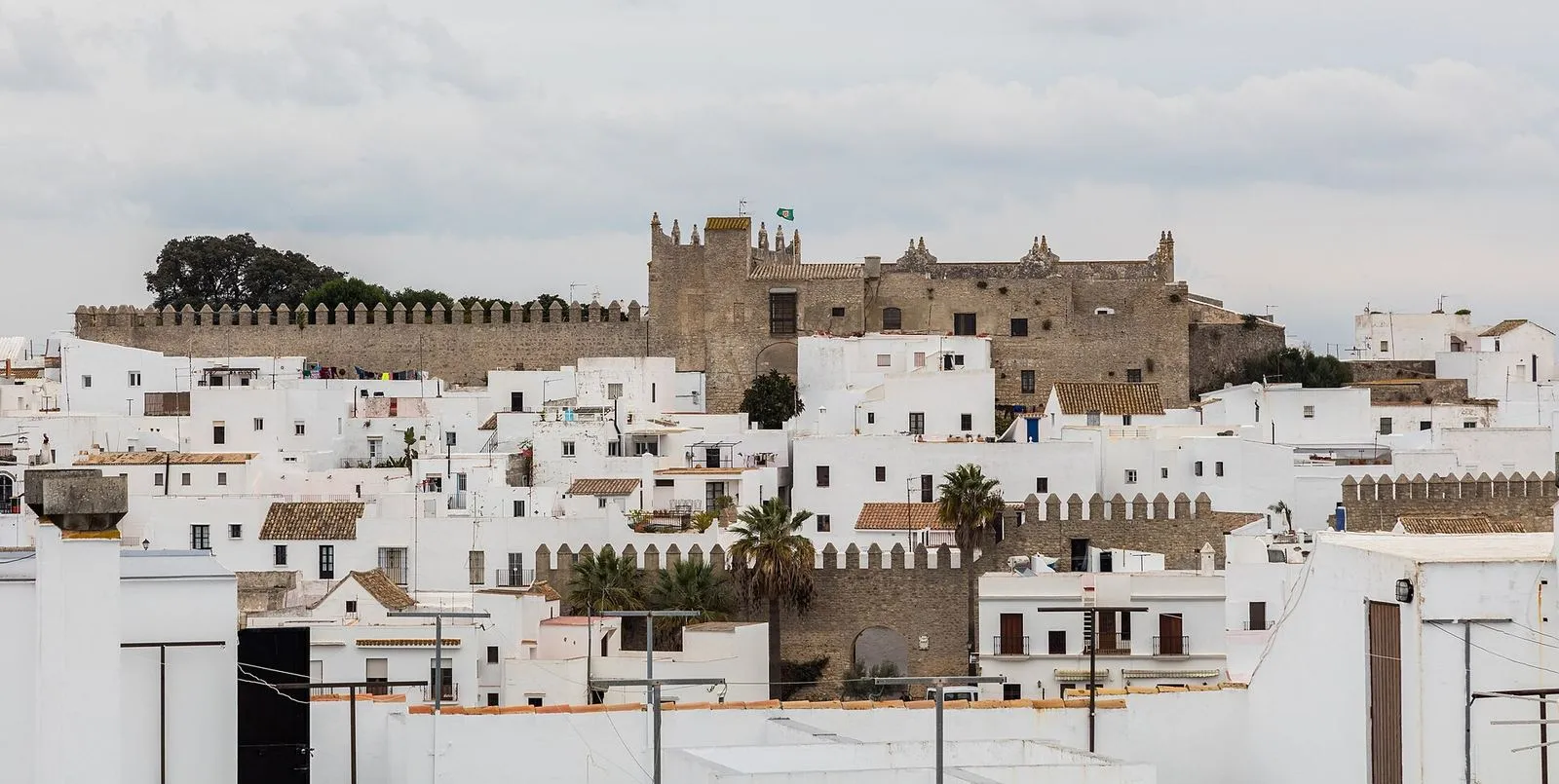
Vejer de la Frontera is a white town on a hill above the Costa de la Luz, in the south of Cádiz province. Its old town, largely inside 15th-century walls, is a tangle of whitewashed lanes and arches, often called the most beautiful of Andalusia’s white villages. The beaches of El Palmar, Los Caños de Meca, Conil and Zahara de los Atunes are all within about half an hour.
- Is it worth it? We think so: a beautiful hill town, a strong food scene and superb beaches below.
- Time needed: half a day for the old town and lunch. Two or three nights if you use it as a base for the coast.
- Day trip or base? Both work. It is an easy day trip from Cádiz or Tarifa, and a quieter, prettier base than the beach towns.
- Do you need a car? Not for the town itself, but yes for the beaches. There is no train, and the buses mostly stop at the foot of the hill.
What to see in the old town
The old town is less than a kilometre across. We’d start at La Plazuela, where the old and new towns meet, and walk up.
The walls and the Arco de la Segur
Four of the gates in the walls survive: the Arco de la Villa on the east side, which opens onto Plaza de España; the Arco de Sancho IV on the north side; the Arco de Puerta Cerrada; and the Arco de la Segur on the west side, built at the end of the 15th century. Its name is usually linked to a carved relief resembling an axe (segur), an old symbol of judicial power.
The Arco de las Monjas
Vejer’s best-known lane runs beside the Convento de las Concepcionistas, founded in the 16th century. A row of arched buttresses spans the street, added after 18th-century earthquakes to hold up the convent wall.
Iglesia del Divino Salvador
The parish church stands at the top of the old town, on the site of the mosque: its bell tower rises on the old minaret. Inside, a 14th-century Gothic-Mudéjar chancel was extended in late Gothic style around 1500.
The castle
Near the church, the castle dates back to the 10th and 11th centuries, with a Moorish horseshoe doorway, a courtyard with a cistern and battlements looking over the rooftops. Opening has been irregular, so ask at the tourist office first.
Plaza de España
Just outside the Arco de la Villa, the main square is lined with palm trees, the town hall and café terraces. At its centre is a fountain decorated with Seville tiles, built in 1957; locals call it the Plaza de los Pescaítos, the square of the little fish. We think it is the best place in town for a drink.
The cobijada
The cobijada was Vejer’s traditional women’s dress: a black cloak and skirt worn so that the cloak covered the face except for one eye. Of Castilian origin, it disappeared in the 1930s; accounts differ on whether a ban or post-war poverty ended it. It was revived in 1976, and every August a Cobijada Mayor is chosen for the patron saint’s festivities. A statue of a cobijada stands near the old Jewish quarter.
Viewpoints
- The Corredera, the walkway along the southern edge of the old town, with wide country views.
- Parque Nelson Mandela, in the San Miguel district, for the old town skyline, near the restored windmills.
- Avenida Buenavista, looking towards El Palmar and Conil: the classic sunset spot.
Sights at a glance
| Sight | Price | Time |
|---|---|---|
| Walls and the four gates | free | 1 hour on foot |
| Arco de las Monjas | free | 10 minutes |
| Plaza de España | free | as long as your drink lasts |
| Iglesia del Divino Salvador | free (check hours) | 20 minutes |
| Castle | check at the tourist office | 20 minutes |
| Museo de Historia y Arqueología (18th-century palace, 13 rooms) | about €4 | 45 minutes |
| Mercado de San Francisco | free entry | lunch |
| Viewpoints and windmills | free | 30–60 minutes |
Where to eat
Vejer eats very well for a small town: almadraba bluefin tuna from the nearby coast and retinto beef from the La Janda plain. Many places close for part of the winter, so check ahead from November to February.
- El Jardín del Califa (Plaza de España): the town’s best-known restaurant, with Moroccan and Andalusian cooking in a garden patio. We’d book in summer.
- Casa Varo: tuna in many forms, in the old town.
- Mercado de San Francisco: the old food market, turned into a tapas hall in 2013, with stalls for sushi made with local tuna, cured meats and fried fish. We’d go for a casual lunch.
- La Castillería: a grill in the countryside at Santa Lucía, a few kilometres out, known for aged retinto beef. It opens from March to October and books up well ahead.
The beaches below Vejer
Vejer sits about 10 km inland, and the coast below it is wide, sandy and mostly undeveloped.
- El Palmar: a long, straight beach 15–20 minutes away, the area’s best-known surf spot, with surf schools and beach bars.
- Los Caños de Meca: past El Palmar, by the Cabo de Trafalgar lighthouse, with a laid-back village and a more sheltered bay.
- Conil de la Frontera: a lively beach town about 15–20 minutes north-west, with long beaches and small coves under the cliffs. See our Conil guide.
- Zahara de los Atunes: a fishing village with a huge beach and tuna restaurants, about half an hour south-east. See our Zahara de los Atunes guide.
The Levante wind
The Levante is a hot, dry easterly wind funnelled through the Strait of Gibraltar. It can blow hard for days at a time, in any season, whipping up sand on the open beaches. El Palmar is badly exposed; the bay at Los Caños de Meca and Conil’s cliff-sheltered coves are better. Or we’d spend the day in Vejer’s lanes and go down for sunset.
Getting to Vejer de la Frontera
| From | Car | Bus |
|---|---|---|
| Cádiz | about 45–50 minutes | Comes, several a day, about 1 hour |
| Seville | about 1 h 45–2 h | Comes, a few a day |
| Tarifa | about 45 minutes | Comes, several a day via the N-340 |
| Jerez | about 1 hour | a few a day |
- By car: the easy option, via the A-48 from Cádiz and Seville or the N-340 from Tarifa. Hire a car at Seville airport or anywhere in Andalusia; our car hire guide covers insurance and tolls.
- By bus: Transportes Generales Comes runs buses from Cádiz, from Seville (Plaza de Armas bus station), from Algeciras and Tarifa, and a couple a day from Málaga. Most stop at La Barca de Vejer, on the main road at the foot of the hill, about 1.5 km and a steep 20-minute walk from the old town; a taxi or the local bus covers the climb. Some services stop in town near the tourist office. Compare times: Seville to Vejer by bus.
- By train: there is no station. The nearest are in Cádiz and San Fernando. Algeciras has no trains until about autumn 2027, while its line is closed for works.
From Seville with a car, Vejer extends our Cádiz day trip from Seville.
Parking
The lanes of the old town are for residents only, and most are too steep and narrow to drive anyway. We’d park outside and walk:
- Los Remedios: a large free car park at the main entrance to the town, by the Parque de Los Remedios, a few minutes’ walk from La Plazuela.
- Parking La Corredera: a paid underground car park on the edge of the old town, with a lift.
- Smaller free car parks and street parking are spread around the new town.
In summer, the car parks near the centre fill by around midday, so arrive in the morning.
Where to stay in Vejer
- La Casa del Califa: a boutique hotel on Plaza de España, set in a maze of old houses, with El Jardín del Califa downstairs.
- Hotel V: a twelve-room boutique hotel in a restored 16th-century house in the old town, with a rooftop hot tub.
- Hotel Convento de San Francisco: a former Franciscan convent on La Plazuela, simple and central.
- Las Palmeras del Califa: from the Califa group, with a pool and views, in the old town.
- More options: hotels in Vejer de la Frontera.
For a city base instead, see where to stay in Cádiz.
When to go
We think May, June, September and October are best: beach weather, fewer people, easier parking. July and August are hot, busy and expensive, with the Velada fair from 10 to 24 August. Winter is mild and quiet, but some restaurants and beach bars close.
Combine Vejer with
Cádiz (45–50 minutes), Tarifa and Bolonia (about 45 minutes), Jerez for sherry (about an hour) and Arcos de la Frontera, the other great white town of Cádiz province. Vejer fits naturally into our Andalusia road trip.
FAQ
How long do you need in Vejer de la Frontera?
Half a day covers the old town and lunch. Stay two or three nights to use it as a base for the beaches.
Can you visit Vejer without a car?
Yes, by Comes bus from Cádiz, Seville or Tarifa, but most buses stop at La Barca de Vejer, a steep 20-minute walk below the town. The beaches are hard to reach without a car.
Does Vejer de la Frontera have a beach?
The town itself is inland, on a hill. Its nearest beach is El Palmar, which belongs to the municipality of Vejer, about 15–20 minutes away by car.
Is Vejer better than Conil as a base?
In our view Vejer is prettier and quieter; Conil is on the beach and livelier. Without a car, Conil is easier.