
Some links on this page are affiliate links. If you book through them we may earn a commission, at no extra cost to you.
The short answer
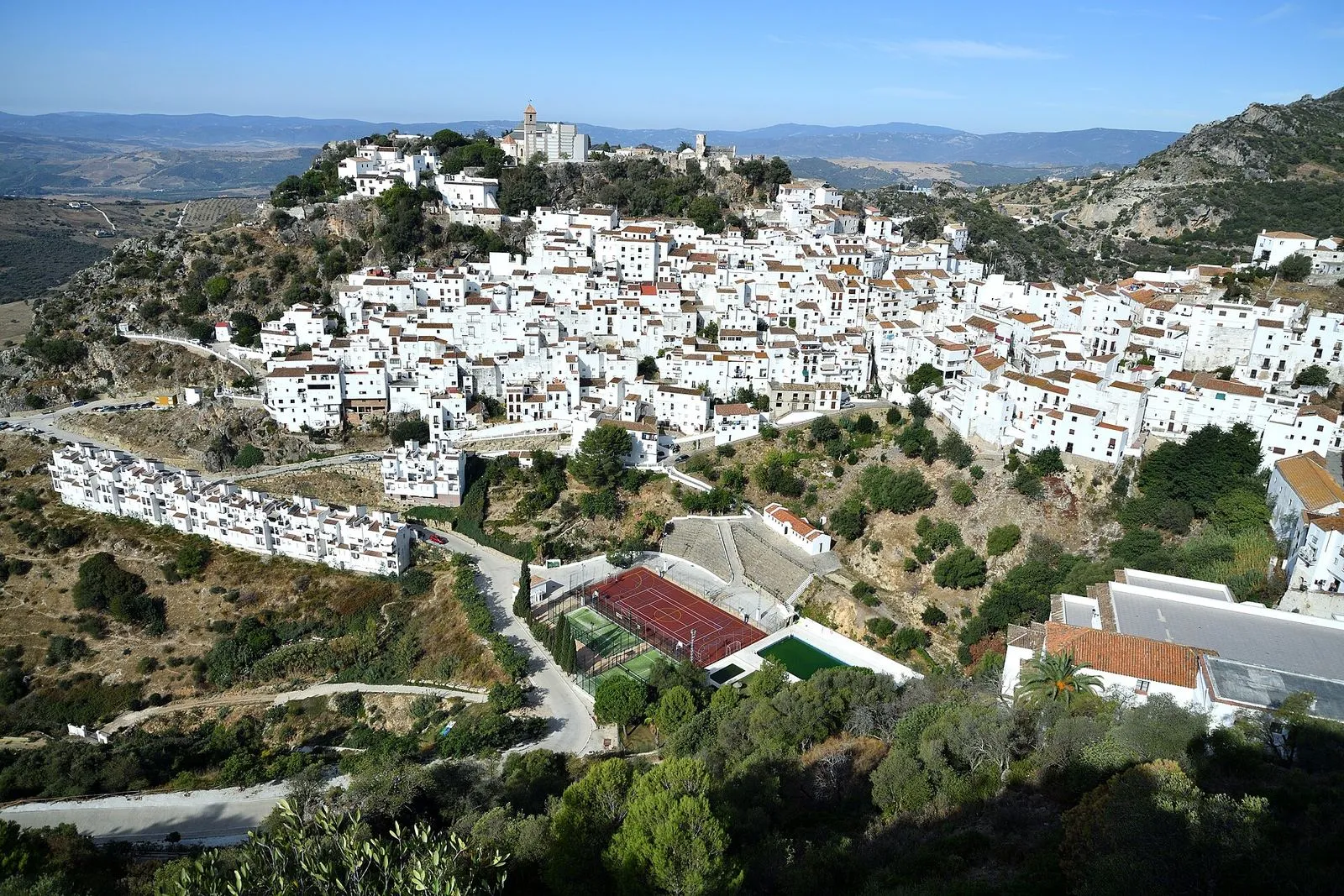
Casares is a white village built on a steep rocky hill about 20 km inland from Estepona, in the west of Málaga province. Its houses are stacked down the slope below a ruined Moorish castle, and from the road it looks like a single white cascade. The old town is a protected historic-artistic site, and it is one of the most photographed white villages of Andalusia.
- Is it worth it? We think so, if you like views and quiet lanes. It is small and much less crowded than Mijas or Frigiliana.
- Time needed: 2–3 hours for the village and the castle. Half a day if you add the Roman baths.
- Cost: the castle and the Blas Infante house are free. The Roman baths are free but need a booking in summer.
- Getting there: about 25–30 minutes by car from Estepona, 40–50 minutes from Marbella and about 1 hour 15 minutes from Málaga. Public transport is very limited, so a car helps.
What to see in Casares
The village is a few steep streets, a main square and a castle on top. You can see all of it on foot in a morning.
The old town and Plaza de España
Park outside (see below) and walk down into the centre. The lanes follow the Moorish layout: narrow, twisting, stepped, with whitewashed walls, wrought-iron balconies and pots of flowers. The main square, Plaza de España, has a fountain, cafés and the town hall. A Friday market is held near Calle Copera in the morning.
The castle
The castle crowns the village on a rocky outcrop at about 427 m. The first written mention of the fortress comes from the 14th century, when Casares belonged to the Nasrid kingdom of Granada, and in 1361 a treaty between Peter I of Castile and the deposed Muhammad V of Granada was signed here. The town surrendered to the Castilian crown in 1485, after the fall of Ronda. Much of what you see of the walls today dates from the Peninsular War, when Spanish troops fortified the hill in the early 19th century.
Inside the walls are the former church of the Encarnación (built in the 16th century, probably over a mosque, and now a cultural centre), a small hermitage and the village cemetery. The climb from Plaza de España takes about 10–15 minutes, steeply, on signed paths and steps. The ruins are open to walk around, and we think the views are the real reward: the white village below, the Serranía de Ronda behind and, on a clear day, the sea, Gibraltar and the coast of Morocco.
Blas Infante’s birthplace
Blas Infante (1885–1936), often called the father of the Andalusian homeland, was born in Casares. He was a lawyer, writer and politician who designed the Andalusian flag and wrote the words of its anthem, and he was shot at the start of the Civil War. The Casa Natal de Blas Infante, on Calle Carrera, is a small museum on his life and on Andalusian identity, with rooms from the original house, his birth certificate and a short film. It is free and doubles as the tourist office. We think it is worth 20–30 minutes; it closes in the afternoon at weekends, so plan around it.
The viewpoints
We think the best picture of the whole village is from the Mirador de Casares, on the approach road, where there is room to stop. We’d go in the late afternoon, when the sun lights the white walls. Inside the village, the castle and the paths around it give the high views.
The Roman baths (Baños de la Hedionda)
In the valley below Casares, on the road towards Manilva, a sulphur spring rises in a domed bathhouse. The name Hedionda means “stinking”, after the smell of the water. Legend says Julius Caesar came here to cure a skin complaint and ordered the town founded. The building you see dates mostly from the 17th century, though local sources link it to older Roman use, and the water is sulphurous.
The baths are free, but in the high season the council limits numbers to protect the dome. In 2026 the season ran from 20 June to 6 September, with a small group admitted each hour on a free booking made online (up to two places per person). Outside the season, bookings have not been required in the past, but the rules change from year to year: check the Casares tourism site before you go. We’d bring water shoes and a towel, and expect a rough track on the last stretch.
Casares Costa: the beach area
The municipality also reaches the sea, about 15 km south of the village, an area known as Casares Costa. It is a stretch of urbanisations, golf courses and two or three beaches, not a village of its own.
- Playa Ancha: the main family beach, with services and a Blue Flag in recent years.
- Playa de la Sal: a quieter, partly rocky cove of about 300 m next to the 16th-century Torre de la Sal, a watchtower from the days of the pirates.
- Playa Piedra Paloma: a rocky stretch used for snorkelling.
You do not need Casares Costa for the village, but it makes sense to combine the two with a car: the hills in the morning, the sea in the afternoon.
Tips for your visit
- We’d wear proper shoes. The lanes are steep, uneven and often polished smooth. The climb is hard with a pushchair or reduced mobility.
- We’d go early or late. Tour groups stop in the middle of the day. In summer the heat is the problem: there is almost no shade on the castle hill.
- Eat on the square or on the approach road. Plaza de España has terraces, and a few restaurants on the road in grill local meat. We’d book at weekends.
- Check the weather. Wind can be strong on the hilltop, and the castle views need clear skies.
Getting there and parking
| From | Car | Public transport |
|---|---|---|
| Estepona | about 25–30 min (23 km) | local bus L-77, a few a day, not daily |
| Marbella | about 40–50 min | via Estepona |
| Málaga | about 1 h 15 | bus to Estepona, then the local bus |
- By car: take the A-7 or AP-7 to the Estepona area and turn inland on the MA-8300. The streets inside the village are very narrow, so park outside. There is free parking along the road into the village and a larger car park at the visitor reception centre on the main street; both fill on weekends. From the car, you walk down to the main square on steep paths. Car hire at Málaga airport is the simplest way to reach it, and our Málaga airport car hire guide explains how to avoid the usual traps.
- By bus: Avanza runs the L-77 from Estepona to Casares, but only a few times a day, with an early outward trip and a late return, so a day trip by bus is awkward. Check the timetable before you plan on it.
- By tour: Some tours of the white villages from the coast stop in Casares. Search Casares white-village day trips from the coast and see our day trips from Málaga.
Combine it with
- Estepona: the flower-filled old town and a long beach, 25–30 minutes away. See the Estepona guide.
- Gaucín: another white village in the Genal valley, about 30–40 minutes inland by road, below a castle with views to Gibraltar.
- Manilva: a village on the coast road to the east of Casares, near the sulphur baths, with a harbour and beaches at Sabinillas.
- Ronda and Setenil: Casares fits on a route from the coast to Ronda and Setenil de las Bodegas.
- The rest of the coast: see the Costa del Sol guide.
Where to stay
Most visitors come for the day from the coast, but a night in the village is quiet and we think the sunset is worth the climb. Casares has a small number of rural hotels and guesthouses, and there are many more places on the coast.
- In the village and nearby: hotels and guesthouses in Casares, mostly small and with views. A car is useful.
- On the coast: hotels in the old town of Estepona, 25–30 minutes away, with restaurants and a beach.
FAQ
Is Casares worth visiting?
Yes. We think it is one of the most scenic white villages in Málaga province, with a castle, a historic old town and wide views, and it is a good half-day trip from the Costa del Sol.
How long do you need in Casares?
Two to three hours for the old town, the castle and the Blas Infante house. Allow half a day if you also visit the Roman baths or have lunch.
Is it free to enter the castle at Casares?
The castle ruins have been free to walk around, but some older sources mention a small charge and limited opening days, so check the village tourist office before you go.
Can you visit Casares without a car?
You can, but it is slow. A local bus runs from Estepona only a few times a day, so most visitors rent a car or join a tour. A taxi from Estepona is another option.
Can you swim in the Baños de la Hedionda?
The baths are a heritage site with a warm sulphur spring, and visits are free. In high season you must book a time slot online and numbers are limited, so rules on bathing and what to wear are best checked with the tourism office.