
Some links on this page are affiliate links. If you book through them we may earn a commission, at no extra cost to you.
The short answer
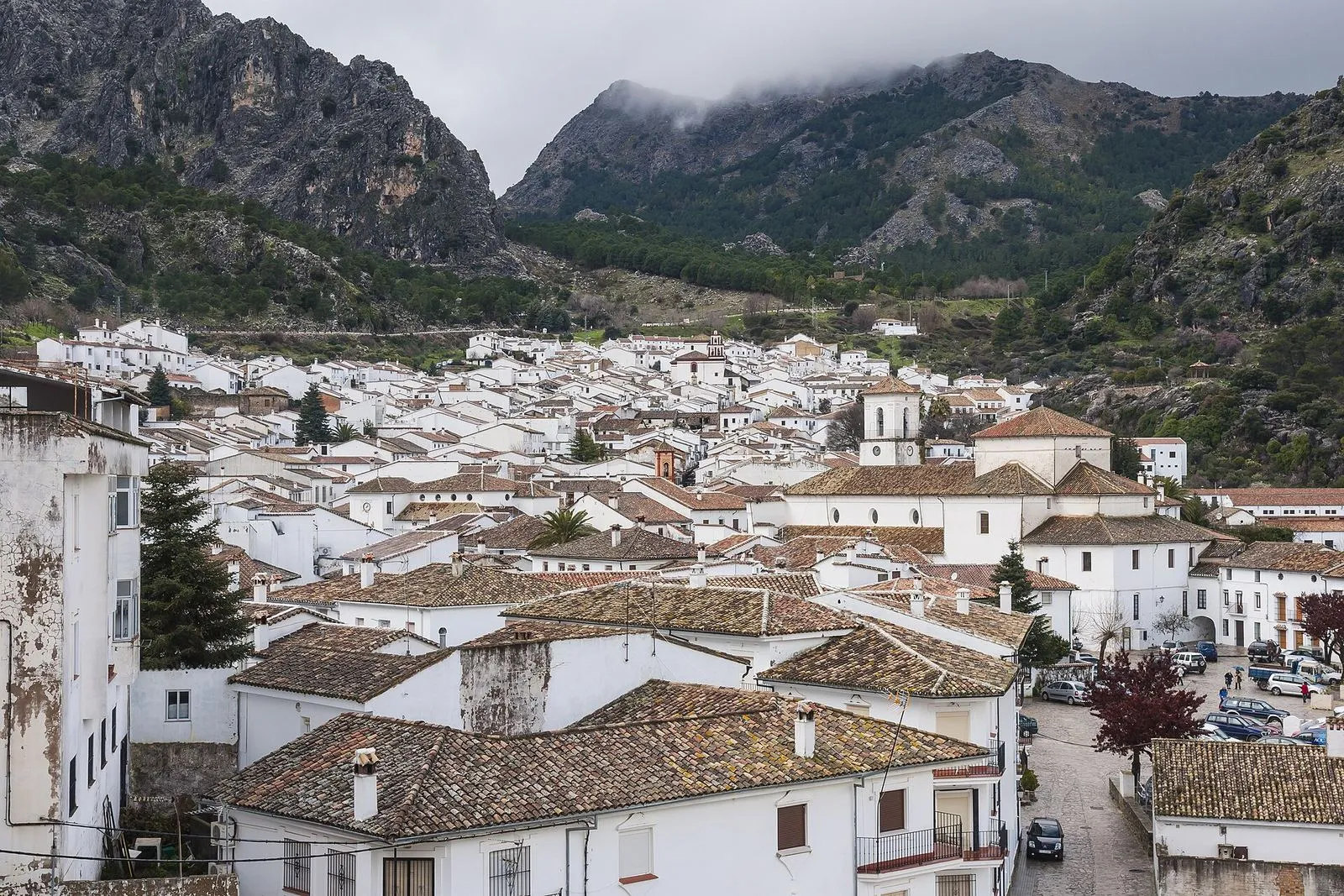
Grazalema is a white village of about 2,000 people at around 800 metres, tucked under the limestone wall of the Peñón Grande in the north-east of Cádiz province. It is the capital, in all but name, of the Sierra de Grazalema Natural Park, the greenest mountains in southern Spain and one of the best walking areas in Andalusia.
- Is it worth it? We think so, especially if you like walking. The village itself is small and pretty; the mountains around it are the real draw.
- Time needed: two or three hours for the village. A night or two if you want to hike, drive the Puerto de las Palomas to Zahara de la Sierra or visit the cheese village of Villaluenga.
- Getting there: about 40–45 minutes by car from Ronda, about 1 h 45 from Seville and about 2 hours from Málaga. We think a car makes everything much easier.
- Before you hike: four of the park’s best trails (El Pinsapar, Garganta Verde, El Torreón and Llanos del Rabel) need a free permit, and from 1 June to 15 October they are closed or limited because of fire risk.
In early February 2026, record rainfall flooded the village and the whole population was evacuated for several days, and several mountain roads and trails closed afterwards. The village has reopened and the road over the Puerto de las Palomas reopened at the end of June 2026, but we’d check trail status with the park before you go.
What to see in the village
Grazalema is compact: an hour’s stroll covers the centre. We’d park at the entrance and walk.
Plaza de España and the Iglesia de la Aurora
The small main square is the heart of the village, with café terraces, the town hall and a stone fountain. On one side stands the Iglesia de Nuestra Señora de la Aurora, built between 1769 and 1800 with money from the town’s textile boom. Its sober limestone front hides a Baroque and Neoclassical interior under an octagonal tiled dome. Two more churches are worth a look nearby: the Encarnación, rebuilt in the early 17th century on an older Mudéjar church, and San José.
Los Asomaderos and the Peñón Grande
Walk to the edge of the village for the Mirador de los Asomaderos, a balcony over the Guadalete valley, with the old stone mule track below and the Serranía de Ronda on the horizon. Above the village rises the Peñón Grande, the rock face that makes Grazalema’s skyline; a well-used circular trail of about 12 km climbs round it without a permit.
The Mantas de Grazalema blanket workshop
Grazalema was a wool town: in the 18th and 19th centuries thousands of its people worked in weaving. One family business keeps the tradition going. The blanket workshop at the entrance to the village (Calle Ronda, by the petrol station) was founded in 1908 and moved to its present site in the 1940s. Its small textile museum of 19th-century carding machines, looms and fulling mills is free and takes about 15 minutes; it usually opens on weekday mornings only. The shop sells the famous wool blankets and throws.
Lanes, fountains and the lavadero
The rest of Grazalema is about the walk: steep lanes of whitewashed houses with iron grilles, flowers and stone fountains fed by mountain springs. Look for the old public lavadero, the communal washing place, down a flight of steps in the lower village.
The Sierra de Grazalema Natural Park
The park covers about 53,400 hectares across 14 municipalities in Cádiz and Málaga provinces. It was declared a UNESCO biosphere reserve in 1977, among the first in Spain, and a natural park in 1985.
The rainiest place in Spain?
Grazalema is often called the rainiest place in Spain. The town puts its average at about 2,200 mm a year; other sources give 1,900–2,000 mm, still around three times the Spanish average. Moist Atlantic air hits the first high mountains inland and dumps its rain here. That is why the hills are so green, and why a wet winter can close roads and paths.
The pinsapo fir forest
The park’s treasure is the pinsapar, a forest of pinsapo, the Spanish fir, a relic of the Ice Age that survives in only three places: here on the north slopes of the Sierra del Pinar, in the Sierra de las Nieves and in the Sierra Bermeja.
Trails that need a permit
| Trail | Length and level | 1 June–15 October |
|---|---|---|
| El Pinsapar (near Grazalema to Benamahoma) | about 10.5 km one way, 4 h 30, medium | only with a licensed guiding company |
| Garganta Verde (near Zahara) | about 2.5 km, steep; a deep gorge with a huge griffon vulture colony, ending at the Cueva de la Ermita | only to the first viewpoint (or a full canyoning descent) |
| El Torreón (from the A-372) | about 3 km one way, 800 m climb, hard; the highest peak in Cádiz province, about 1,650 m | closed |
| Llanos del Rabel | a high plateau walk towards the fir forest | only the plateau |
Permits are free. Apply on the Junta de Andalucía’s online system (cupos-ciudadano, in Spanish), by email or by phone to the park’s El Bosque visitor centre (956 70 97 33). You need the names, ID or passport numbers, the date and the number of people. Daily numbers are limited and weekends fill up, so we’d apply as early as you can, and have a back-up date. Dogs are not allowed on these trails.
Plenty of good walks need no permit, including the Peñón Grande circuit and the path down the Majaceite river from El Bosque to Benamahoma. In summer, the easiest way onto the restricted trails is a guided hike in the Sierra de Grazalema with a local company.
The Puerto de las Palomas drive to Zahara de la Sierra
The CA-9104 north from Grazalema climbs to the Puerto de las Palomas, a pass at about 1,350 m with views over three provinces, then drops in tight hairpins to Zahara de la Sierra. It is about 30 minutes of slow, spectacular driving; the Garganta Verde trailhead is on the way down.
Zahara is one of the most photographed white villages: houses stacked on a rock under a Nasrid castle tower, above the turquoise Zahara–El Gastor reservoir. The climb to the tower takes about an hour there and back, with views over the lake to Olvera and Algodonales. From Zahara, the road continues to Olvera, Setenil de las Bodegas and Ronda. See our Zahara de la Sierra guide.
Other villages nearby
- Villaluenga del Rosario (about 15 minutes south): a tiny stone-and-white village known for payoyo cheese, made from the milk of the local Payoya goat. It has a cheese museum, and hosts an artisan cheese fair each year.
- Benaocaz (about 20–25 minutes): a quiet village on an old Roman road, the calzada romana, that walkers follow down to Ubrique.
- El Bosque and Benamahoma (about 25 minutes west): trout streams, the park’s visitor centre and the end of the Pinsapar trail.
- Ubrique (about 30 minutes): a working town famous for its leather goods, made here for luxury brands; its shops sell bags and belts at workshop prices.
- Arcos de la Frontera (about 1 hour west), where the white villages route begins.
Food
Mountain food: lamb and goat, game in season, cured sausages and hams, and cheeses from local goats and Merino sheep. We’d try the sopa de Grazalema, a broth with bread, egg, chorizo and mint, and buy payoyo cheese to take home. Sweets include amarguillos, small almond biscuits. Mesón El Simancón and Restaurante El Torreón are two long-standing places for traditional cooking in the village.
When to go
- Spring (March to May) is, in our view, best: green hills, flowers, full streams and every trail open with a permit.
- Autumn (mid-October to November) is also good, once the fire-season limits end.
- Summer is pleasant in the village, cooler than Seville, but the restricted trails are closed or guided only. The big event is the Lunes del Toro, on the Monday after 16 July (19 July in 2027), when bulls held on ropes run through the streets.
- Winter can be cold, foggy and very wet, with occasional snow. Roads may close after storms.
Getting to Grazalema
| From | Car | Bus |
|---|---|---|
| Ronda | about 40–45 minutes (A-374 and A-372) | Damas, a few a day, about 45 minutes |
| Seville | about 1 h 45 | no direct bus; change in Ronda or El Bosque |
| Málaga | about 2 hours, via Ronda | change in Ronda |
| Arcos / Jerez | about 1 h / 1 h 30 on the A-372 | limited |
- By car: we strongly recommend it. Hire at Málaga airport, Seville airport or Jerez airport; see our car hire guide. Mountain roads are narrow and winding, so allow more time than the sat-nav says. Park in the car parks at the entrance to the village.
- By bus: Damas runs a few buses a day between Ronda and Grazalema, and some to El Bosque and Ubrique. There is no railway station; trains through Ronda are replaced by buses until about autumn 2027.
- On a tour: white-villages tours from Ronda and Seville often stop in Zahara, and sometimes Grazalema; check the itinerary. See also our Ronda day trip from Seville.
Where to stay
- Hotel Fuerte Grazalema: a four-star hotel a few kilometres outside the village on the Ronda road, with mountain views, a pool and a spa area. Rated 9.0 on Booking.
- Villa Turística de Grazalema: rooms and apartments with balconies and a pool, about 10 minutes’ walk from the centre. Rated 8.8.
- Tambor del Llano: a small rural hotel on a 32-hectare estate about 4 km from the village, for peace and walks from the door. Rated 9.2.
- More options: hotels and houses in Grazalema, or base yourself in Ronda and drive over for the day.
Grazalema fits well into a white villages loop or an Andalusia road trip, with a sherry stop in Jerez or a night by the sea in Cádiz.
FAQ
Is Grazalema worth visiting?
Yes, we think, for the setting more than the sights. The village is pretty and quiet, and the natural park around it has some of the best walking and mountain driving in Andalusia.
Do you need a permit to hike in the Sierra de Grazalema?
Only for four trails: El Pinsapar, Garganta Verde, El Torreón and Llanos del Rabel. Permits are free from the El Bosque visitor centre or online; most other paths need none.
Can you hike El Pinsapar in summer?
From 1 June to 15 October, only with a licensed guiding company, because of fire risk. The rest of the year you can walk it yourself with a free permit.
How far is Grazalema from Ronda?
About 33 km, or 40–45 minutes by car. Damas runs a few buses a day, taking around 45 minutes.
Is Grazalema or Zahara de la Sierra better?
We’d say Zahara is more photogenic, with its castle and lake, and Grazalema is the better base for walking and has more places to stay and eat. With a car, see both in a day over the Puerto de las Palomas.