
Some links on this page are affiliate links. If you book through them we may earn a commission, at no extra cost to you.
The short answer
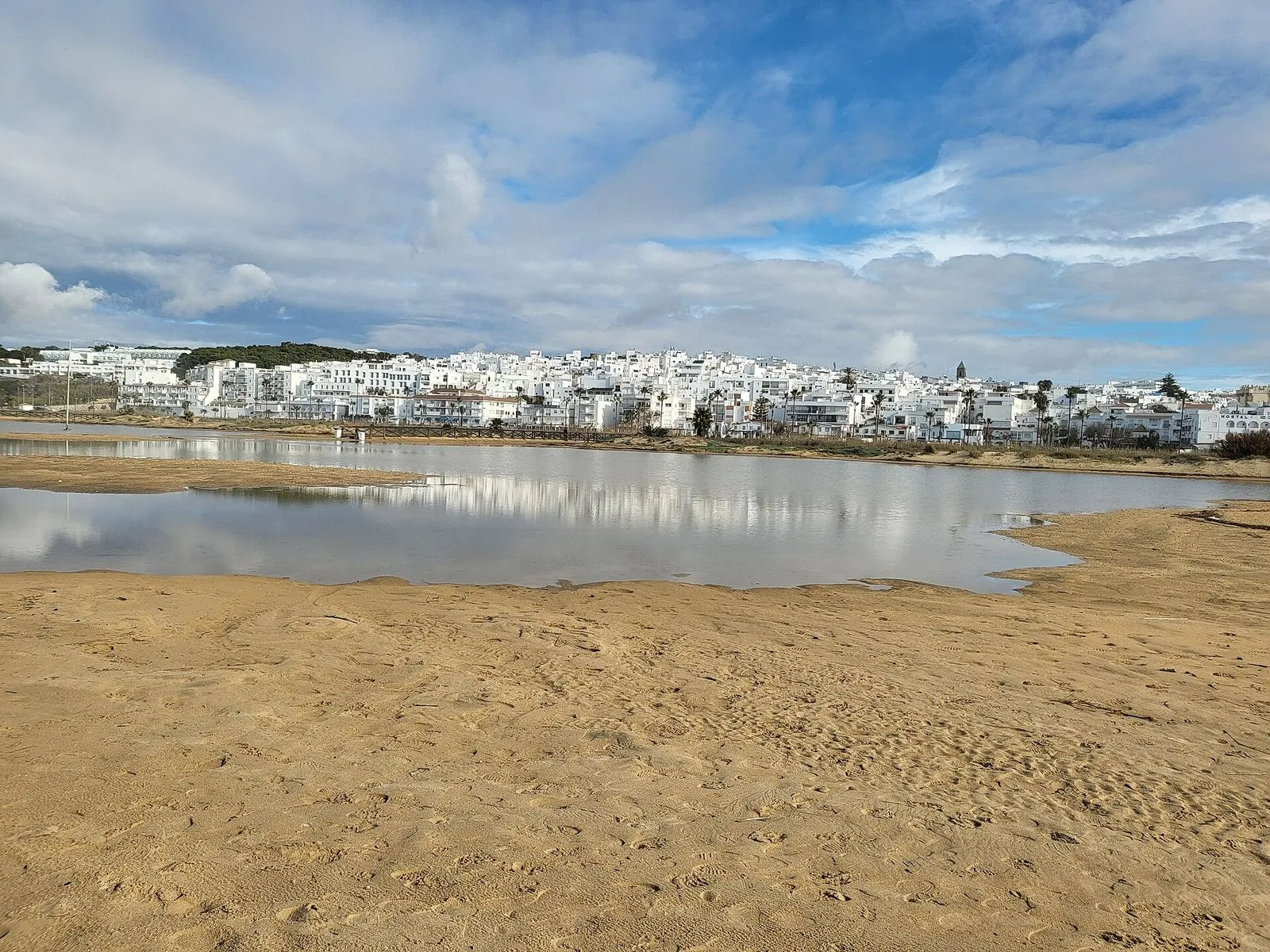
Conil de la Frontera is a white fishing town on the Costa de la Luz, in the province of Cádiz, about 40 minutes south of Cádiz city. It has a compact old town on a low hill and around 14 km of coast below it, from wide sandy beaches to small coves under ochre cliffs. It is also one of the four towns on this coast that still fish bluefin tuna with the ancient almadraba nets.
- Who it suits: families, beach lovers and anyone who wants a real Spanish town by the sea.
- Compared with its neighbours: livelier and bigger than Zahara de los Atunes, less windy and less of a kite scene than Tarifa, and much less built up than the Costa del Sol, though the sea is cooler.
- Time needed: a day for the old town and a beach; three days to a week as a beach base.
- Car needed? Not for the town and its main beaches. For the coves and day trips, it helps.
Conil has been a favourite with German visitors since the 1980s. In July and August it is also full of Spanish families.
The beaches of Conil
Conil faces west over the Atlantic. The beaches by the town are long and sandy; further north the coast turns into cliffs and small coves (calas).
| Beach | Type | Best for |
|---|---|---|
| Los Bateles | Urban beach below the old town, promenade | Families, everything on foot |
| La Fontanilla | Wide sandy beach north of the centre, beach restaurants | Families, lunch by the sea |
| Fuente del Gallo | Sand below cliffs, small at high tide | A short walk from town, windsurfing |
| Cala del Aceite | Large cove below red cliffs, near the port | Poniente days, swimming |
| Calas de Roche | Small coves below cliffs and pines, steps down | Levante days, quiet, naturists |
| Playa de Roche | Longer beach by the Roche estate | Space, services |
| Castilnovo | Undeveloped beach between Conil and El Palmar | Long walks, nature, naturists |
| El Palmar (Vejer) | Long open beach about 10 km south | Surfing, sunsets |
Los Bateles and La Fontanilla
Los Bateles is the town beach, about 1.4 km of fine sand below the old town, with a promenade, lifeguards and a Blue Flag. To the north it runs into La Fontanilla, the family favourite, with fish restaurants at the back. Both are a short walk from anywhere in town.
The calas: Cala del Aceite and the calas of Roche
North of the town, the coast becomes a line of coves under red and ochre cliffs backed by pines. Cala del Aceite, one of the largest, is about 250 metres of sand with lifeguards in summer and a car park. Further north, the calas of Roche (Cala Encendida, El Pato, El Frailecillo and others) are smaller and wilder, reached by steps down the cliff, with few or no services. We’d check the tide: some almost disappear at high tide. You need a car, a bike or a long walk to reach them.
Castilnovo and El Palmar
South of Los Bateles, over the Río Salado footbridge, Castilnovo is more than 2 km of undeveloped beach below an old watchtower, with no services and strong waves on windy days. It runs on to El Palmar, about 10 km from Conil and part of Vejer: a long beach with no buildings on the seafront, known for its sunsets and surf.
The wind and surfing
Conil lives by two winds. The levante, from the east, is hot, dry and often strong, can last several days and whips up the sand on the open beaches: we’d head for the calas of Roche, sheltered by the cliffs. The poniente, from the west, is cooler and gentler, a good day for Cala del Aceite and the long beaches.
For surfing, we’d go to El Palmar, one of the best-known surf beaches in Andalusia, with several schools on the beach. The biggest waves come from autumn to spring; summer is smaller and better for beginners. Surf lessons at El Palmar.
The old town
The old town is small and white, easy to see in an hour or two, and liveliest on summer evenings.
- Torre de Guzmán: the square tower that the town grew around, built around 1300 by Alonso Pérez de Guzmán, “Guzmán el Bueno”, to watch over the coast and the tuna grounds. We’d climb to the top for views over the rooftops and the sea. Entry is free, but it opens only on some days.
- Arco de la Villa (Puerta de la Villa): the only one of the four gates of the town walls still standing, built in 1502. It was once called the Puerta de Vejer, because the road to Vejer started here.
- Plaza de España: by the gate, the pedestrian square at the heart of town, ringed by terraces.
- La Chanca: the tuna-salting complex built by the Dukes of Medina Sidonia in the 16th century, now a free interpretation centre on the almadraba and tuna.
The almadraba and the tuna season
The almadraba is a maze of nets anchored a few kilometres offshore that traps bluefin tuna as they swim towards the Mediterranean to spawn. Conil, Barbate, Zahara and Tarifa still use it. In Conil, fishing usually runs from late April to June.
The best time to taste it is the Ruta del Atún, the town’s tuna route: in 2026 it ran from 8 May to 8 June, with around thirty bars and restaurants serving tuna dishes and tapas, a cooking contest, and a public ronqueo, the carving of a whole tuna, in the Plaza de España.
Food
Beyond tuna, Conil eats fried fish, seafood and vegetables from the market gardens (huertas) around town. The town hall also runs the Ruta de la Huerta in April and the Ruta del Retinto, built around the local beef, in late October. For tapas, we’d try the terraces around the Plaza de España.
Day trips from Conil
- Vejer de la Frontera: one of the most beautiful of the white villages, about 20 minutes inland by car. See our Vejer guide.
- Zahara de los Atunes: a smaller beach village and another almadraba town, about 40 minutes south. See our Zahara guide.
- Cádiz: the old city surrounded by the sea, about 40–45 minutes by car or an hour by bus. See our Cádiz guide.
- Jerez de la Frontera: sherry bodegas and horses, about an hour by car. See our Jerez guide.
Getting to Conil
There is no train to Conil. The bus station is on Avenida Cañada Honda, a short walk from the old town.
| From | Car | Bus |
|---|---|---|
| Cádiz | about 40–45 min | about 1 h, several a day (Comes) |
| Jerez airport | about 50 min | no direct bus |
| Seville | about 1 h 40 | about 2 h–2 h 30, a few a day (Comes) |
| Málaga | about 2 h 45 | slow and infrequent; driving is far easier |
- By car: we think it is the easiest way, and the best for the coves, El Palmar and day trips. Pick up a car at Jerez airport, Seville airport or Málaga airport, and read our car hire guide. In summer, parking near the old town is hard; we’d use the car parks on the edge of the centre.
- By bus: Transportes Generales Comes runs buses from Cádiz and Seville (Prado de San Sebastián station), with fewer on weekends and more in summer. Compare times: Seville to Conil by bus.
From Seville, Conil is a long day trip; the Cádiz day trip from Seville is easier, and we think Conil is better for a night or more.
Where to stay in Conil
We’d stay in or near the old town to walk everywhere, or on La Fontanilla for resort hotels by the sand. For more options across the province, see where to stay in Cádiz.
- Hotel Almadraba Conil: a small hotel in an 18th-century house with two Andalusian patios, in the old town near the Torre de Guzmán, about 250 m from Los Bateles.
- Casa Alborada: a guesthouse in the old town with a traditional patio and a roof terrace with sea views.
- Hotel Diufain: a family-run three-star hotel with rooms and one-bedroom apartments with kitchens, a pool and gardens, on the road towards Fuente del Gallo.
- Hotel Fuerte Conil-Resort: a large four-star resort right on La Fontanilla, about 10 minutes’ walk from the centre, with six pools, a spa and a kids’ club.
- Hipotels Gran Conil & Spa: a modern four-star spa hotel on the cliff above La Fontanilla, with direct beach access.
- More options: hotels and apartments in Conil.
When to go
- June and September: the best months: warm, with fewer people than in August.
- July and August: hot, lively and crowded, with Spanish families on holiday and the highest prices. We’d book early.
- May and June: the tuna season and the Ruta del Atún.
- October to March: quiet and mild. Many beach restaurants and some hotels close or cut their hours, so check before you book.
For the weather month by month, see the best time to visit Andalusia. Conil fits well on a loop through the south: see our Andalusia road trip and the best places to visit in Andalusia.
FAQ
Is Conil de la Frontera worth visiting?
Yes, if you want long Atlantic beaches, a real white town and good tuna. It is less developed than the Costa del Sol, but the sea is cooler and the wind can spoil some beach days.
What is the best beach in Conil?
Los Bateles and La Fontanilla are the easiest, with sand, services and the town a short walk away. For something wilder, try Cala del Aceite or the calas of Roche, or Castilnovo for a long, empty beach.
Which beach to go to in Conil when the levante blows?
The calas of Roche, north of the port, are sheltered by the cliffs. The open beaches such as Los Bateles and El Palmar are the worst hit by blowing sand.
Is Conil or Tarifa better?
We think Conil is better for a family beach holiday. Tarifa is windier, with kitesurfing, whale watching and the ferry to Morocco.
When is the tuna season in Conil?
The almadraba fishes from about late April to June. The Ruta del Atún, with tuna tapas across the town, runs for about a month from early May.
How do you get to Conil without a car?
By Comes bus from Cádiz (about an hour) or Seville (two hours or more); there is no train. In town you can walk, but the coves and El Palmar are much easier with a car.