
Some links on this page are affiliate links. If you book through them we may earn a commission, at no extra cost to you.
The short answer
Antequera is a market town of about 41,000 people in the north of Málaga province, halfway between Málaga, Granada, Córdoba and Seville. It has three sights that would each justify the trip: the Antequera Dolmens, a UNESCO World Heritage Site with some of the largest megalithic tombs in Europe; El Torcal, a limestone landscape of stacked, wind-carved rock; and a Moorish Alcazaba above an old town full of churches.
- Why go: 5,700-year-old stone tombs, one of the strangest landscapes in Spain, and few tour groups.
- Time needed: one full day for the Dolmens, El Torcal and the Alcazaba. A night lets you add a walk in El Torcal at sunset or the Caminito del Rey.
- Cost: the Dolmens are free for EU citizens and €1.50 for others; El Torcal is free; the Alcazaba and Colegiata cost €8 together.
- Getting there: about 45 minutes by car from Málaga, and an hour or so from Granada.
Day trip or one night?
From Málaga, Antequera is, we think, one of the best day trips from Málaga for history and nature. You need a car or a tour for El Torcal, 16 km out of town up a mountain road.
We’d stay a night if you are driving between cities, or want the Caminito del Rey too. Antequera sits on the motorways to all four big cities, so it makes a good first or last stop on an Andalusia road trip, and hotels cost less than on the coast.
The Antequera Dolmens (UNESCO)
The Antequera Dolmens Site was inscribed on the UNESCO World Heritage List in 2016. The listing is unusual: it covers three megalithic monuments and two natural ones, because the tombs were built to line up with the landscape around them.
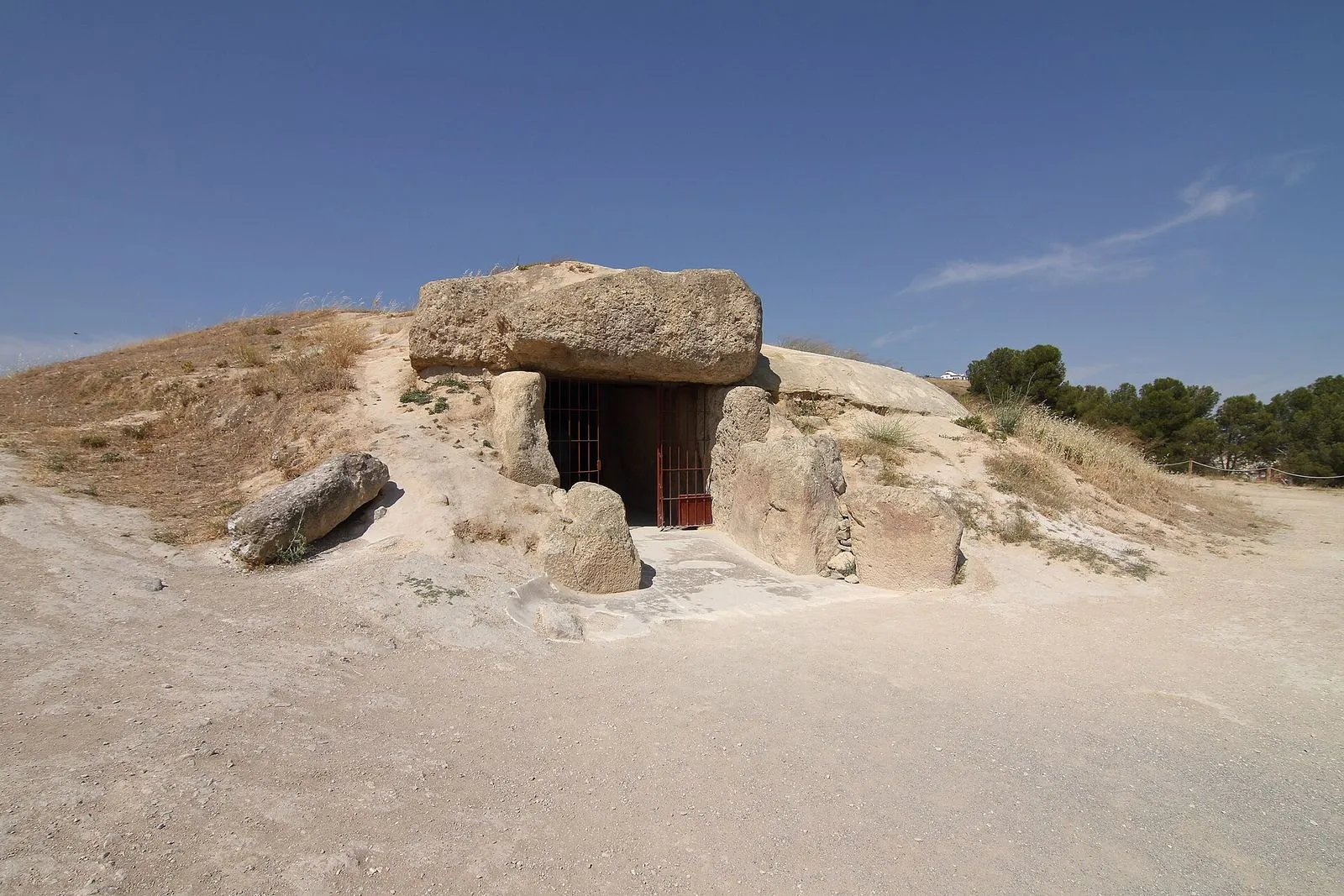
- Dolmen de Menga: built around 3700 BC, it is 27.5 metres long and made of 32 megaliths. The largest capstone weighs about 180 tonnes. Most dolmens face the sunrise; Menga faces the Peña de los Enamorados, the mountain shaped like a face on the horizon. At the back of the chamber is a deep well, a feature not found in other dolmens.
- Dolmen de Viera: next to Menga, a long narrow corridor lined with stone slabs, aligned with the sunrise at the equinoxes.
- Tholos de El Romeral: younger (Copper Age), with a false dome of small stones instead of huge slabs. It points towards El Torcal.
- Peña de los Enamorados and El Torcal: the two natural monuments in the listing. You see the Peña from the entrance to Menga, which is the point of the alignment.
Prices, hours and distances
- Price: free for EU citizens (bring ID); €1.50 for everyone else. No booking needed for individual visitors.
- Hours from 21 September to 20 March: Tuesday to Saturday 09:00–18:00; Sundays and holidays 09:00–15:00. Closed on Mondays unless a holiday follows.
- 21 March to 20 June: Tuesday to Thursday 09:00–18:00, Friday and Saturday 09:00–21:00, Sundays 09:00–15:00.
- 21 June to 20 September: Tuesday to Saturday 09:00–14:00 and 19:00–22:00, Sundays 09:00–15:00.
- Last entry is 30 minutes before closing. Closed on 24, 25 and 31 December, 1 and 6 January and 1 May.
Menga and Viera share one site on the Málaga road, about a 15–20 minute walk from the centre, with an interpretation centre. El Romeral is about 2 km further out, beside a farm and an industrial area, so most people drive. Allow two to three hours for all three.
El Torcal de Antequera
El Torcal is a protected natural area of about 12 km² on a limestone plateau south of town, at around 1,200 metres. Rain and frost have worn the rock into towers, stacks and narrow corridors that look like piles of flat stones. It is one of the best examples of karst landscape in Europe, and the rock is full of ammonite fossils from when this was a seabed.
Entry is free, with no booking for individual visitors. The road ends at the Torcal Alto visitor centre, with parking, information, a café-restaurant and an astronomical observatory. The marked trails start here:
| Route | Length | Time | Difficulty |
|---|---|---|---|
| Green route (Ruta Verde) | 1.5 km, circular | about 45 minutes | easy |
| Yellow route (Ruta Amarilla) | 3 km, circular | about 2 hours | moderate |
| Orange route (Ruta Naranja) | 3.6 km, one way on asphalt | about 1 h 30 | steady climb, lower to upper car park |
The ground is rocky and uneven, so we’d wear proper shoes. Guided walks can be booked through the visitor centre.
- Getting there: about 25 minutes by car from Antequera on the A-7075. There is no regular bus.
- Busy days: on weekends and holidays, the road to the upper car park closes when it fills up. You then park in the lower car park on the A-7075 and take a shuttle bus (€2 return).
- Heat and weather: there is little shade. In summer, we’d walk early or late; in winter, the plateau is often cold, windy or in cloud.
- Sunset: the trails never close, but they are not lit. Finish before dark.
The Alcazaba and the Real Colegiata
At the top of the old town, the Alcazaba is a Moorish fortress taken by the Castilians in 1410, 82 years before Granada fell. You walk the walls and gardens and can climb the Torre del Homenaje, topped with a 16th-century bell cote known as the Papabellotas.
Just below it, the Real Colegiata de Santa María la Mayor is a 16th-century Renaissance church, now used for exhibitions and concerts. You enter both through the Arco de los Gigantes, a late-16th-century arch in Plaza de los Escribanos.
- Price: €8 for the Alcazaba and the Colegiata, with an audio guide in English. €5 for the Alcazaba alone, €4 for the Colegiata alone; reduced prices for children and seniors.
- Hours: daily 10:00–18:00; shorter hours on 24 and 31 December and 5 January; closed on 25 December and 1 and 6 January.
- No booking needed, except for the guided visits with a host.
The old town and viewpoints
Antequera has more than thirty churches and convents, and the best way to see them is from above. The Mirador de las Almenillas, next to the Arco de los Gigantes, looks over the roofs, bell towers and domes of the town to the Peña de los Enamorados. The tower of the Alcazaba gives a similar view with the fortress walls in the foreground.
Below, the main street, Calle Infante Don Fernando, leads past churches and palaces to the town museum.
Sights at a glance
| Sight | Price | Time needed | Booking needed? |
|---|---|---|---|
| Dolmens of Menga and Viera | free for EU citizens, €1.50 others | 1–1.5 hours | no |
| Tholos de El Romeral | same ticket as Menga and Viera | 30 minutes, plus the drive | no |
| El Torcal (marked trails) | free (shuttle €2 on busy days) | 1.5–3 hours | no |
| Alcazaba and Real Colegiata | €8 with audio guide | 1.5 hours | no |
| Mirador de las Almenillas | free | 15 minutes | no |
What to eat
Antequera has its own dishes, and we think it is worth staying for lunch.
- Mollete de Antequera: a soft, flat, lightly baked bread roll, with protected geographical status. We’d eat it for breakfast, toasted, with olive oil and tomato or manteca colorá.
- Porra antequerana: a thick cold soup of tomato, bread, olive oil and garlic, like a heavier salmorejo, usually topped with egg and ham or tuna.
- Bienmesabe: a dessert of almonds, sugar, egg and sponge cake, first made in the town’s convents. Some convents still sell sweets through a turning hatch.
Getting to Antequera
| From | Car | Train | Bus |
|---|---|---|---|
| Málaga (45–55 km) | about 45 minutes | about 30 minutes to Antequera AV or Santa Ana | about 1 hour (Alsa) |
| Granada (about 100 km) | about 1 hour | about 50 minutes to Antequera AV | yes, a few a day |
| Córdoba (about 115 km) | about 1 h 15 | about 1 hour | limited |
| Seville (about 160 km) | about 1 h 45 | about 2 hours | yes, a few a day |
- By car: the easiest option, and the only practical way to see El Torcal and El Romeral on your own. The A-45 runs to Málaga and Córdoba, the A-92 to Seville and Granada. Pick up a car at the airport: car hire at Málaga airport. Our Málaga airport car hire guide covers insurance and the deposit.
- By train: Antequera has two stations. Antequera AV (also called Antequera Ciudad), opened in 2023, is on the high-speed line to Granada, about 2 km (20 minutes’ walk) from the centre. Antequera-Santa Ana, on the Madrid–Málaga line, is 17 km out of town, with very few buses; you will usually need a taxi. Check which station your train uses before booking.
- By bus: Alsa runs direct buses from Málaga’s main bus station, taking about an hour. Antequera’s bus station is about 5 minutes from the centre. Compare times: Málaga to Antequera by bus or train.
Tours from Málaga
Without a car, a tour is the simplest way to see the Dolmens and El Torcal in one day, usually with free time in the old town. Antequera and El Torcal day trip from Málaga.
For the gorge walk nearby, see Caminito del Rey tours.
Where to stay
- Parador de Antequera: a modern parador in gardens on the edge of town, with a pool and views of the Peña de los Enamorados. Close to the Dolmens.
- Hotel Convento La Magdalena: a five-star hotel in a 16th-century convent in the olive groves outside town, about 10 minutes’ drive. Our pick if you have a car.
- Hotel Plaza San Sebastián: a small, simple hotel in a 19th-century building in the centre, for a cheaper night close to everything.
Combine Antequera with the Caminito del Rey and more
The Caminito del Rey, the walkway through the Gaitanes gorge, starts about 40 minutes’ drive from Antequera. You can do both in one long day: book a Caminito slot for the morning, then see the Dolmens and the Alcazaba in the afternoon, and El Torcal on another day. See our Caminito del Rey guide.
By car, Ronda and the white villages are about 1 h 15 south-west, and Granada or Córdoba about an hour away, so Antequera works well as a stop between cities.
For more ideas, see the best places to visit in Andalusia.
FAQ
Is Antequera worth visiting?
Yes, we think so. The Dolmens are among the most important prehistoric monuments in Europe, El Torcal is unlike anywhere else in Spain, and the town gets far fewer visitors than Ronda or Granada.
Are the Antequera Dolmens free?
They are free for EU citizens with ID. Everyone else pays €1.50. The ticket covers Menga, Viera and El Romeral.
Can you visit Antequera and El Torcal without a car?
The town and the Dolmens of Menga and Viera, yes: take the bus or train from Málaga and walk. El Torcal has no regular bus, so you need a taxi or a tour.
How long do you need in El Torcal?
About an hour for the green route and the viewpoints, or two to three hours if you walk the yellow route. Add 25 minutes’ drive each way from town.
Can you do Antequera and the Caminito del Rey in one day?
Yes, by car. The Caminito takes three to four hours plus the shuttle back, and it is about 40 minutes from Antequera. We’d do the Caminito in the morning and the Dolmens and Alcazaba in the afternoon.
Are the Dolmens open on Mondays?
No, except before a public holiday. El Torcal and the Alcazaba open every day.