
Some links on this page are affiliate links. If you book through them we may earn a commission, at no extra cost to you.
The short answer
Zahara de los Atunes is a small fishing village on the Costa de la Luz, in the province of Cádiz, between Barbate and Tarifa. It belongs to the municipality of Barbate, has only about 1,200 residents outside summer, and is known for a long, open beach and for bluefin tuna caught with the ancient almadraba nets.
Don’t confuse it with Zahara de la Sierra, the white village under a castle tower in the Sierra de Grazalema, more than two hours inland by car. That one is in our white villages guide; this page is about the beach village.
- Who it suits: couples and families who want a long beach, good fish and a quiet evening. Not a party town, and not for big sights.
- Time needed: a day trip works; two to four nights let you add Atlanterra, Bolonia and Vejer.
- Car: we strongly recommend one. Buses are few, and the best coves and day trips are spread out.
- Compared with Conil and Tarifa: Conil is a bigger town with more life and more places to stay; Tarifa is windier, with kitesurfing and the ferry to Morocco. Zahara is the smallest and calmest of the three, and the one most focused on food.
The beach
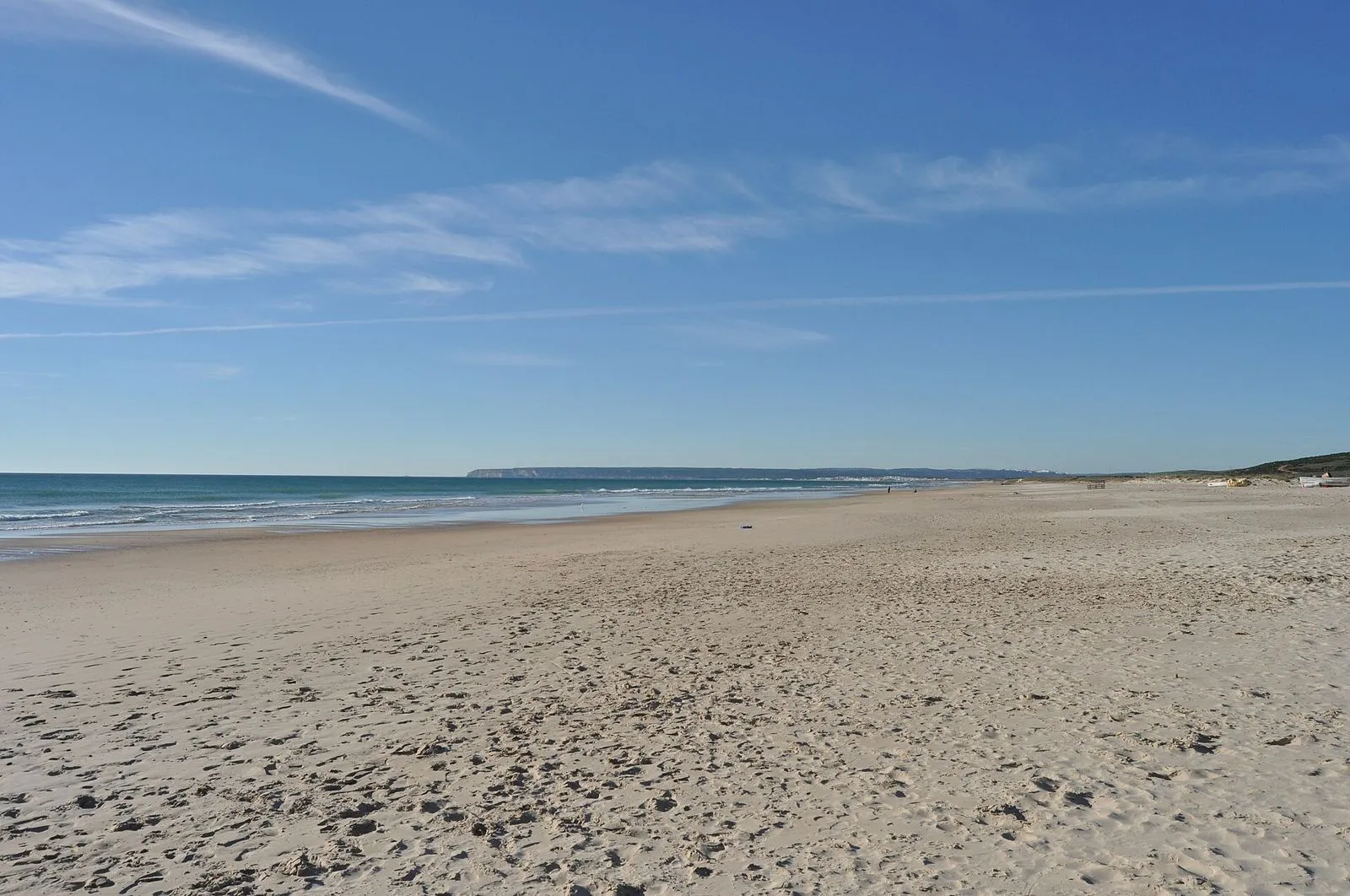
The main beach, also called Playa del Carmen, runs south from the village to Cabo de Plata, about 1.6 km of golden sand and some 70 metres wide. It has lifeguards, showers and loungers in summer. Beyond the built-up edge, dunes and low scrub back the sand.
North of the village the coast looks even wilder. The long El Retín beach, towards Barbate, lies inside a military training area, so it is only open to the public in summer, and it has never been built on.
Atlanterra, Cabo de Plata and the coves
South of the village, the road climbs to Atlanterra, a spread of villas and holiday homes on the hillside above the sea. Administratively it is in Tarifa, but everyone treats it as part of Zahara.
- Cabo de Plata: a headland with a large concrete bunker from the 1940s sitting on the rocks, one of the most photographed spots on this coast.
- Playa de los Alemanes: about 1.5 km of fine sand in a bay between Cabo de Plata and Cabo de Gracia, with clear water. Parking is limited in summer.
- El Cañuelo: a small, completely undeveloped cove beyond Los Alemanes, reached on foot. The Camarinal lighthouse on Cabo de Gracia stands above it, and a coastal path continues to Bolonia.
Almadraba tuna and what to eat
The village is named after the tuna (atunes). Each spring, Atlantic bluefin tuna pass along this coast on their way into the Mediterranean to spawn, and fishermen catch them in the almadraba, a maze of fixed nets anchored off the shore, a technique used here since Phoenician and Roman times. The nets go in during spring and the catch usually runs from late April into June.
In May the village holds the Ruta del Atún, a tuna tapas route with dozens of bars and restaurants taking part, and live ronqueos, the traditional butchering of a whole tuna. Fresh almadraba tuna is best from May to early June, but frozen and cured tuna is served all year.
What to try:
- Tuna tartare, tataki and grilled belly (ventresca) in the village restaurants.
- Mojama, salt-cured and air-dried tuna loin, sliced thin with almonds, a speciality of Barbate.
The village and the castle ruins
The old village is a few flat streets of low white houses around a small church square, with bars that fill up on summer evenings. It takes half an hour to walk round.
At its heart stand the walls of the Castillo de las Almadrabas, also called the Palacio de las Pilas or Palacio de Jadraza. The Dukes of Medina Sidonia built it in the 15th and 16th centuries as a fort against Barbary pirates, a summer residence during the tuna season, and a factory where the fish were cut and salted. Only the outer walls and corner towers survive, in poor condition. The village church, Nuestra Señora del Carmen, was built in 1906 inside the old salting hall.
The council now owns the walls and plans a restoration, but for now there is no museum: you look at it from outside. In summer the enclosure is sometimes used for markets and open-air cinema.
Bolonia and Baelo Claudia
About 30 minutes by car, Bolonia is one of the finest beaches in Andalusia: a wide bay with clear water and a big protected dune. Behind it lie the ruins of Baelo Claudia, a Roman town that grew rich on salted fish and garum. The Junta de Andalucía runs the site: entry is free for EU citizens and €1.50 for others, with no booking needed. It closes on Mondays and on a few public holidays, and is open mornings only in summer. Details are in our Tarifa guide.
There is no coast road between Atlanterra and Bolonia: you drive back to the N-340 and around.
The levante wind
The levante, the dry east wind from the Strait, is the thing that can spoil a beach day here. It can blow hard for several days, whipping sand along the beach. The poniente, from the west, is cooler and gentler.
We’d check a wind forecast before planning a beach day. On a strong levante day, we’d head for the village and its restaurants, Vejer, or the ruins at Baelo Claudia instead.
Day trips from Zahara
| Place | From Zahara | Best for |
|---|---|---|
| Cabo de Plata and Los Alemanes | about 10–15 min by car | coves, the bunker, clear water |
| Barbate | about 15 min | the fishing port, mojama |
| Vejer de la Frontera | about 30 min | a hilltop white town, dinner |
| Bolonia and Baelo Claudia | about 30 min | the dune, Roman ruins |
| Conil de la Frontera | about 40 min | a livelier beach town |
| Tarifa | about 40 min | kitesurfing, the old town, Tangier ferry |
| Cádiz | about 1 h 15 | the old city, the cathedral |
| Gibraltar | about 1 h 30 | the Rock, a day across the border |
Vejer de la Frontera is the easiest half-day, and in our view the best place for dinner with a view. For Cádiz, see our Cádiz guide; for Gibraltar, our Gibraltar guide.
Getting to Zahara de los Atunes
There is no train. The nearest stations are Cádiz and San Fernando. Algeciras has no trains until about autumn 2027, while its line is closed for works.
| From | Car | Bus |
|---|---|---|
| Cádiz | about 1 h 15 | about 2 h, a few a day (Comes) |
| Jerez airport | about 1 h 30 | via Cádiz or Jerez, with a change |
| Seville | about 2 h 15–2 h 30 | about 3 h 30, direct on some days |
| Málaga | about 2 h 45 | no direct bus; change on the way |
- By car: the easiest way. From Cádiz, take the A-48 south towards Vejer, then follow the signs for Barbate and Zahara. Pick up a car at Jerez airport, Seville airport or Málaga airport, and read our car hire guide. In July and August, parking in the village is hard.
- By bus: Comes runs the buses, with a handful a day from Cádiz via Chiclana, Vejer and Barbate, more in summer. Check tgcomes.es or compare times: Cádiz to Zahara by bus.
Where to stay
We’d stay in the village to walk to restaurants and the beach, or in Atlanterra for sea views and the coves, with a car.
- Hotel Gran Sol: on the beach at the edge of the old village, with a pool.
- Hotel Pozo del Duque: a white-walled hotel a few metres from the sand, with a rooftop infinity pool for adults.
- Hotel Antonio: a family-run hotel on the Atlanterra road, by the beach, best known for its tuna restaurant.
- Meliá Zahara Resort & Villas: a big resort in Atlanterra with pools and direct beach access, open in the summer season.
- More options: all hotels in Zahara de los Atunes.
When to go
- May and June: the tuna season, warm days and far fewer people. In our view, the best time for food.
- July and August: hot, busy and expensive, with the beach bars and nightlife in full swing. We’d book months ahead.
- September: the sea is at its warmest and the crowds thin after the first week.
- October to April: very quiet. Many hotels, beach bars and some restaurants close, especially in Atlanterra, but the beaches are empty and the light is lovely.
Zahara fits well on a coastal loop from Cádiz to Tarifa: see our Andalusia road trip and the best places to visit in Andalusia.
FAQ
Is Zahara de los Atunes worth visiting?
Yes, we think so, if you want a long natural beach, a small village and excellent tuna. It is quieter than Conil or Tarifa and has few sights, so it suits a relaxed stay rather than sightseeing.
Is Zahara de los Atunes the same as Zahara de la Sierra?
No. Zahara de los Atunes is a beach village on the coast near Barbate. Zahara de la Sierra is a white mountain village in the Sierra de Grazalema, more than two hours’ drive away.
Do you need a car in Zahara de los Atunes?
It helps a lot. Buses are few, especially outside summer, and Atlanterra, Bolonia, Vejer and Tarifa are much easier to reach by car.
When is the tuna season in Zahara de los Atunes?
The almadraba catch usually runs from late April to June, and the Ruta del Atún tapas route takes place in May. Fresh tuna is best then, but tuna is on menus all year.
Is Zahara de los Atunes windy?
Often. The levante, the east wind, can blow strongly for days, especially in summer, and blows sand across the beach. Check the forecast and keep a plan B such as Vejer or Baelo Claudia.
Which is better, Zahara de los Atunes or Conil?
Conil is bigger, livelier and easier to reach by bus. Zahara is smaller, calmer and has wilder beaches nearby. For a quiet beach break with good food, we’d choose Zahara.