
Some links on this page are affiliate links. If you book through them we may earn a commission, at no extra cost to you.
The short answer
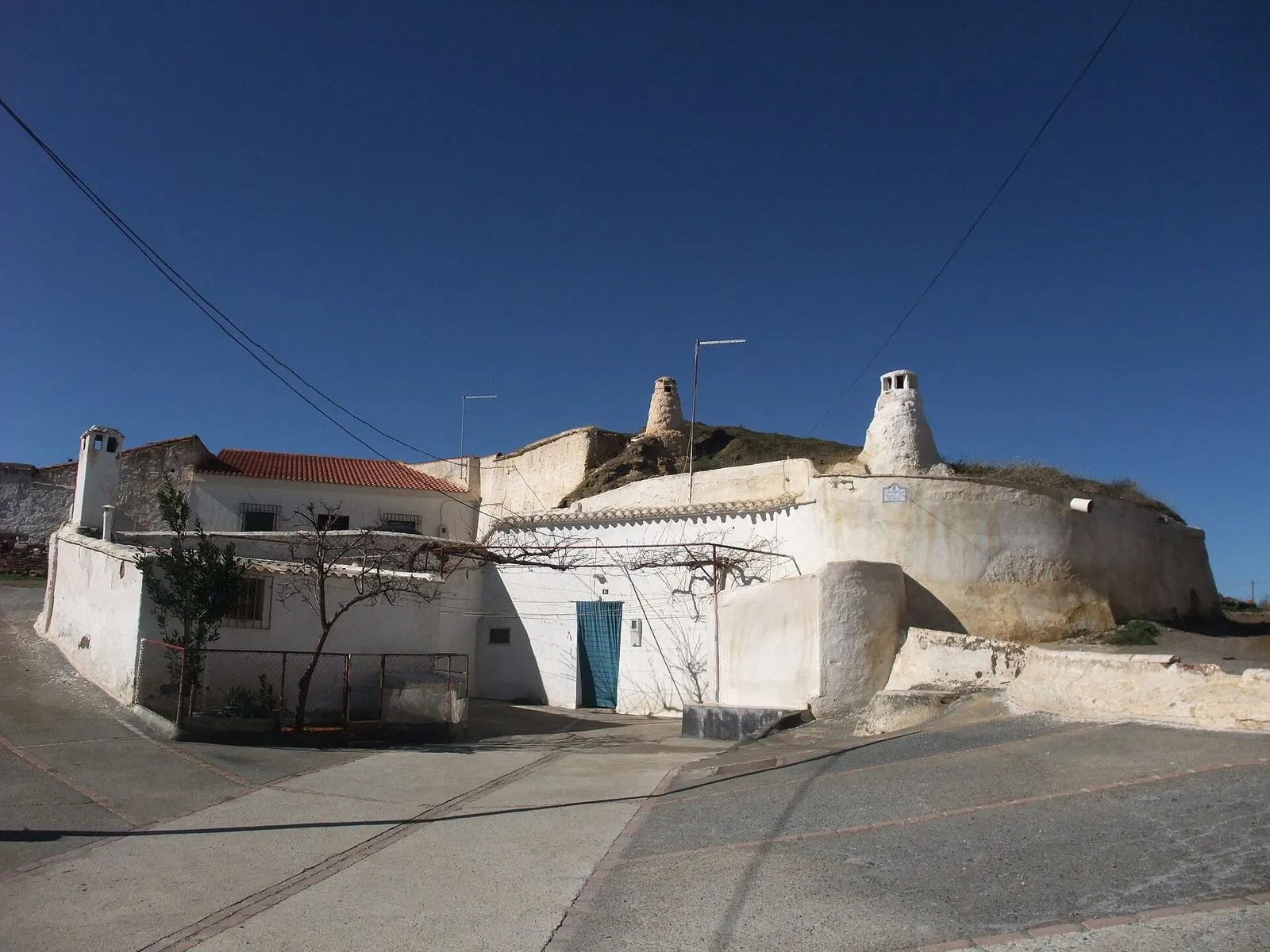
Guadix is a town of about 19,000 people at 913 metres on a high plain east of Granada, below the north face of the Sierra Nevada. It is famous for its cave houses: around 2,000 homes dug into the soft clay hills, most of them still lived in, their white chimneys sticking up out of the ground.
- Is it worth it? Yes. We think the cave quarter is unlike anywhere else in Europe, and the old town has a big Baroque cathedral, a Moorish fortress and a Roman theatre.
- Time needed: half a day for the caves and the cathedral. We’d stay a night in a cave hotel if possible, and add a second day for the badlands, the Gorafe dolmens and La Calahorra castle.
- Getting there: about 50–55 minutes by car from Granada on the A-92, or about an hour by train or Alsa bus.
- Costs: the cave museum is about €2.60, the cathedral €7 (€9 with the tower).
It works as a day trip from Granada, or as a stop on the drive between Granada and Almería.
The cave quarter (Barrio de las Cuevas)
The cave houses fill the hills south of the old town, in the Barrio de las Cuevas, which runs up from the Barrio de Santiago behind the Alcazaba. From the street you see whitewashed fronts set into the hillside, with doors and windows, and chimneys and TV aerials sprouting from the earth above.
People have dug homes into these hills for centuries. Many were made after 1492, when the Moors were pushed out of the town centre, and the quarter grew again in the 19th and 20th centuries as cheap housing for farm workers. Today the caves have electricity and plumbing.
Why live in a cave?
Insulation. The clay walls keep the inside at around 18–20 °C all year, while Guadix freezes in winter and bakes in summer. The clay is soft enough to dig yet firm enough to hold a vaulted ceiling, and many owners simply add a room by digging further back.
The Centro de Interpretación Cuevas de Guadix
We think the best way in is the cave museum in the Plaza del Padre Poveda: a real cave house, furnished as it would have been a century ago, with rooms on cave life, crafts and farming. Visits are usually guided, leave every 45 minutes or so and take about half an hour. Entry is about €2.60, and children under 14 go free. It is normally closed on Monday afternoons or all day Monday, and closes for lunch around 14:00–16:00, so check before you go.
The Mirador Padre Poveda
Right next to the museum, the Mirador Padre Poveda is the classic viewpoint: the white Ermita Nueva church and its bell tower in front, cave chimneys all around, and the cathedral and Alcazaba behind, with the Sierra Nevada on the skyline. It is free and open at all times, and we’d go in the late afternoon.
Walk on beyond the museum for quieter lanes, but remember these are private homes: no peering through doors or climbing on the roofs.
Sleeping in a cave
A night in a cave is the reason many people come: cool in summer, warm in winter and very quiet.
- Cuevas Oro y Arcilla: three large cave houses in the cave quarter, facing the Alcazaba, about five minutes’ walk from the centre, with private pools in two of them. Rated 9.3 on Booking.
- Cueva de Manuela: a cave house for self-caterers in Guadix, good for couples and families. Rated 9.1.
- Cuevas La Granja: 18 cave houses on an old farm in Benalúa, about 10 minutes north of Guadix, with breakfast available. Rated 8.9.
- More options: cave houses and hotels in Guadix.
The old town
Catedral de la Encarnación
Guadix’s cathedral is out of all proportion to the town, a reminder that by tradition Guadix is one of the oldest bishoprics in Spain. It was begun in the Gothic style in the 16th century, extended by Diego de Siloé, who also worked on Granada’s cathedral, and finished in the 18th century with a Baroque front and tower.
- Tickets: €7 for the cathedral with its exhibition rooms and a video-mapping show, €9 with the tower, €12 for a guided visit that adds the crypt. Tower-only is €5.
- Hours: from October to March, Monday to Thursday 11:00–14:30 and 16:00–18:00, Friday and Saturday 11:00–19:00, Sunday 15:00–18:00; in summer it closes an hour later on weekday afternoons. Last entry an hour before closing.
- Free: Monday to Saturday, 9:00–9:45.
We’d climb the tower for the view over the rooftops to the cave hills.
The Alcazaba
The Moorish fortress on the hill above the cathedral dates from the 11th century. It is still being excavated and restored, so you can only go in on free guided visits run by the tourist office on certain days; ask there or call ahead. Below it, the Cueva Museo de Alfarería La Alcazaba is a cave pottery museum, with pieces from the local potters.
The Roman theatre
Guadix was the Roman colony of Acci, and part of its theatre, from the time of Augustus, has been excavated near the cathedral in recent years. It opens for guided visits on Sunday mornings, about €2.60, with tickets from the tourist office.
Plaza de la Constitución and the Palacio de Peñaflor
The arcaded main square, the Plaza de la Constitución, has the town hall and the tourist office. Near the Alcazaba, the 16th-century Palacio de Peñaflor has a wooden gallery on octagonal pillars along its front, typical of the noble houses of the area.
The badlands and the Granada Geopark
Around Guadix the land breaks into badlands: ridges and gullies of pale clay carved by millions of years of rain, once the bed of a huge lake. This is the landscape the caves are dug into, and since 2020 it has been part of the Granada UNESCO Global Geopark, which covers about 4,700 km² of the Guadix, Baza and Huéscar areas and is known for its fossils and ice-age deposits.
The easiest way to see it is from a viewpoint on the edge of town, or on a Guadix and Geopark tour from Granada, about seven hours with a local guide.
Day trips from Guadix
- Gorafe and its desert (about 35 minutes north): a valley of dramatic badlands, sometimes called the Desierto de Gorafe, with one of the largest groups of dolmens in Europe. Over 240 prehistoric tombs have been counted, and marked routes and an interpretation centre in the village explain them.
- Castillo de La Calahorra (about 20 minutes east): a square castle with round corner towers on a hill, hiding one of the first Italian Renaissance courtyards in Spain, built in 1509–1512. Visits are guided only, about 40 minutes, usually Friday to Sunday, and must be booked online.
- Purullena (about 10 minutes west): a cave village on the old road to Granada, known for its pottery, sold from roadside cave shops.
- The north side of the Sierra Nevada: from La Calahorra, the road climbs over the Puerto de la Ragua, a pass at about 2,000 m, and drops into the Alpujarras. See our Sierra Nevada guide for the rest of the range.
Food
Guadix eats mountain food for cold winters: migas (fried breadcrumbs with pork and peppers), choto al ajillo (young goat with garlic), papas a lo pobre (potatoes slow-fried with peppers and onion) and hearty gachas and stews. Lamb from the local segureña sheep is on many menus. In winter, look for the olla de San Antón, a bean and pork stew made around 17 January. Many bars give a free tapa with a drink, as in Granada.
When to go
We think spring (April to early June) and autumn (late September to early November) are the best months. At over 900 m, Guadix has a continental climate: winters are cold, with January averaging about 5 °C, frequent frosts and the odd snowfall, and July averages about 26 °C, with hot afternoons. See the Granada weather guide for the region’s climate month by month.
Getting to Guadix
| From | Car | Train | Bus |
|---|---|---|---|
| Granada | about 50–55 min (A-92, about 55 km) | about 1 h, a few a day | Alsa, about 1 h, many a day |
| Almería | about 1 h 15 (A-92) | about 1 h 40 | Alsa, about 1 h 30 |
| Málaga | about 2 h | change in Granada | change in Granada |
- By car: the easiest option, and the only practical way to reach Gorafe or La Calahorra. Hire in Granada, at Málaga airport or at Almería airport; see our car hire guide. We’d park near the centre and walk up to the caves, which are about 10–15 minutes uphill.
- By train: Renfe trains on the Granada–Almería and Madrid–Almería lines stop at Guadix. The station is on the northern edge of town, a walk of about 20 minutes to the cathedral.
- By bus: Alsa buses from Granada bus station are the most frequent public transport, and arrive closer to the centre. Book trains and buses on Omio.
Day trip or overnight?
A day trip from Granada is enough for the caves, the cathedral and the old town. If you want the Geopark, Gorafe and La Calahorra as well, or simply the experience of sleeping underground, we’d stay a night. Guadix also fits neatly into an Andalusia road trip between Granada and Almería’s desert and coast. Find it on our map of Andalusia, and see more ideas in the best places to visit in Andalusia.
FAQ
Is Guadix worth visiting?
Yes. Its cave quarter, with about 2,000 inhabited caves, is often called the largest in Europe, and the town also has a fine cathedral and a Moorish fortress. It is an easy trip from Granada.
Can you visit the cave houses in Guadix?
Most are private homes, but you can walk through the cave quarter freely and see a furnished cave at the Centro de Interpretación Cuevas de Guadix, for about €2.60. In our view the best way to get to know one is to spend a night in a cave hotel.
How far is Guadix from Granada?
About 55 km, or 50–55 minutes by car on the A-92. Trains and Alsa buses take about an hour.
How long do you need in Guadix?
Half a day covers the cave quarter, the museum and the cathedral. Allow a full day or a night if you also want to see the Geopark badlands, Gorafe or La Calahorra castle.
Why do people live in caves in Guadix?
The clay hills are easy to dig and keep the inside at about 18–20 °C all year, cool in the hot summers and warm in the freezing winters. For centuries caves were also the cheapest homes for poor families; now many are sought after.