
Some links on this page are affiliate links. If you book through them we may earn a commission, at no extra cost to you.
The short answer
Cádiz has the mildest climate in Andalusia: about 16 °C by day in January and 28 °C in July and August, with nights that rarely drop below 10 °C. The Atlantic keeps summers fresher than inland and winters warmer, and the sea is warm enough for most swimmers from about June to October.
- Best time to visit, in our view: May, June, September and October, with highs of 23–26 °C and a sea of 19–22 °C
- Beach holiday: June to September, when the sea is 21–23 °C
- Summer escape: in July and August Cádiz averages 28 °C, against 36 °C in Seville
- Wettest months: November to January, with 9–10 rain days a month
- Wind: the east wind, the levante, can blow for days and spoil beach time, especially further south towards Tarifa
- Busiest: Carnival (4–14 February 2027), Semana Santa (21–28 March 2027) and July–August
Cádiz weather month by month
| Month | Avg. high / low | Sea | Sunshine (hours) | Rain days |
|---|---|---|---|---|
| January | 16 / 10 °C | 16 °C | 184 | 9 |
| February | 17 / 11 °C | 15 °C | 197 | 8 |
| March | 19 / 12 °C | 16 °C | 228 | 8 |
| April | 20 / 14 °C | 17 °C | 255 | 7 |
| May | 23 / 17 °C | 19 °C | 307 | 5 |
| June | 26 / 20 °C | 21 °C | 331 | 1 |
| July | 28 / 22 °C | 23 °C | – | 0 |
| August | 28 / 22 °C | 23 °C | – | 1 |
| September | 26 / 20 °C | 22 °C | 252 | 3 |
| October | 24 / 18 °C | 21 °C | 228 | 8 |
| November | 20 / 13 °C | 18 °C | 187 | 9 |
| December | 17 / 11 °C | 17 °C | 166 | 10 |
Temperatures and rain days are AEMET averages for the Cádiz city station (1991–2020). Sunshine hours are AEMET averages for 1981–2010; the station has no published figures for July and August, which are the sunniest months of the year. Sea temperatures are 10-year averages. Single days can be much warmer or cooler.
Climate by month
Choose a city. Bars run from the average low to the average high.
| Month | High | Low | Rain days | Sunshine (h) | Sea |
|---|---|---|---|---|---|
| Jan | 16 °C | 10 °C | 9 | 184 | 16 °C |
| Feb | 17 °C | 11 °C | 8 | 197 | 15 °C |
| Mar | 19 °C | 12 °C | 8 | 228 | 16 °C |
| Apr | 20 °C | 14 °C | 7 | 255 | 17 °C |
| May | 23 °C | 17 °C | 5 | 307 | 19 °C |
| Jun | 26 °C | 20 °C | 1 | 331 | 21 °C |
| Jul | 28 °C | 22 °C | 0 | – | 23 °C |
| Aug | 28 °C | 22 °C | 1 | – | 23 °C |
| Sep | 26 °C | 20 °C | 3 | 252 | 22 °C |
| Oct | 24 °C | 18 °C | 8 | 228 | 21 °C |
| Nov | 20 °C | 13 °C | 9 | 187 | 18 °C |
| Dec | 17 °C | 11 °C | 10 | 166 | 17 °C |
Source: AEMET, monthly averages 1991–2020 (Cádiz sunshine 1981–2010). Sea: seatemperature.info, 10-year average.
Why Cádiz is so mild
The old town sits on a narrow peninsula with the Atlantic on three sides, and the sea moderates everything. The gap between day and night is only 6–7 °C in most months, and the difference between January and August is about 12 °C. In summer, a sea breeze usually cools the afternoons, so Cádiz stays around 28 °C while Seville, about 100 km inland, averages 36 °C in July and August and often passes 40 °C. In winter, frost is almost unknown.
The levante and the poniente
Two winds decide what a beach day in Cádiz feels like:
- Levante (east): hot, dry and often strong. It funnels through the Strait of Gibraltar and can blow for three or four days in a row, sometimes longer, most often from spring to late summer. On the open beaches it drives sand across your towel. Because it blows offshore on this coast, the sea can turn noticeably colder but flatter and clearer. In summer, a strong levante is also the one wind that can bring real heat into the city.
- Poniente (west): from the Atlantic, cooler, more humid and usually gentler. It brings waves and a fresh, clear feel, and, we think, is the better wind for most beach days around Tarifa.
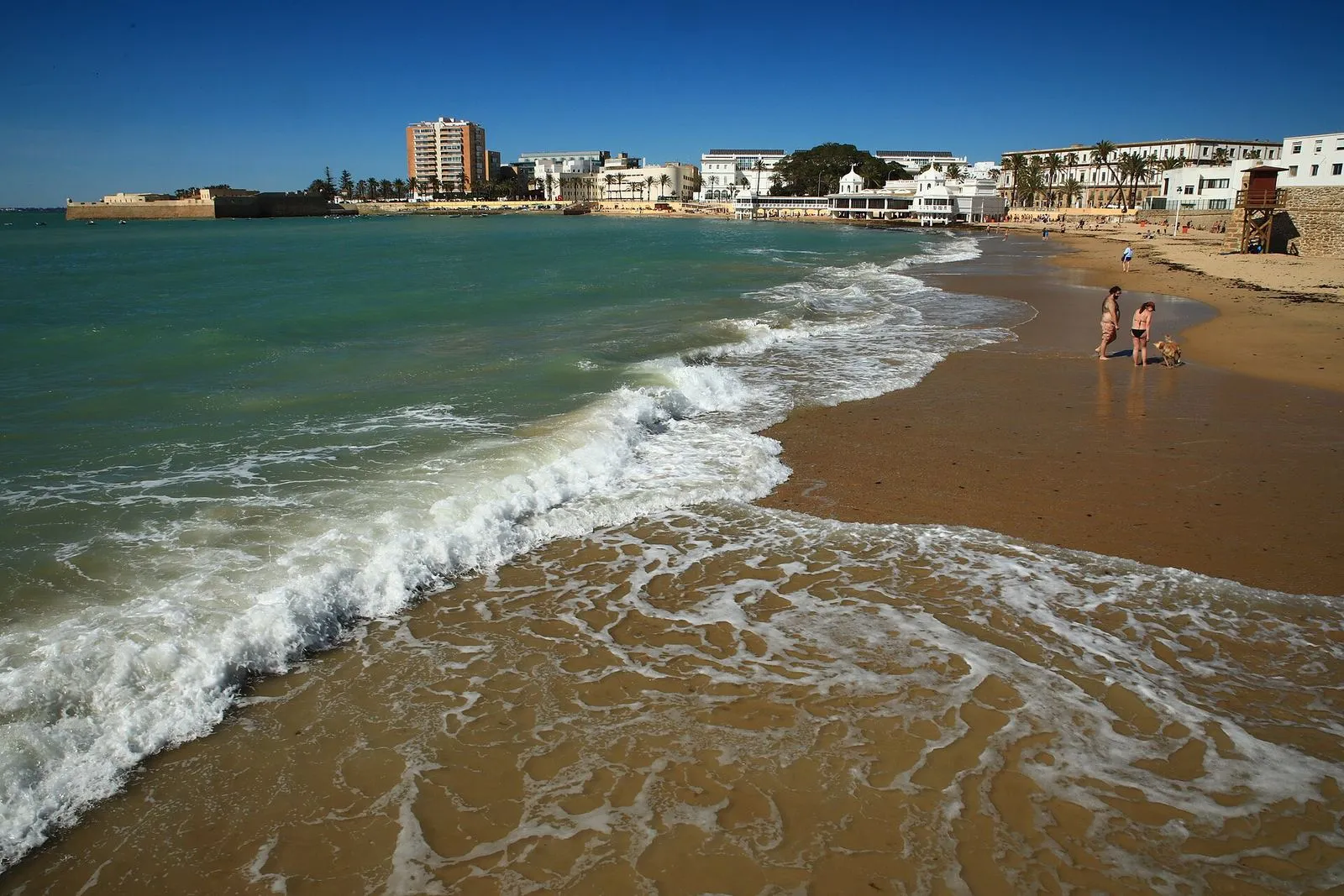
The levante is much stronger around Tarifa, Bolonia and Zahara than in Cádiz itself, so a windy forecast in Tarifa is often a fine beach day in the city. When the levante does blow in Cádiz, the small, sheltered cove of La Caleta is usually calmer than the long, open Playa de la Victoria. We’d check a wind forecast the evening before. More on the wind along the coast in our Costa de la Luz guide.
Sea temperature: Atlantic, not Mediterranean
The sea at Cádiz is about 15–17 °C from December to April, 19 °C in May, 21 °C in June and 22–23 °C from July to September. It is still about 21 °C in October. That is only slightly cooler on average than the Mediterranean at Málaga (24 °C in August), but the Atlantic varies more: after a few days of levante the water can drop several degrees overnight. The beaches also have real tides and, on some days, waves, so we’d swim near the lifeguards on Playa de la Victoria in summer.
Month-by-month notes
January
The coolest month, but still 16 °C at midday and 10 °C at night, the mildest January nights of any major city in Andalusia. It is also one of the wettest, with about nine rain days, usually in Atlantic fronts followed by bright, windy days. The city is quiet, and the Carnival song contest (the COAC) at the Gran Teatro Falla usually starts its preliminary rounds in January.
February
Carnival month. In 2027 the Carnival runs from Thursday 4 to Sunday 14 February: the COAC final at the Gran Teatro Falla on 5 February, the opening pregón on the 6th, the big parade (the Cabalgata) on the 7th and the burning of the Bruja Piti to close it on the 14th. The weather (17 / 11 °C) is fine for the streets, but take a warm layer for the nights. Hotels sell out months ahead; see where to stay in Cádiz for Carnival tips.
March
Spring starts: 19 / 12 °C and about 228 hours of sun, with rain still likely on some days. In 2027 Semana Santa runs from 21 to 28 March, with processions through the old town. The sea (16 °C) is still cold.
April
Good for walking the old town at 20 / 14 °C, with about seven rain days: the cathedral, Torre Tavira and day trips to Jerez. Too cool for swimming.
May
We think it is a very good month: 23 / 17 °C, about 307 hours of sun and only five rain days. Terraces fill and the first sunbathers appear on Playa de la Victoria, although the sea is only about 19 °C.
June
Summer arrives without the crowds of July: 26 / 20 °C, almost no rain and a sea of about 21 °C. The evenings are long, with sunsets after 21:30. On the night of 23 June, the Noche de San Juan, people gather on the city beaches.
July
Warm rather than hot: 28 / 22 °C and a sea around 23 °C, with no rain on a typical day. Spanish families fill the beaches and hotels, and prices are at their highest. A levante spell can bring a few days of dry heat and blowing sand.
August
The warmest month on average (28 / 22 °C) and the warmest sea (about 23 °C). The city stays busy. The Trofeo Carranza, a pre-season football tournament held in Cádiz since 1955, is usually held in August (in 2026 on 8 August, with concerts on the seafront). We’d book early.
September
Our favourite month, and many people’s: still 26 / 20 °C with a 22 °C sea, but quieter once the Spanish school holidays end. The first rain usually comes late in the month.
October
Warm and golden at 24 / 18 °C, with a sea still around 21 °C, so swimming is possible, especially in the first half. The autumn rain returns (about eight rain days), often as short, heavy downpours. We think it is a good month for a city break with a beach afternoon or two. The clocks go back on the last Sunday of October.
November
Mild (20 / 13 °C) but less settled, with about nine rain days and 187 hours of sun. Prices drop and the city feels local again.
December
The wettest month (about ten rain days) and the least sunny (166 hours), but still 17 °C at midday and 11 °C at night. Christmas lights and nativity scenes fill the old town, and the sea views on a clear winter day are some of the best of the year.
When is the best time to visit Cádiz?
- City break: April, May, October and November. Mild, comfortable for walking, and no queues. See things to do in Cádiz.
- Beach holiday: June and September, with a warm sea and fewer people than in July and August.
- Escape the inland heat: July and August. Cádiz is 8 °C cooler than Seville on average, and an easy day trip from Seville by train, about 1 h 45.
- Carnival: early to mid-February, and we’d only go if you book your bed well ahead.
- Kitesurfing in Tarifa: the wind blows all year, but spring to autumn is the most reliable, with warmer water. Levante days suit experienced riders and poniente days are better for learning, for example on a kitesurf lesson in Tarifa.
- Budget: November, January and early March, outside Carnival and Easter.
For the rest of the region, see the best time to visit Andalusia, and for the Mediterranean coast, Málaga weather by month.
Where to stay by season
From autumn to spring, we’d stay in the old town, close to the cathedral, the market and the tapas bars: compare hotels in Cádiz old town. In summer, a hotel on Playa de la Victoria puts the beach across the road. Our guide to where to stay in Cádiz compares the areas, and the best hotels in Cádiz lists specific picks. For more on the city, start with our Cádiz travel guide.
What to pack
- November to March: layers, a warm jumper for the evenings, a rain jacket or umbrella and a windproof layer. Older houses and flats can feel damp and cold inside.
- April, May and October: t-shirts, a light jacket for the evenings and the sea wind, comfortable walking shoes.
- June to September: light clothes, swimwear, a sun hat and high-factor sun cream. The sea breeze hides how strong the sun is.
- All year: sunglasses, and a jacket for the promenade: the wind off the Atlantic can make it feel much cooler than the forecast.
FAQ
What is the weather like in Cádiz in October?
Warm and mostly sunny: about 24 °C by day and 18 °C at night, with the sea still around 21 °C, so you can often swim. Expect some rain, about eight rain days on average, usually in short showers.
Is Cádiz hot in summer?
Not as hot as the rest of Andalusia. In July and August the average high is 28 °C, against 36 °C in Seville, because the sea breeze cools the city. A strong levante can bring a few hotter, windy days.
When is the sea warm enough to swim in Cádiz?
From about June to October, when the Atlantic is 21–23 °C. In May it is about 19 °C, and from December to April 15–17 °C, too cold for most people.
Is Cádiz windy?
Often, yes. The levante (east) wind can blow for several days, most often from spring to late summer, and is strongest around Tarifa. In Cádiz itself it is usually weaker, and La Caleta is more sheltered than Playa de la Victoria.
What is the weather like in Cádiz in winter?
Mild: about 16–17 °C by day and 10–11 °C at night from December to February, the warmest winter nights of Andalusia’s main cities. It is also the wettest season, with 8–10 rain days a month.