
Some links on this page are affiliate links. If you book through them we may earn a commission, at no extra cost to you.
The short answer
Chiclana de la Frontera is a town of more than 85,000 people in the province of Cádiz, 25 minutes south of Cádiz city on the Costa de la Luz. It comes in two halves that most visitors treat as two different places:
- The coast: La Barrosa, about 8 km of fine sand with a Blue Flag, backed by the resort hotels and golf courses of Novo Sancti Petri, and the old fishing village of Sancti Petri, with its marina and a castle on an islet offshore. This is where the holiday hotels are.
- The old town: a few kilometres inland, a working Andalusian town with a neoclassical church, a free museum and old wine bodegas known for fino and moscatel.
Who it suits: families, resort and all-inclusive holidays, golfers, and anyone who wants a long, easy beach with every service. Who it doesn’t: travellers looking for a pretty white village by the sea (try Conil or Vejer) or wild, empty beaches. A car is useful but not essential.
Two halves: town and coast
The old town sits by the Río Iro, on the edge of the salt marshes. La Barrosa and Novo Sancti Petri are roughly 7–10 km away by road, depending on which end of the beach you head for. There is no real village along the beach: it is mostly hotels, apartments, villas and restaurants, and the old town is a short drive or bus ride away.
La Barrosa beach
Playa de la Barrosa runs for about 8 km from the Torre del Puerco in the south to the cliffs near Sancti Petri in the north. It is wide, fine and golden, shelves gently into the water, and has lifeguards, beach bars, toilets and accessible walkways in summer. It has a Blue Flag, and it is one of the longest beaches in the province.
The beach has two distinct parts:
- The southern end (Novo Sancti Petri): in front of the big resort hotels, with a promenade and the most services. Busy in July and August but never cramped, because the beach is so long.
- The northern end (Loma de Sancti Petri): the older area of apartments and holiday houses, with a seafront promenade past the Torre Bermeja watchtower and more local Spanish families.
The Atlantic here is cooler than the Mediterranean, but the bay and the shallow shelf keep La Barrosa calmer than the open beaches further south. On strong levante days, when the east wind spoils the beaches around Tarifa and Zahara, Chiclana is often one of the better places to be.
Torre del Puerco and the cliffs
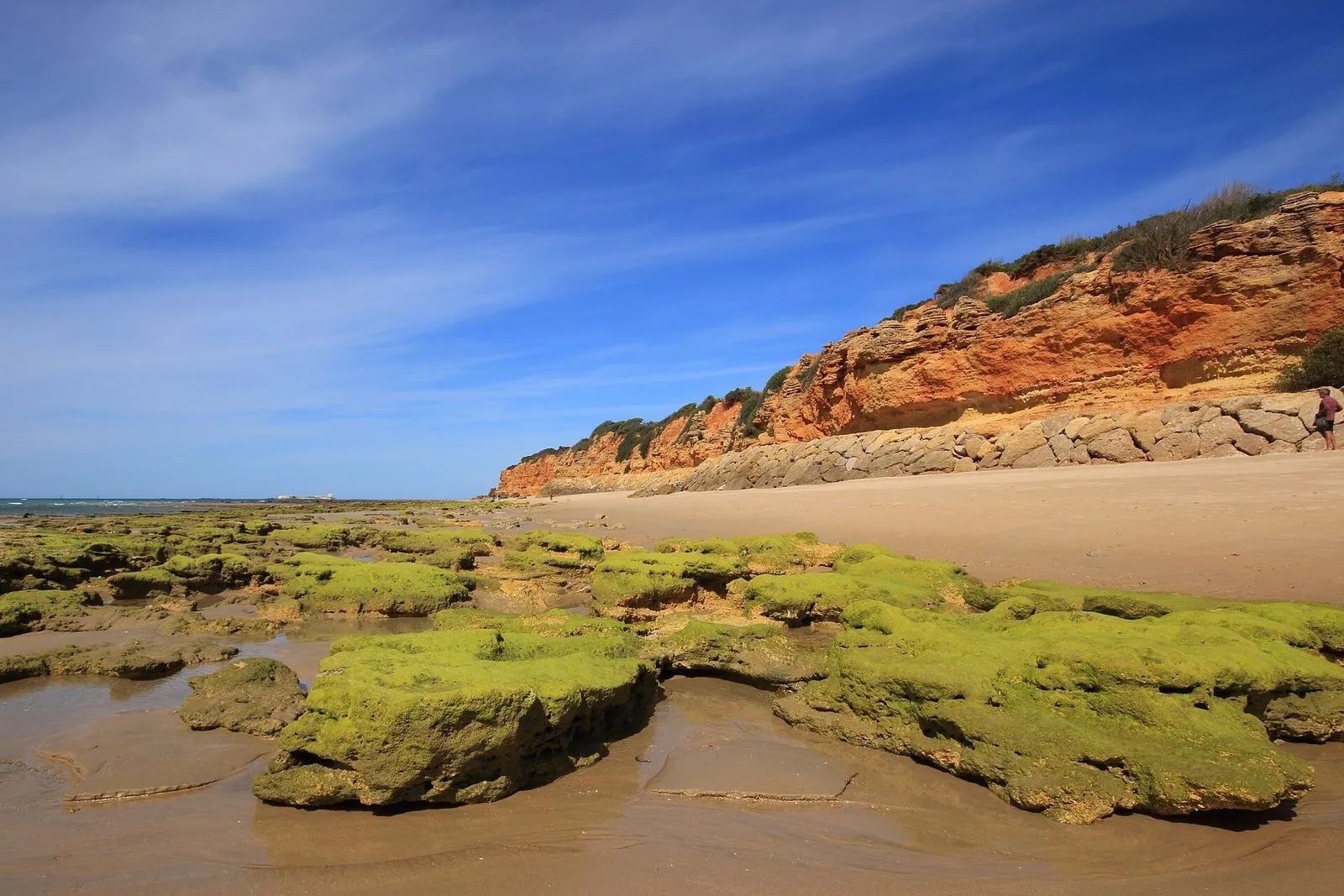
At the southern end, the Torre del Puerco is a 16th-century watchtower built under Philip II to look out for Barbary pirates, standing on low cliffs of fossil dunes. A path runs along the cliff top, and below it the beach continues south towards Roche and Conil, quieter and wilder than La Barrosa proper. It is a popular spot for sunset.
The area is also where the Battle of Barrosa (or Battle of Chiclana) was fought in March 1811, when a British and Spanish force defeated the French during the Peninsular War.
Sancti Petri: the village and the castle
At the northern tip of the coast, Sancti Petri is a former almadraba (tuna-fishing) village built by the state tuna consortium from 1929. The fishing stopped in the early 1970s, the families left, and the village was later used by the army. Today it is a mix of ruins, a restored chapel, a sailing club, a marina and a row of seafood restaurants looking over the channel. It is atmospheric rather than pretty, and in our view at its best at lunchtime or at sunset.
Offshore stands the Castillo de Sancti Petri, an 18th-century fort on a rocky islet at the mouth of the Caño de Sancti Petri, the channel that leads into the Bay of Cádiz. Ancient writers describe a great temple of Melqart, the god the Greeks and Romans called Hercules, somewhere near Gades (Cádiz), and tradition places it on or near this islet. Its exact site has never been confirmed, so we’d treat the legend as part of the fun.
Visiting the castle: you can only reach it by boat or kayak from the Sancti Petri marina, a crossing of about 15 minutes. In 2026 a boat trip with entry cost about €15 for adults, with guided and unguided visits from Tuesday to Sunday. Boats and tours around the castle also run from the marina. Boat trips to Sancti Petri castle.
The salt marshes and the Bahía de Cádiz natural park
Much of Chiclana’s land lies inside the Parque Natural Bahía de Cádiz, a maze of tidal channels, marshes and old salt pans. Only a few salt pans are still worked by hand. The best place to see them, we think, is the Salina Santa María de Jesús (Salinas de Chiclana), now an environmental centre, where you can learn how sea salt is made and, in season, eat fish from the esteros (the salt-pan ponds). The marshes are also good for birdwatching, and the Sancti Petri channel is the calm place for paddle boarding and kayaking.
The old town
Chiclana’s centre is small and easy to walk in a couple of hours.
- Iglesia de San Juan Bautista: the main church on the Plaza Mayor, built from 1773 to 1814 to designs by Torcuato Cayón. It is one of the landmarks of neoclassical church architecture in the province, with a cathedral-like interior.
- Museo de Chiclana: next to the church in an 18th-century house, with local history from prehistory to the Napoleonic period, wine-making traditions and a room on the writer Fernando Quiñones. Entry is free; closed on Mondays.
- Centro de Interpretación del Vino y la Sal: opposite the market, a free centre on the town’s two traditional industries, wine and salt. In our view, a good first stop before a bodega visit.
Chiclana wine
Chiclana lies inside the sherry region (the Marco de Jerez) and has made wine for centuries. Locals drink their own fino, moscatel and, in winter, young mosto in old bars and ventas. Several family bodegas open to visitors, usually by appointment, including Primitivo Collantes, founded in 1830 and known for its Fino Arroyuelo, San Sebastián, Manuel Aragón “El Sanatorio” and the Unión de Viticultores Chiclaneros co-operative. For the big sherry houses, go on to Jerez, about 40 minutes away.
Golf and water sports
Golf is a big draw at Novo Sancti Petri. Real Novo Sancti Petri, opened in 1990, was the first course in Spain designed by Seve Ballesteros, with holes running through pines close to the sea. More courses lie nearby, and several resort hotels sell golf packages.
On the water, La Barrosa has surf and kitesurf schools, and the calmer Sancti Petri channel is used for paddle boarding, kayaking and sailing. The waves are small in summer, which suits beginners. Serious kitesurfers usually head to Tarifa.
Food
Chiclana eats like the rest of the Bay of Cádiz: fried fish, prawns, clams, grilled fish from the esteros, and tuna in spring. The restaurants by the Sancti Petri marina are the classic place for seafood with a view; the ventas around town serve local wine with simple country food.
When to go
- June and September: in our view the best months, warm and less crowded.
- July and August: hot and busy, with Spanish families and high prices. We’d book months ahead.
- Spring and October: good for golf, walks and a quieter beach, with some cool days.
- November to March: mild but quiet. Many beach restaurants close and some resorts shut for the winter, so check before you book.
For month-by-month temperatures, see the weather in Cádiz.
Getting to Chiclana
| From | Car | Public transport |
|---|---|---|
| Cádiz | about 25 min | Trambahía tram-train about 35 min, or bus M-020 |
| Jerez airport | about 40–45 min | no direct link; change in Cádiz or take a taxi |
| Seville | about 1 h 30 | Comes bus about 1 h 30–1 h 45, a few a day |
| Málaga | about 2 h 45 | slow; driving is far easier |
- From Cádiz: the Trambahía tram-train runs from Cádiz via San Fernando to Chiclana in a little over half an hour, and the M-020 bus links Cádiz with the Chiclana bus station.
- To the beach: in summer, town buses (lines 8 and 11) run frequently from the centre to La Barrosa, Novo Sancti Petri and Sancti Petri. Out of season they run less often.
- By car: we think it is the easiest way, especially from an airport or for day trips. Pick up a car at Jerez airport or Seville airport, and read our car hire guide. Most resort hotels have parking.
- From Seville by bus: Comes runs direct buses from the Prado de San Sebastián station. Compare times: Seville to Chiclana by bus.
We think Chiclana is too far for a comfortable day trip from Seville; for that, see the Cádiz day trip from Seville.
Where to stay in Chiclana
We’d stay on La Barrosa / Novo Sancti Petri for a beach or resort holiday, which is what most visitors come for. The old town is cheaper but you will need transport to the beach. For the whole province, see where to stay in Cádiz.
- Hipotels Barrosa Palace & Spa: a five-star hotel in Andalusian palace style right on the beach, with a spa and direct beach access. Rated 9.4 on Booking.
- Hipotels Barrosa Park: a large, family-friendly beachfront hotel with pools and gardens. Rated 9.2.
- Iberostar Selection Andalucía Playa: an Andalusian-style resort just off the beach, with big gardens, pools and a spa. Rated 9.0.
- Royal Hideaway Sancti Petri: a beachfront five-star with several outdoor pools and a very large spa. Rated 8.9.
- More options: hotels and apartments in Sancti Petri and La Barrosa.
Chiclana also works as a base for the rest of the coast: Conil is about 20–25 minutes south, Vejer about 30, and Cádiz 25. To build it into a longer trip, see our Andalusia road trip.
FAQ
Is Chiclana de la Frontera worth visiting?
Yes, for a beach or resort holiday: we think La Barrosa is one of the best family beaches in Andalusia, with good hotels and golf. If you want a charming white town by the sea, we think Conil or Vejer suit you better.
How long is La Barrosa beach?
About 8 km, from the Torre del Puerco in the south to the cliffs near Sancti Petri in the north. It is wide, gently shelving and has a Blue Flag.
Can you visit Sancti Petri castle?
Yes, by boat or kayak from the Sancti Petri marina, a crossing of about 15 minutes. Guided and self-guided visits run most of the year; in 2026 a boat trip with entry cost about €15.
How far is Chiclana from Cádiz?
About 25 km, or 25 minutes by car. The Trambahía tram-train takes a little over half an hour, and there are frequent buses.
Do you need a car in Chiclana?
Not if you stay in a beach resort and are happy with the beach, buses and the tram-train to Cádiz. For day trips to Vejer, Conil, Jerez or the white villages, a car makes life much easier.