
Some links on this page are affiliate links. If you book through them we may earn a commission, at no extra cost to you.
The short answer
Chipiona is a seaside town in the province of Cádiz, at the mouth of the Guadalquivir, on the northern end of the Costa de la Luz. It is the classic summer resort of families from Seville and the rest of Andalusia: sandy beaches, a promenade, ice cream and fried fish, and very few foreign visitors.
- Main sights: the Faro de Chipiona, at about 69 metres the tallest lighthouse in Spain; the corrales, stone fishing weirs uncovered at low tide; the Santuario de Regla; the small castle; and sweet moscatel wine.
- Who it suits: families, budget beach holidays, and anyone who wants to see how Spaniards holiday.
- Time needed: half a day to a day from Jerez or Sanlúcar; a few days to a week as a beach base.
- Car needed? No. The town is flat and walkable, and buses run from Seville, Jerez and Cádiz.
We want to be clear about what it is: in July and August Chipiona is busy, noisy and very Spanish, with packed beaches and apartments full of families. Out of season it is quiet and many places close.
The lighthouse (Faro de Chipiona)
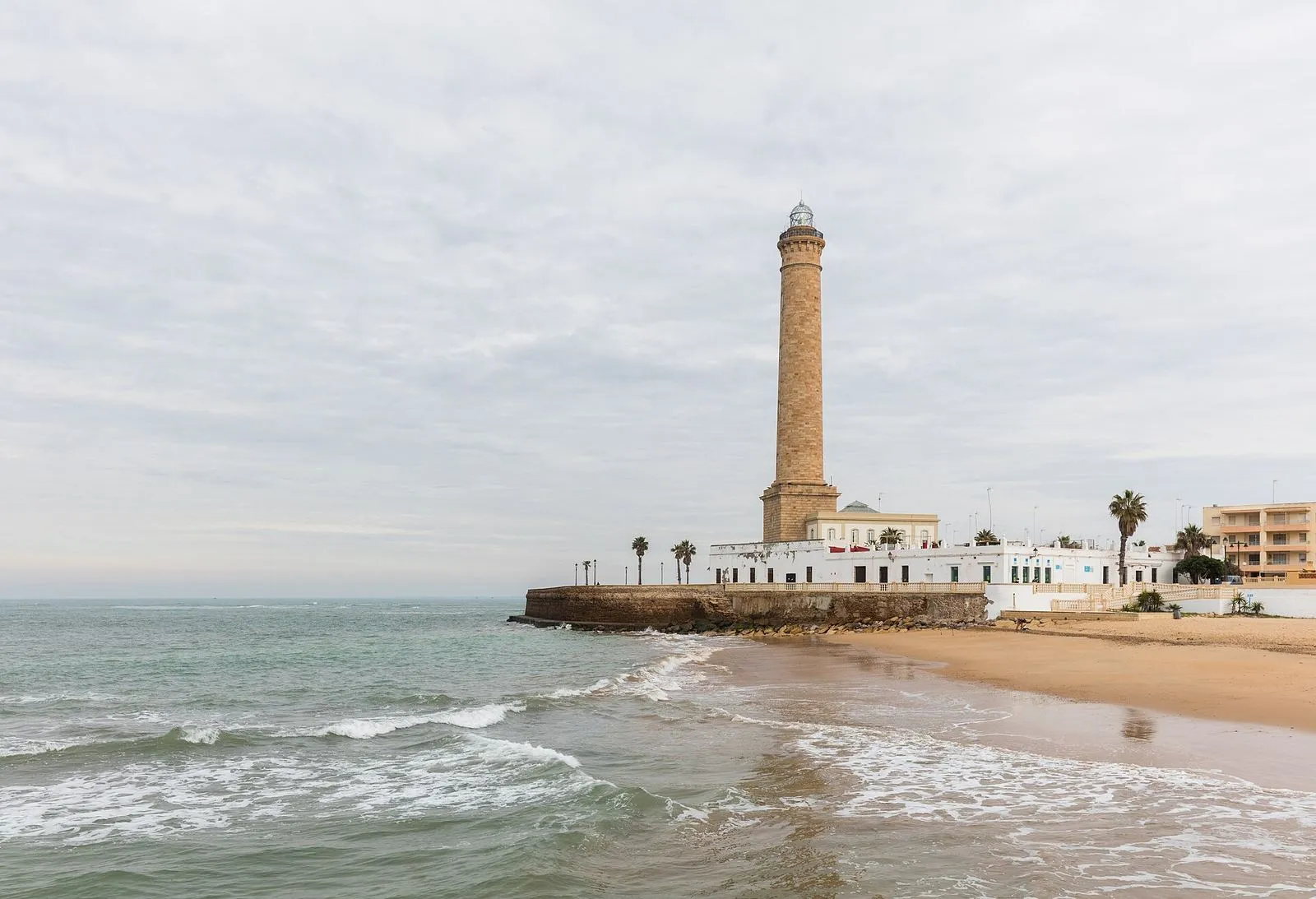
The Faro de Chipiona stands on Punta del Perro, at the west end of Playa de Regla. It was built between 1863 and 1867 and is about 69 metres high, which makes it the tallest lighthouse in Spain. It still guides ships into the Guadalquivir towards Seville. The town takes its name from an older light: a Roman tower built here by the general Quintus Servilius Caepio.
Climbing it: the town runs small guided visits up the 322 steps to the lantern, normally a few mornings a week (more in July and August), for about €5 (children under 7 free, card payment only). You must book in advance with the tourist office (phone 956 929 065). Visits are often suspended: in spring 2026 they were stopped while peregrine falcons nested in the tower. We’d call before you plan around it. From outside, the tower is free to see at any time, and, in our view, best at sunset from Playa de Regla.
The beaches of Chipiona
Chipiona faces west and north-west over the Atlantic and the river mouth. Five beaches had the Blue Flag in 2026. The tide makes a big difference here: at low tide the sand is wide and rock shelves and corrales appear; at high tide some beaches shrink to a strip.
| Beach | Where | Best for |
|---|---|---|
| Playa de Regla | Town centre, from the lighthouse to the Santuario | Families, bars, everything on foot |
| Cruz del Mar | By the port, below the old town | Families, promenade, easy access |
| Las Canteras | North of Cruz del Mar, near the castle | Rock pools, corrales at low tide |
| Micaela (Costa de la Grajuela) | North towards Sanlúcar, small coves | Quiet, even in summer |
| Montijo | Further north, near the Sanlúcar boundary | Shells, space, few services |
| Camarón and La Ballena | South, towards Costa Ballena and Rota | Long sandy beaches, dunes, resorts |
- Playa de Regla is the main beach, around a kilometre of sand between the lighthouse and the Santuario, with lifeguards, beach bars and the busiest promenade.
- Cruz del Mar is the small town beach by the port, with a renovated promenade and good wheelchair access. It joins Las Canteras, where flat rocks and the stone walls of the corrales appear at low tide.
- Micaela and Montijo, north towards Sanlúcar, are smaller, sandier and quieter, with fewer services and limited parking.
- Camarón and La Ballena, to the south, are long beaches backed by dunes. La Ballena runs in front of Costa Ballena, a golf and resort development shared with Rota.
The wind: Chipiona is less windy than Tarifa and the southern Costa de la Luz. The strong easterly levante blows from the land here, so the sea is often flatter, but the air gets hot and fine sand can blow on the open beaches. The westerly poniente is cooler and brings small waves. For the weather month by month, see Cádiz weather.
The corrales de pesca
The corrales are low stone walls built in the sea, forming enclosures that fill at high tide and trap fish as the water drops. The technique is very old, possibly older than the Romans, and a few families still fish them on foot at low tide. The corrales of Chipiona and Rota are protected as the Monumento Natural Corrales de Rota, the first natural monument declared in Andalusia (2001).
You can see them from the promenade at Las Canteras and Cruz del Mar at low tide. In August and September, the tourist office usually runs free guided walks with the fishers, in small groups; we’d book in advance.
The town: Regla, the castle and Rocío Jurado
- Santuario de Nuestra Señora de Regla: the town’s great church, on the seafront at the east end of Playa de Regla. The present neo-Gothic building dates from 1904–1909, but the site goes back to a castle given to the Augustinians in 1399, and the Mudéjar cloister is from the 15th century. Franciscans have run it since 1882. The feast of the Virgen de Regla, on 8 September, is the town’s biggest.
- Castillo de Chipiona: a small 15th-century castle above Cruz del Mar, built by the Ponce de León family. Inside is the “Cádiz y el Nuevo Mundo” interpretation centre, on the province’s role in the voyages to America, open mornings from Tuesday to Sunday for about €2.
- The old town: a few streets of white houses around the castle and Calle Isaac Peral, the pedestrian street of shops and terraces. Busy on summer evenings.
- Rocío Jurado: the singer, one of the great voices of Spanish copla, was born here in 1944, and the town treats her like a saint. The Centro de Interpretación Rocío Jurado, opened in 2022, shows hundreds of her stage dresses, awards and her car (about €9, closed Mondays; tickets at rociojurado.es). Her bronze monument stands on a roundabout on Avenida de Rocío Jurado, and her mausoleum is in the San José cemetery.
Moscatel wine and bodegas
Chipiona is one of the towns of the sherry region, and its speciality is moscatel: a sweet wine made from Moscatel de Alejandría grapes, often dried in the sun before pressing. Bodegas César Florido, a small family bodega in town, is known for its moscatel and has a shop and tasting bar. Other bars and shops around the centre sell local moscatel by the glass or bottle. For the dry wines, go to Sanlúcar (manzanilla) and Jerez (sherry).
Day trips from Chipiona
- Sanlúcar de Barrameda (about 10 minutes by car): manzanilla bodegas, prawns on the Bajo de Guía waterfront, and the Real Fernando boat into Doñana National Park, a trip of about 2 h 30–2 h 45 including a stop of about an hour in the park; book ahead with the operator. See our Sanlúcar guide.
- Jerez de la Frontera (about 35–40 minutes): sherry bodegas, flamenco and the Royal Andalusian School of Equestrian Art. See our Jerez guide.
- Rota (about 20 minutes): another beach town with its own corrales and a pleasant old town, past Costa Ballena.
- Cádiz (about 50 minutes): the old port city surrounded by the sea. See our Cádiz guide.
- The Huelva coast lies across the river mouth, but there is no road through Doñana; it is more than two hours by road via Seville. See our Huelva guide.
Getting to Chipiona
There is no train to Chipiona. The nearest airport is Jerez, about 40 km away.
| From | Car | Bus |
|---|---|---|
| Jerez airport | about 35–40 min | no direct bus; change in Jerez |
| Jerez | about 35–40 min | about 1 h (Consorcio de Transportes Bahía de Cádiz) |
| Sanlúcar | about 10 min | about 15–20 min, frequent (Consorcio) |
| Cádiz | about 50 min | about 1 h 15–1 h 30, a few a day (Consorcio) |
| Seville | about 1 h 15 | about 1 h 45–2 h 15, several a day (Damas, from Prado de San Sebastián) |
- By car: handy for day trips and the quieter beaches. Pick up a car at Jerez airport or Seville airport and read our car hire guide. Parking in the centre is hard in August.
- By bus: Damas runs from Seville’s Prado de San Sebastián station, with extra buses in summer. Compare times: Seville to Chipiona by bus. From Jerez and Cádiz, use the Consorcio buses; we’d buy a Consorcio travel card if you will use them often.
Chipiona also fits on a loop through the Sherry Triangle and the coast: see our Andalusia road trip.
Where to stay in Chipiona
We’d stay near Playa de Regla or Cruz del Mar to walk to the beach and the centre. Most visitors rent apartments; we’d book early for July and August. For bigger resort hotels, look at Costa Ballena, and for more options across the province, see where to stay in Cádiz.
- Hotel Agaró: a modern four-star hotel on the seafront by Playa de Regla, with an infinity pool facing the Atlantic and two restaurants (rated 8.8 on Booking).
- Sercotel Cruz del Mar: a four-star hotel on the promenade at Cruz del Mar, with a rooftop pool and sea views (rated 8.8 on Booking).
- Hotel La Española: a small two-star hotel on Calle Isaac Peral, a short walk from Cruz del Mar, with an Andalusian patio and a roof terrace looking at the lighthouse and the castle (rated 9.1 on Booking).
- More options: hotels and apartments in Chipiona.
When to go
- June and September: in our view the best months: warm sea, open beach bars and fewer people than in August. Early September brings the Virgen de Regla festivities.
- July and August: hot, crowded and lively, with Spanish families and the highest prices.
- May and October: mild and quiet, good for walking, the lighthouse and wine, with cool water.
- November to March: very quiet; many restaurants and apartments close.
FAQ
Is Chipiona worth visiting?
Yes, in our view, for a relaxed, affordable Spanish beach holiday with long sandy beaches and good food. It has less to see than Cádiz or Jerez, and in August it is very crowded.
Can you climb the Chipiona lighthouse?
Normally yes, on small guided visits of about €5 booked through the tourist office. Visits are sometimes suspended, as they were in 2026, so call the tourist office before you go.
What is the best beach in Chipiona?
Playa de Regla is the main family beach, with everything on foot. For a quieter day, we’d head north to Micaela and Montijo, or south to the long, dune-backed beaches of Camarón and La Ballena.
What are the corrales of Chipiona?
Ancient stone fishing weirs in the sea that trap fish as the tide goes out. You can see them at low tide from Las Canteras and Cruz del Mar, and join free guided walks in August and September.
How do you get to Chipiona without a car?
By Damas bus from Seville (about 2 hours) or by Consorcio bus from Jerez (about an hour), Sanlúcar or Cádiz. There is no train; the nearest station and airport are in Jerez.