
Some links on this page are affiliate links. If you book through them we may earn a commission, at no extra cost to you.
The short answer
Cabo de Gata is the Cabo de Gata-Níjar Natural Park, about 40 minutes east of Almería: a volcanic coast of cliffs, dark hills, white villages and some of the least built-up beaches on the Mediterranean. It is one of the driest corners of Europe, so expect bare, desert-like hills and a very clear sea.
- Best beaches: Mónsul, Genoveses and the Barronal coves near San José; Playa de los Muertos near Carboneras; Cala de San Pedro and Cala de Enmedio, reached only on foot or by boat.
- Summer rule: from late June to late September, car access to the beaches west of San José (Genoveses to Cala Carbón) is capped. We’d arrive before about 9:00 or take the shuttle bus from San José.
- Best base: San José for the southern beaches; Agua Amarga or Las Negras for the north.
- Time needed: a long day gives you a taste; we think three to five nights is better.
- You need a car. Buses from Almería reach San José a few times a day, and not much else.
What the natural park is
The park covers the coast from the edge of Almería city to Agua Amarga, plus a strip of sea. It is the remains of volcanoes that erupted millions of years ago, which explains the black and red rock, the columns of lava and the reefs off the lighthouse. It was the first park in Andalusia to protect land and sea together, and it is also a UNESCO biosphere reserve and a UNESCO Global Geopark.
You often read that it is “the driest place in Europe”. Rainfall at the lighthouse is only around 150–200 mm a year, among the lowest in mainland Europe, though a few other spots in south-east Spain make similar claims. In practice: little shade, strong sun, and fields of agave, dwarf palms and prickly pear. After a wet winter the hills turn briefly green and flower in spring.
The beaches
Most beaches have no services. Bring water, shade and food, and take your rubbish with you.
| Beach | Type | How to get there | Best for |
|---|---|---|---|
| Genoveses | Wide golden sand, shallow | Dirt road from San José, 1.5 km; summer shuttle | Families |
| Barronal and its coves | Sand coves between the two | Short walk from the Barronal stop | Quieter swims, nudist-friendly |
| Mónsul | Sand, dune and volcanic rocks | Dirt road, about 4 km from San José; summer shuttle | The classic view |
| Cala de Enmedio | Small sandy cove, white rocks | 30–40 min walk from Agua Amarga | Snorkelling |
| Playa de los Muertos | Long, pale pebbles, turquoise water | 15–20 min steep path from the road | Clear water |
| Los Escullos | Sand below a fossil dune and fort | By car, easy parking | Easy, with a bar |
| Playazo de Rodalquilar | Wide sandy bay | Track from the Rodalquilar road | Space, no crowds |
| Agua Amarga | Village beach | In the village | Services and restaurants |
| Cala de San Pedro | Cove with a spring and a small hippy community | About 1 h walk from Las Negras, or boat taxi | Adventure |
Mónsul, Genoveses and the Barronal coves
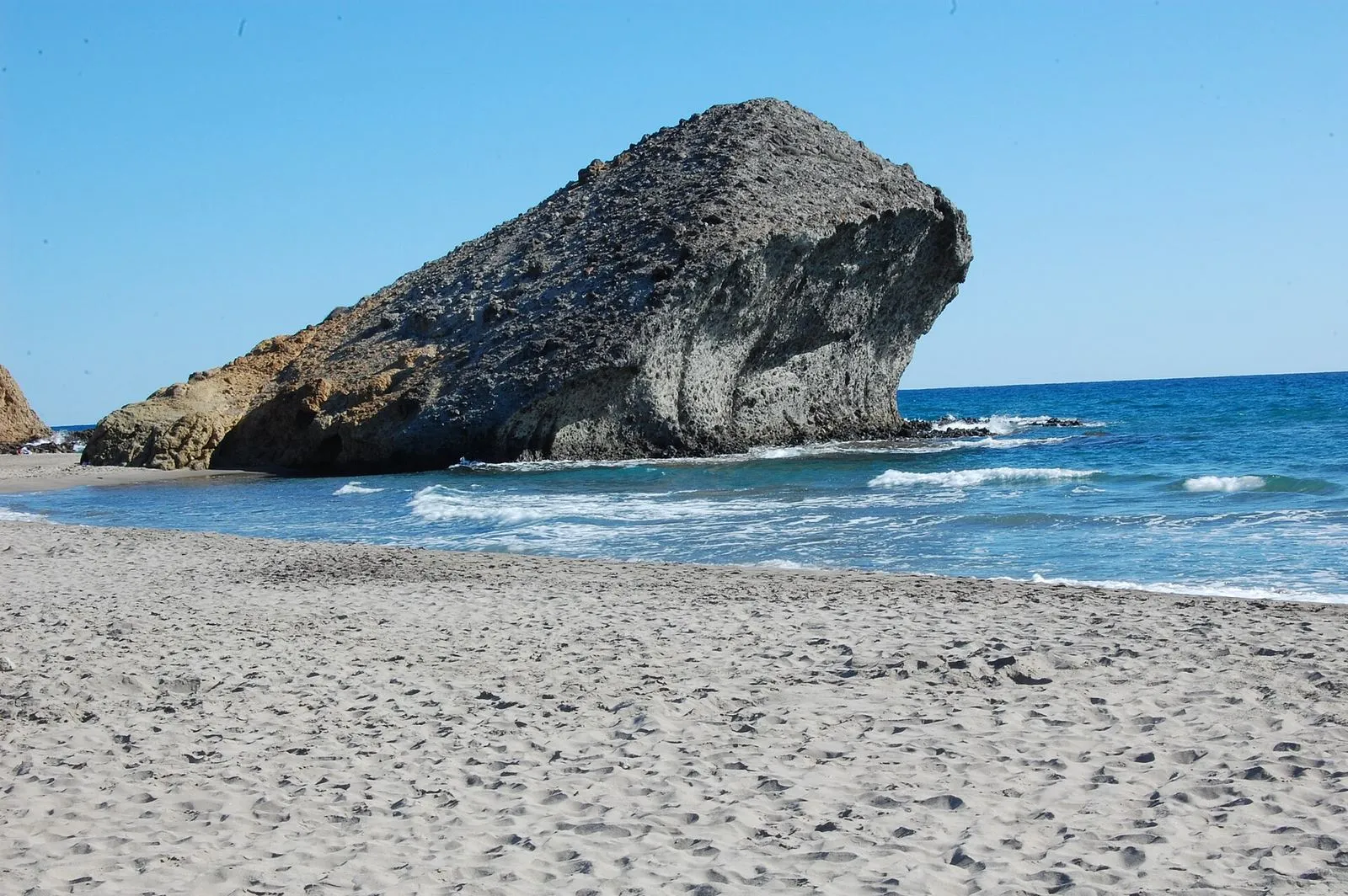
These three are the reason most people come. Genoveses is a long, shallow bay backed by eucalyptus and dunes, good for children. Mónsul is smaller and more dramatic, with a big sand dune at one end and the rock shaped like a wave that you may recognise from Indiana Jones and the Last Crusade. Between them, the Barronal coves are quieter, and naturists use some of them. Further on, Media Luna and Cala Carbón are smaller and stonier.
All are reached from San José on a dirt road. Walkers and cyclists can use it freely all year: it is about 1.5 km to Genoveses and 4 km to Mónsul, with no shade.
Summer access to Mónsul and Genoveses
Each summer the park limits cars on this road. In 2026 the rule ran from 20 June to 27 September. In practice:
- The car parks by the beaches hold a few hundred cars and charge a fee of about €5–6 a day. When they are full, a barrier closes and only lets cars in as others leave. At night the road is closed to vehicles, which keeps campervans out.
- We recommend arriving before about 9:00 in July and August if you want to drive in.
- A shuttle bus runs from San José roughly every hour from mid-morning to early evening, for a euro or two a trip, stopping at Genoveses, Barronal, Mónsul, Media Luna and Cala Carbón. Buy tickets at the tourist office on San José’s main street. It fills up at peak hours, so allow time.
The dates and fees are set each year, so check before you go.
Playa de los Muertos
Near Carboneras, at the northern end of the park, this is a long curve of pale pebbles with extraordinarily clear, turquoise water. Park by the road between Carboneras and Agua Amarga (a charge applies in July and August) and walk down a steep path of about 15–20 minutes. The climb back up in the heat is the hard part. There is no shade, no bar and no lifeguard on most days.
The northern coves
From Agua Amarga, a coastal path climbs over the headland to Cala de Enmedio, a small sandy cove framed by white, wave-smoothed rocks, in about 30–40 minutes. From Las Negras, a path of about an hour leads over the cliffs to Cala de San Pedro, which has no road, a freshwater spring, the ruins of a castle and a small community living in tents and huts. In summer a boat taxi runs from Las Negras beach in about ten minutes.
The villages
- San José: the main village and, in our view, the best base, with a sandy beach, a marina, most of the hotels and restaurants, the tourist office and the boat and kayak trips. Busy in August.
- La Isleta del Moro: a tiny fishing village on a rocky point, with a couple of fish restaurants and good snorkelling.
- Los Escullos: a beach and a few houses beside the 18th-century Castillo de San Felipe, built on a fossil dune to guard against pirates.
- Rodalquilar: a former gold-mining village. The ruined mine works on the hill above it can be explored on foot, and the Casa de los Volcanes, an eco-museum in the old mine buildings, explains the volcanoes and the mining history (mornings only, closed Mondays).
- Las Negras: relaxed, with a dark volcanic beach and a hippy past. The start of the walk and boat to Cala de San Pedro.
- Agua Amarga: the most polished village, at the north end, with a sandy beach and some of the best small hotels.
- Níjar: a white hill town inland, about 30 minutes from San José, known for its glazed pottery in green and blue and its jarapas, colourful rag rugs.
The lighthouse, the salt flats and the flamingos
On the western side of the park, the road from Almería passes the village of Cabo de Gata (San Miguel de Cabo de Gata) and its long beach, then the salinas, working salt pans that attract greater flamingos and many other water birds. There are hides and viewing points by the road; we’d bring binoculars. Flamingos are usually present much of the year.
The road ends at the Faro de Cabo de Gata, a lighthouse from the 1860s. From the viewpoint below it you see the Arrecife de las Sirenas, jagged volcanic reefs in the sea. The name comes from the monk seals that once lived here, which sailors took for mermaids. A narrower road continues towards the Vela Blanca tower, with traffic restricted because it crosses a reserve area; from there walkers can continue to Mónsul and San José.
Walks, snorkelling, kayaks and boats
- Walks: a coastal path runs almost the whole length of the park; the short sections to the beaches above are the best. We’d avoid the middle of the day from June to September.
- Snorkelling: the water is clear and the park protects large meadows of Posidonia seagrass. We’d try the rocks at La Isleta del Moro, Los Escullos, Cala de Enmedio and the ends of Mónsul.
- Kayaks: guided kayak trips leave San José, Las Negras and La Isleta for caves and coves you cannot reach by land: kayak tours in Cabo de Gata. In summer, groups of more than five kayaks or similar craft need an authorisation, so go with an operator.
- Boat trips: from San José and Las Negras, usually 2–3 hours with a swimming stop: boat trips in Cabo de Gata.
Where to stay
San José has the most choice; Agua Amarga is quieter and a little more upmarket. The hotels below scored 8.5 or more on Booking.com when we checked.
- Hotel MC San José: a small hotel in San José, a short walk from the beach and the shuttle. Rated 8.8.
- Cortijo El Sotillo: a country hotel in an old farmhouse just outside San José, handy for driving to Genoveses and Mónsul. Rated 8.8.
- miKasa Agua Amarga & Spa: a boutique hotel with a spa in Agua Amarga, a short walk from the beach. Rated 9.3.
- Hotel Senderos: a small hotel in the village of Agua Amarga. Rated 9.1.
- More options: hotels in San José and hotels in Agua Amarga. Much of the accommodation is holiday rentals, and August books up months ahead.
When to go
The sea is warmest from July to September. Averages for the Almería coast:
| Month | Sea | Air (max) | What to expect |
|---|---|---|---|
| May | about 18 °C | about 24 °C | Flowers, empty beaches, cool swims |
| June | about 21 °C | about 28 °C | Good all round, busier from late June |
| July–August | 24–25 °C | 30–31 °C | Hot, crowded, car limits in force |
| September | about 24 °C | about 28 °C | The best month for swimming |
| October | about 21 °C | about 25 °C | Warm sea, quiet villages |
We’d avoid August if you can: June and September give you the same beaches with far fewer people. In winter the park is good for walking, but many restaurants close. See also the best time to visit Andalusia.
Getting there and around
| From | Car | Bus |
|---|---|---|
| Almería city | about 40 min to San José | a few a day to San José (Autocares Bernardo), about 1 h |
| Almería airport | about 35 min | via Almería city |
| Mojácar | about 40 min to Agua Amarga, 1 h 15 to San José | not practical |
| Granada | about 2 h 30 | via Almería |
- By car: the park is best seen by car. The villages are linked by roads that loop inland, so San José to Agua Amarga takes around 40 minutes. Pick up a car at the airport: car hire at Almería airport, and read our car hire guide.
- By bus: buses leave Almería’s bus and train station for San José a few times a day, fewer at weekends. Other villages have little or no service.
Cabo de Gata makes a good final stop on an Andalusia road trip heading east from Granada, and pairs well with Mojácar further north. For more ideas, see the best places in Andalusia.
FAQ
What is the best beach in Cabo de Gata?
Mónsul is the most famous, with its dune and volcanic rocks, and we think Genoveses is the best for families. For the clearest water, Playa de los Muertos near Carboneras is, in our view, hard to beat.
Can you drive to Mónsul and Genoveses in summer?
Yes, but only until the car parks are full. From late June to late September a barrier limits the number of cars, so arrive before about 9:00 or take the shuttle bus from San José.
How do you get to Playa de los Muertos?
Drive to the car park on the road between Carboneras and Agua Amarga, then walk down a steep path of about 15–20 minutes. Parking is paid in July and August.
Where should I stay in Cabo de Gata?
San José is the best base for the southern beaches and has the most hotels and restaurants. Agua Amarga and Las Negras are quieter and closer to Playa de los Muertos and the northern coves.
Can you visit Cabo de Gata without a car?
Only partly. Buses from Almería reach San José a few times a day, and from there the summer shuttle covers Genoveses and Mónsul. For the lighthouse, the northern villages and the other beaches, you need a car or a tour.