The short answer
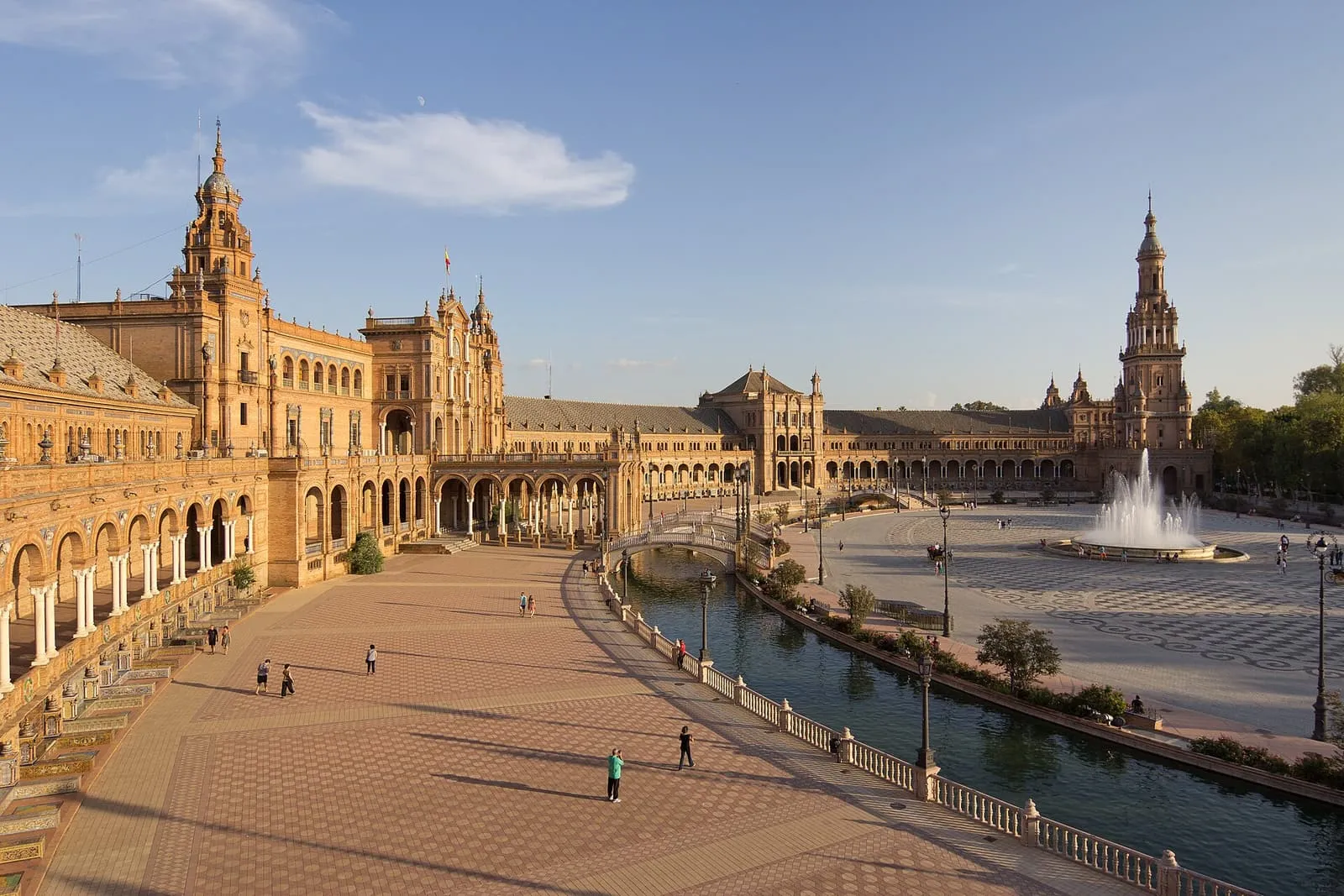
Plaza de España is a huge semicircular square built for the 1929 Ibero-American Exposition, and one of the most photographed places in Spain. It is free, always open, and a 15-minute walk from the cathedral.
- Time needed: about an hour, more if you walk the Parque de María Luisa
- Price: free. Rowing boats on the canal cost about €6 for 35 minutes
- Best time: early morning for empty photos, or late afternoon for warm light on the brick
- Where: on the edge of the Parque de María Luisa, south of the historic centre
What to see
- The building. A 200-metre arc of brick, marble and ceramics by the architect Aníbal González, with two tall towers at each end, in a mix of Renaissance, Baroque and Mudéjar revival styles.
- The province alcoves. Along the base of the building, 48 tiled benches show a map and a scene from the history of each Spanish province, in alphabetical order. Spanish visitors look for their own province, so do you.
- The canal and bridges. A 500-metre canal follows the curve of the building, crossed by four bridges, one for each of the old kingdoms of Spain, with tiled balustrades.
- The upper gallery. Climb one of the staircases to the first-floor gallery for the view over the square and the fountain.
- The central fountain, by Vicente Traver.
Film fans: the plaza appears in Lawrence of Arabia and as the city of Theed on Naboo in Star Wars: Episode II – Attack of the Clones.
Opening hours and access
The square is open to the public and free. The surrounding Parque de María Luisa is open daily from early morning until late evening (later in summer). Much of the building houses government offices and a military museum, which are not part of the usual visit.
Flamenco dancers and guitarists often perform in the colonnade in the afternoon and evening. If you watch, leave a tip.
Tips
- Photos: stand in the middle of the square facing the building, or on one of the bridges. For the whole arc, go up to the gallery. A wide-angle lens helps.
- Boats: the rowing boats are fun with children and give a great angle on the bridges. Queues form in the late afternoon.
- Summer: there is almost no shade in the square. Go before 11:00 or after 19:00, and walk through the shaded park.
- Horse carriages wait around the square and the cathedral. Agree the price before you get in.
Nearby: combine it with
- Parque de María Luisa. Walk south through the park to Plaza de América and its two museums (archaeology and folk arts). Bikes and four-person quadricycles are for hire around the park.
- Real Alcázar and the cathedral. 15 minutes on foot through the Jardines de Murillo and past the university (the old tobacco factory of Carmen). See the Real Alcázar guide.
- Torre del Oro and the river. 10 minutes west.
- Guided walks: many free walking tours end here.
How to get there
- On foot: 15 minutes from the cathedral.
- Tram: Metrocentro to Prado de San Sebastián, then 5 minutes’ walk.
- Metro: Line 1 to Prado de San Sebastián or Puerta de Jerez.
- Bus: several routes stop on Avenida de Portugal and Avenida de Isabel la Católica.
FAQ
Is Plaza de España in Seville free?
Yes. Entry is free and the square is open every day. Only the rowing boats cost money.
How much time do you need at Plaza de España?
About an hour for the square, and one to two hours if you add a walk in the Parque de María Luisa.
When is the best time to visit Plaza de España?
Early in the morning for photos without crowds, or late afternoon for golden light and flamenco performers. Avoid the middle of the day in summer.
Which film was shot at Plaza de España?
Star Wars: Episode II – Attack of the Clones (as the planet Naboo) and Lawrence of Arabia, among others.