
Some links on this page are affiliate links. If you book through them we may earn a commission, at no extra cost to you.
The short answer
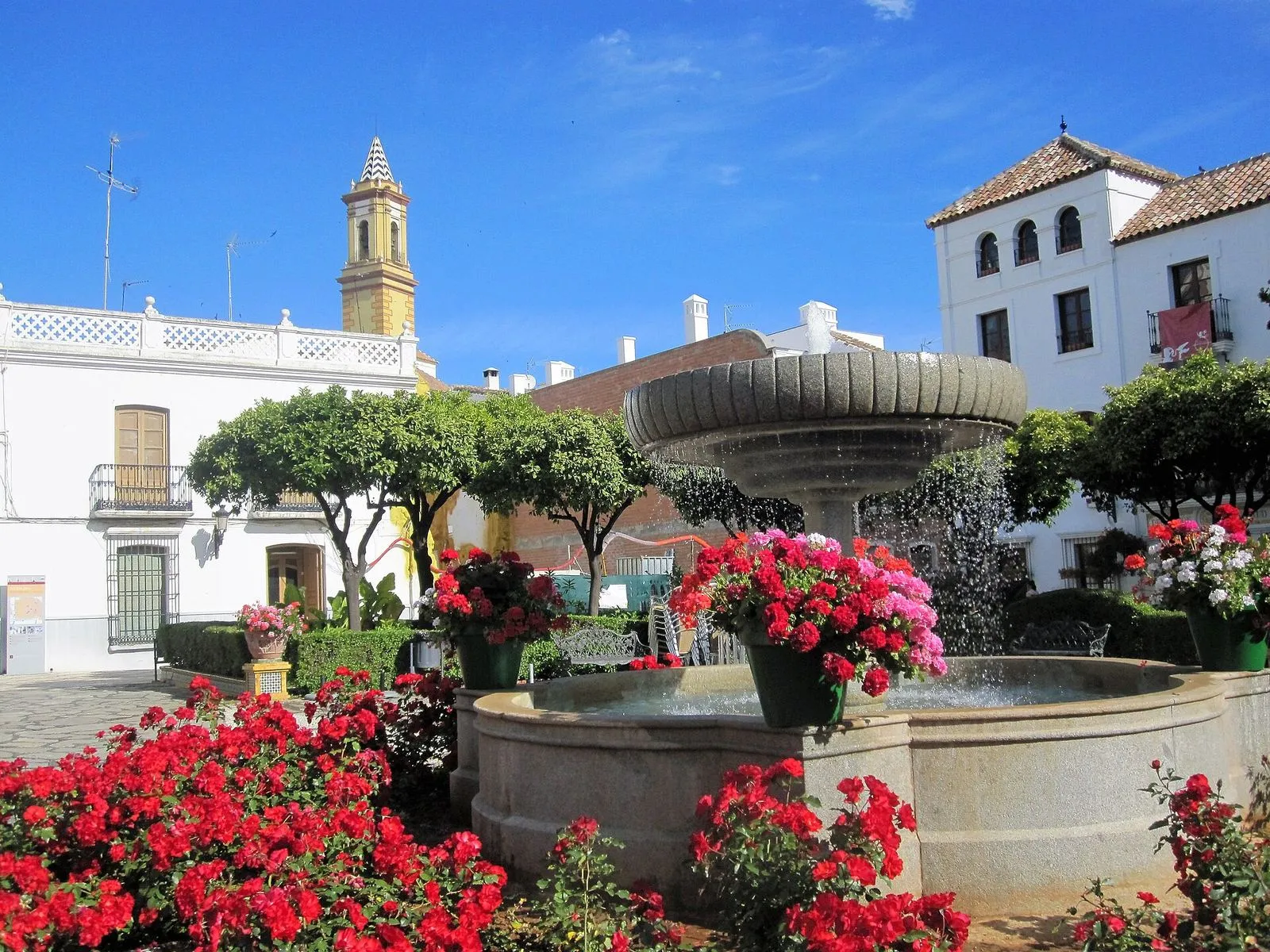
Estepona is the most westerly of the big towns on the Costa del Sol, about an hour’s drive west of Málaga airport and 30 minutes beyond Marbella. It calls itself “the garden of the Costa del Sol” for the flowerpots that cover the white walls of its old town.
- Why go: a pretty, lived-in old town, a route of more than 60 large murals, a long town beach with a promenade, a fishing port and marina, and Casares and Gibraltar within reach.
- Who it suits: couples, older travellers and anyone who wants a calmer base than Marbella or the busy resorts further east, such as Fuengirola.
- Who it doesn’t suit: nightlife seekers, and anyone who wants to arrive by train: there is none.
- Time needed: half a day for the old town and the seafront; 3–7 nights as a beach base.
- Cost: the old town, the murals, the beaches and the promenade are free. The Orchidarium and the Mirador del Carmen cost a few euros.
Estepona or Marbella?
Marbella has the famous names: Puerto Banús, the Golden Mile, beach clubs and nightlife. Estepona is smaller and quieter, with a more Spanish evening scene and generally lower prices. Both have whitewashed old towns, but we think Estepona’s flowers make it the more photogenic of the two. Compared with Torremolinos, Benalmádena and Fuengirola, it is further from the airport and has no train, but it feels far less like a package resort.
Things to do in Estepona
The old town and the flowerpot streets
The casco antiguo is a web of narrow white lanes a few minutes from the beach, largely pedestrianised and restored in recent years. Almost every wall carries flowerpots, and in many streets all the pots share one colour, which changes from street to street. The tourist office promotes a walking route, Rincones con Encanto (charming corners), that links the prettiest lanes and squares.
We’d start at the Plaza de las Flores, the main square, with orange trees, a central fountain, café terraces and the tourist office, then walk Calle Real, the long shopping street through the centre. Look out for:
- the Torre del Reloj, the clock tower that is all that remains of the town’s first church, damaged in the Lisbon earthquake of 1755;
- the Iglesia de Nuestra Señora de los Remedios, an 18th-century church that began as a convent chapel, on Plaza de San Francisco;
- the remains of the Castillo de San Luis, a 16th-century fort near the clock tower.
In our view the lanes are at their best early in the morning or in the evening, when locals come out and the light is soft.
The mural route (Ruta de Murales)
Since 2012, artists from Spain and abroad have painted more than 60 large murals on the sides of apartment blocks, turning Estepona into an open-air gallery. Some cover whole buildings. They are spread across different neighbourhoods, many away from the old town, so we’d download the official map from the tourism website or pick one up at the tourist office, and allow a couple of hours on foot.
The Orchidarium (Orquidario)
The Parque Botánico-Orquidario, on the edge of the old town, is a botanical garden with three glass domes, the tallest about 30 metres high. Inside are more than 1,500 species of orchid, which the town says is the largest collection of living orchids open to the public in Europe, and a 15-metre indoor waterfall. We think it is a good hour on a hot or rainy day.
- Hours: Tuesday to Saturday 10:00–13:30 and 15:00–18:00; Sundays and public holidays 10:00–14:00. Closed on Mondays.
- Price: €5 for adults, €3 for children aged 6–12 and seniors. Pay at the door.
The Mirador del Carmen
On the seafront avenue, the Mirador del Carmen is a modern cultural centre with a library, a music school and a tower more than 30 metres tall. The viewing platform at the top looks over the rooftops, the coast and, on clear days, towards Gibraltar and Africa. Entry to the viewpoint costs €3.
The beaches and the Paseo Marítimo
Playa de La Rada is the main town beach: about 2.6 km of grey, fine sand in front of the centre, with sunbeds, chiringuitos (beach restaurants) and usually a Blue Flag. Behind it, the Paseo Marítimo is a wide, palm-lined promenade with gardens, sculptures and play areas, good for an evening walk.
Playa del Cristo, just west of the port, is a sheltered cove of about 700 metres between two rocky points, with calm water and usually a Blue Flag. It is the favourite with families. East of town, quieter beaches such as El Saladillo sit between the housing developments.
Like the rest of the coast, the sand is not golden. For comparison, see the beaches section of the Costa del Sol guide.
The port and the Sunday markets
At the western end of La Rada, the port combines a fishing harbour and a marina lined with bars and restaurants. On Sunday mornings (9:00–14:00), about 50 stalls fill the port with crafts, clothes, leather and bric-a-brac. On the same morning, a second-hand and antiques market is held at the bullring, and the weekly street market takes place on Wednesday mornings.
Selwo Aventura
Selwo Aventura is a safari park east of Estepona, just off the A-7, with more than 2,000 animals. You walk between enclosures and can add a guided off-road safari, a zip line and other extras. It suits families and needs half a day. The park is seasonal, and online tickets start at about €19.90 for adults, less than at the gate, so check the calendar on its website first.
Day trips from Estepona
- Casares: a white village spilling down a hill below a Moorish castle, about 20–25 minutes inland by car. It is the birthplace of Blas Infante, the father of Andalusian nationalism. See other white villages.
- Sotogrande: about 25 minutes west, a smart estate known for polo, golf and its marina. See the Sotogrande guide.
- Gibraltar: about 45 minutes to the border at La Línea, then walk across. Bring your passport. See the Gibraltar guide or a Gibraltar day trip from Marbella.
- Ronda: about 1 h 10 by car over the mountains. See the Ronda guide or a Ronda day trip from Marbella.
- Marbella and Mijas: Marbella is 30 minutes east; the white village of Mijas is about 50 minutes.
Food
Estepona is a fishing town, so we’d eat fish: fried fish, espetos (sardines grilled on skewers on the beach) and seafood in the port. The old town’s squares and lanes are full of tapas bars; the streets around Plaza de las Flores and Calle Real are the liveliest. The covered market, the Plaza de Abastos next to the clock tower, is the place to see the day’s catch in the morning.
When to go
- May, June, September and October are, in our view, the best months: warm, with a swimmable sea and fewer people than in high summer.
- July and August are hot and busy, with the highest hotel prices.
- Winter is mild and sunny, about 17 °C at midday, and popular with long-stay visitors. Too cold for most swimmers.
For the month-by-month detail, see the best time to visit Andalusia.
Getting to Estepona
Estepona has no train station. The nearest railway is the C1 from Málaga, which ends at Fuengirola.
| From | Car | Bus |
|---|---|---|
| Málaga airport | about 1 h | about 1 h 05–1 h 15, direct (Avanza) |
| Marbella | about 30 min | frequent, about 45 min |
| Casares | 20–25 min | a few a day |
| Gibraltar (La Línea) | about 45 min | a few a day |
- By bus: Avanza runs direct buses from Málaga airport, about 17 a day, and from Málaga bus station, plus frequent buses from Marbella. Estepona’s bus station is on Avenida del Litoral, next to the conference centre, within walking distance of the old town and the beach. Compare times on Málaga to Estepona by bus.
- By car: take the free A-7 along the coast, or the faster AP-7 toll motorway, which bypasses Fuengirola and Marbella. Tolls are much higher in summer. See car hire at Málaga airport or compare prices on DiscoverCars.
- Parking: the old town is largely pedestrian. We’d use the underground car parks near the seafront and the centre; street parking is hard in summer.
For a longer route, combine Estepona with Ronda, Seville and Granada on an Andalusia road trip, or start with our Málaga guide.
Where to stay in Estepona
We’d stay in or near the old town if you want to walk to restaurants and the beach. The big resort hotels are spread along the coast on either side of town.
- Hotel Boutique Casa Veracruz: restored old houses in the heart of the old town, about 300 metres from La Rada beach and close to the Orchidarium.
- The Old Town: an adults-only boutique hotel in the old town, with a rooftop bar.
- H10 Estepona Palace: a four-star beachfront hotel on Guadalobón beach, about 1.5 km west of the port, with pools and a spa.
- Elba Estepona Gran Hotel & Thalasso Spa: a five-star beachfront hotel just outside town, with a large seawater spa.
- More options: hotels in Estepona’s old town.
Sights at a glance
| Sight | Price | Time needed |
|---|---|---|
| Old town and flowerpot streets | Free | 1–2 h |
| Mural route | Free | About 2 h |
| Orchidarium | €5 | 45 min–1 h |
| Mirador del Carmen | €3 | 30 min |
| La Rada beach and Paseo Marítimo | Free | As long as you like |
| Port and Sunday market | Free | 1–2 h |
| Selwo Aventura | From about €19.90 online | Half a day |
| Casares | Free | Half a day |
FAQ
Is Estepona worth visiting?
Yes. We think it has one of the prettiest old towns on the Costa del Sol, a long beach and a calmer, more Spanish feel than Marbella. It works as a base for a relaxed beach holiday or as a half-day stop on the way to Gibraltar or Casares.
Is Estepona better than Marbella?
It depends on the trip. Estepona is quieter, usually cheaper and prettier in the centre; Marbella has more hotels, restaurants, nightlife and Puerto Banús. They are 30 minutes apart, so it is easy to see one from the other.
How do you get from Málaga airport to Estepona?
Take the direct Avanza bus, which takes a little over an hour, or drive in about an hour on the A-7 or the AP-7 toll road. There is no train.
What is Estepona known for?
Its flower-filled old town, which earned it the name “the garden of the Costa del Sol”, its large murals, the Orchidarium and La Rada beach.
When is the Sunday market in Estepona?
Every Sunday from 9:00 to 14:00 in the port, with a second-hand and antiques market at the bullring on the same morning.
Is Estepona good for families?
Yes. El Cristo beach is sheltered, the promenade has play areas, and Selwo Aventura is just outside town. Evenings are quieter than in the resorts further east.