
Some links on this page are affiliate links. If you book through them we may earn a commission, at no extra cost to you.
The short answer
Torremolinos is the first resort west of Málaga, a town of about 75,000 people whose centre is about 10 minutes from Málaga airport on the C1 train. This is where mass tourism on the Costa del Sol began in the late 1950s and 60s, and it still looks the part: tower-block hotels, a long promenade and wide sandy beaches. It is not pretty, but it is lively, good value and very easy to reach.
- Who it suits: beach holidays without a car, short breaks straight off the plane, LGBTQ+ travellers, nightlife, budget stays and anyone who wants to see Málaga by train.
- Who it doesn’t suit: anyone looking for a pretty old town or quiet beaches in August. For that, look at Nerja.
- Compared with the neighbours: Benalmádena, next door, has a marina and a cable car and feels more family-oriented; Fuengirola is bigger, flatter and more British; Málaga city has the museums and the food, but city beaches.
- Time needed: a day trip from Málaga for the beach and lunch in La Carihuela; 3–7 nights for a beach holiday.
Is Torremolinos worth it?
We think so, if you know what you are getting. Until the 1950s it was a village of fishermen and flour mills, the molinos in its name, powered by the springs above the town. Then came the Hotel Pez Espada, the first luxury hotel on the coast, opened in 1959, followed by artists, film stars and, in the 1960s and 70s, the package-holiday boom that built the high-rise seafront you see today. Parts of it look tired, and the centre is busy and commercial.
What it does well: long, clean, gently shelving beaches, fried fish in La Carihuela, plenty of affordable hotels and a train station in the middle of town. It has also been one of the most open places in Spain for gay travellers since the 1960s.
The beaches
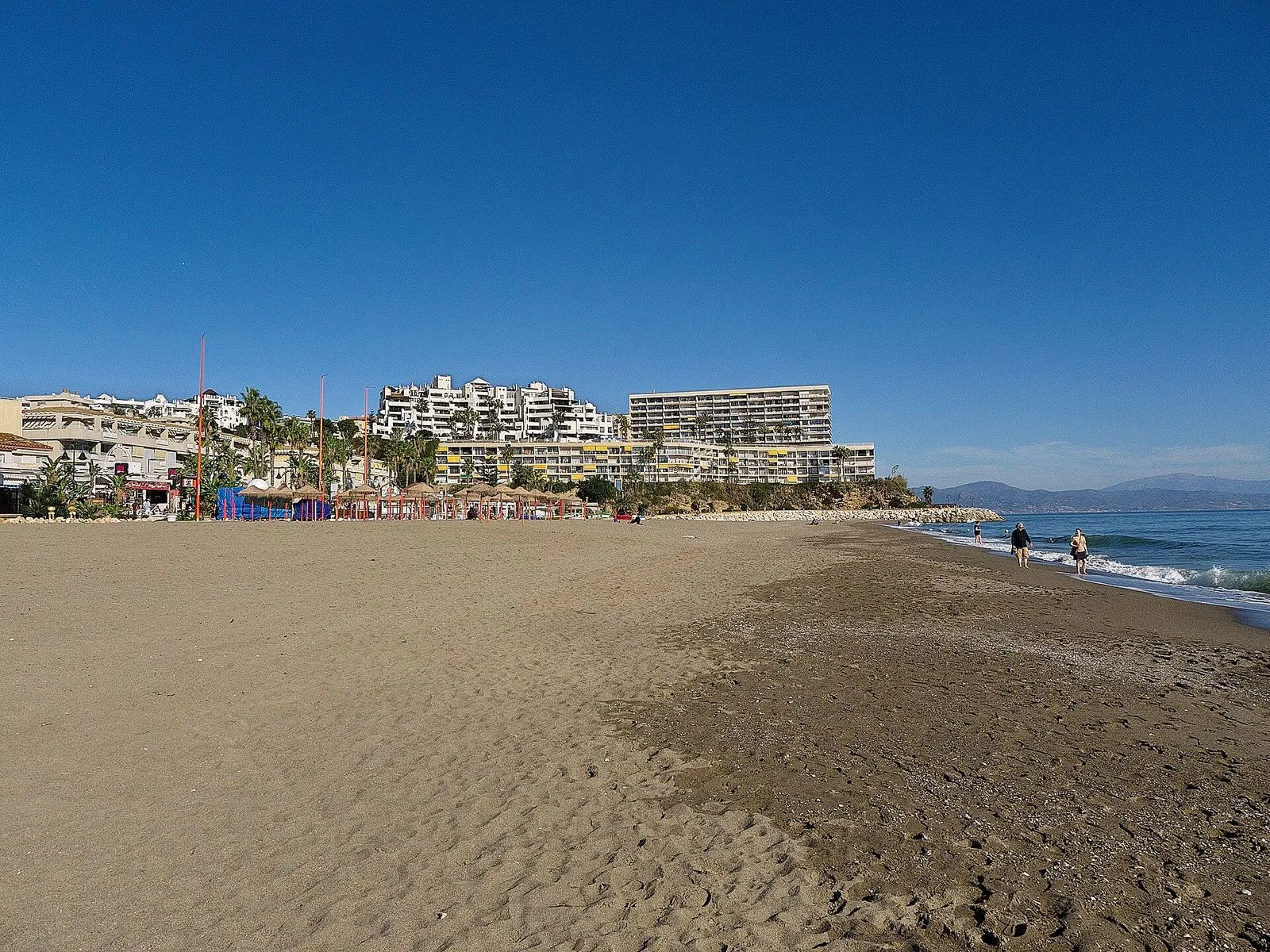
Torremolinos has about 7 km of sandy coast, all joined by a seafront promenade. The sand is grey-brown, as everywhere on this coast, and the beaches are wide, with sunbeds, parasols and chiringuitos (beach restaurants) grilling sardines on skewers. From east to west:
- Los Álamos: at the Málaga end, with modern beach clubs, chill-out music and parties that run from the afternoon past midnight in summer. Younger and louder.
- Playamar: a broad beach in front of the 1970s tower blocks, calmer and popular with families, with beach volleyball and water sports.
- El Lido and El Bajondillo: the town beaches below the centre, reached down the lanes and steps from Calle San Miguel. El Bajondillo, more than a kilometre long, is the busiest stretch.
- La Carihuela: the longest beach, over 2 km, in front of the old fishing quarter and its promenade of fish restaurants.
- Montemar: the western end, towards Benalmádena, a little quieter.
For every beach near the city, see Málaga beaches.
La Carihuela: the fishing quarter and fried fish
La Carihuela is the reason many people come. The old fishermen’s quarter runs along the western promenade, with low white houses and dozens of restaurants facing the sea. The speciality is pescaíto frito: small fried fish such as boquerones (anchovies), squid, cuttlefish and red mullet, served in mixed platters with a salad and lemon. On the beach, espetos, sardines grilled on a cane skewer over an olive-wood fire, are in our view best from May to August.
The best-known address is Casa Juan (Los Mellizos), around a small square just back from the front, known for fried fish and rice dishes. Spaniards eat lunch from about 14:00 and dinner from 21:00, so we’d arrive a little earlier for a table by the sea. On 16 July, the fishermen’s procession for the Virgen del Carmen takes the statue out to sea.
The town centre and Calle San Miguel
The centre sits on the low cliff above the beaches. Calle San Miguel, a long pedestrian street of shops, bars and cafés, is the main strip, running from near the train station down towards the sea. At its lower end stands the Torre de Pimentel, a Nasrid watchtower from around 1300 that gave the town its name (it was once the “tower of the mills”). You can see it from the street, but not go inside.
From there, the steep Cuesta del Tajo drops to El Bajondillo beach. Above the beach, the Casa de los Navajas, a neo-Mudéjar mansion from 1925 with sea views, is owned by the town and used for exhibitions and concerts, with free entry when it is open.
Things to do beyond the beach
- Molino de Inca: a botanical garden of about 15,500 m² at the Los Manantiales springs, with around a thousand plant species, a working replica of the old water mill, a Japanese garden and an aviary. Open from 10:00 to 18:00; small entry fee.
- Crocodile Park: more than 300 crocodiles in lakes and enclosures, with a museum and a nursery. Open all year from 11:00 (to 17:00, or 18:00 in July and August); adults €18.50.
- Aqualand Torremolinos: a large water park with slides, open from April to September (not every day in spring). A combined ticket with the Crocodile Park is available.
- Parque de la Batería: a big free park near Montemar Alto station, built around an old coastal gun battery, with cannons and bunkers, a 15-metre lookout tower and rowing boats on the lake.
- The promenade: we’d walk or cycle west from La Carihuela to Benalmádena’s Puerto Marina, about 3 km along the seafront.
LGBTQ+ Torremolinos
Torremolinos has a real place in Spain’s LGBTQ+ history. In the 1960s, the Pasaje Begoña, a small alley off Calle San Miguel, was full of bars, clubs and music venues, some of them among the first openly gay bars in Spain, at a time when homosexuality was persecuted under Franco. In June 1971, the police raided the alley, detained more than a hundred people and closed the bars. The story made the international press.
Today the Pasaje has bars again, several named after those closed in 1971, and the Andalusian government declared it a Place of Tourist Interest in 2020. The scene spreads from here to La Nogalera, the 1960s complex in the centre, with bars, clubs and drag shows. Pride Torremolinos, usually held from late May into early June, is one of the biggest in Spain.
Nightlife
Torremolinos is livelier at night than most of the coast west of Málaga. Expect bars and clubs around La Nogalera and Calle San Miguel, beach bars on El Bajondillo and summer beach clubs at Los Álamos. La Carihuela is for a long dinner and a drink on the promenade. In summer, many places stay open until the early hours; in winter, the town is much quieter.
Getting there and around
| From | Train (C1) | Car or taxi |
|---|---|---|
| Málaga airport | about 10 min | about 15 min |
| Málaga Centro-Alameda | about 20 min | 20–30 min |
| Benalmádena (Arroyo de la Miel) | about 5 min | about 10 min |
| Fuengirola | about 25 min | about 25 min |
- By train: the Cercanías C1 from Málaga to Fuengirola, via the airport, runs about every 20 minutes from early morning to late evening. It has four stops in town: Los Álamos for the eastern beaches, La Colina, Torremolinos (in the centre, near Calle San Miguel, about 10 minutes’ walk down to El Bajondillo) and Montemar Alto, the closest to La Carihuela and the Parque de la Batería, about 10–15 minutes’ walk from the beach.
- By taxi: from the airport, about 15 minutes, with an official fare of around €16–20.
- By bus: interurban buses link Torremolinos with Málaga and Benalmádena, and local buses run across the town.
- By car: not needed in town, where parking is hard in summer. For day trips inland, see car hire at Málaga airport or compare prices on DiscoverCars.
Where to stay
| Area | Vibe | Best for | Walk to the beach |
|---|---|---|---|
| El Bajondillo | Central, busy | Nightlife, first-timers, the train | 0–10 min, downhill |
| La Carihuela | Seafront, restaurants | Couples, food, evening strolls | On the beach |
| Playamar | Tower blocks, calmer | Families, apartments | 2–5 min |
| Montemar | Residential, hillside and seafront | Quieter stays, the park | 0–15 min |
- El Bajondillo: Meliá Costa del Sol, a large hotel right on the promenade, with the centre up the hill.
- La Carihuela: MS Amaragua, a four-star hotel with a pool and spa, separated from the beach only by the promenade, close to the fish restaurants.
- Montemar: Hotel Pez Espada, the 1959 landmark that started it all, on the seafront a few minutes’ walk from La Carihuela.
- More options: hotels in Torremolinos, from simple hostales to apartments in Playamar.
Choosing between the city and the coast? See where to stay in Málaga.
Day trips from Torremolinos
- Málaga: the Alcazaba, the Picasso Museum and the old town, 20 minutes by train. See the Málaga travel guide.
- Mijas Pueblo: a white village above Fuengirola, about 25 minutes by car. See the Mijas guide.
- Nerja: the caves and the Balcón de Europa, about 1 h 15 by car. See the Nerja guide or a Nerja and Frigiliana day trip from Málaga.
- Ronda: the town on the gorge, about 1 h 30 by car. See the Ronda guide or a Ronda day trip from Málaga.
- Caminito del Rey: the walkway through the Gaitanes gorge, about an hour by car. We’d book well ahead. See the Caminito del Rey guide or a Caminito del Rey tour from Málaga.
- Gibraltar: about 1 h 30 by car to the border at La Línea. See the Gibraltar guide or a Gibraltar day trip from Málaga.
Many tours from Málaga pick up along the coast; check the meeting points. For more ideas, see all day trips from Málaga.
When to go
- May, June, September and early October: we think the best months, warm enough to swim, with fewer people and lower prices.
- July and August: hot, crowded and the most expensive, with the warmest sea and the liveliest nights. We’d book early.
- Winter: mild and sunny, around 17 °C at midday, and popular with long-stay visitors. Too cold for most swimmers, and some beach bars close.
- Events: Pride in late May and early June, the Virgen del Carmen on 16 July, and the Romería and Feria de San Miguel in the second half of September, when the town walks to the pine woods with decorated carts and horses, followed by a week of fair.
For the whole region month by month, see the best time to visit Andalusia.
FAQ
How far is Torremolinos from Málaga airport?
About 9 km by road. The C1 train takes about 10 minutes to Torremolinos station, and a taxi about 15 minutes.
Is Torremolinos or Benalmádena better?
We’d choose Torremolinos for nightlife, La Carihuela’s fish restaurants and the LGBTQ+ scene, and Benalmádena for families, with its marina, cable car and more attractions for children. They are next to each other, so you can easily see both.
Is Torremolinos nice?
It depends on what you want. The beaches are wide and clean, La Carihuela is charming and the transport is excellent, but the town is built-up, with plenty of 1960s and 70s concrete. It is not the place for a pretty old town.
Is Torremolinos good for families?
Yes, especially Playamar and La Carihuela, with gently shelving beaches, the Crocodile Park and Aqualand in summer. Families who want a quieter base often choose Benalmádena or Fuengirola.
Can you visit Málaga from Torremolinos without a car?
Easily. The C1 train reaches Málaga Centro-Alameda in about 20 minutes, about every 20 minutes, so a day in the city is simple.
Which is the best beach in Torremolinos?
La Carihuela for a beach day with lunch by the sea, Playamar for more space, and El Bajondillo for being close to the centre and the train.