
Some links on this page are affiliate links. If you book through them we may earn a commission, at no extra cost to you.
Is it worth it? How long?
Yes, if you like Renaissance and Baroque towns without the crowds. Osuna is a ducal town about 90 km east of Seville, built up in the 16th century by the Counts of Ureña, later Dukes of Osuna. It has a hilltop collegiate church with paintings by José de Ribera, the family’s underground pantheon, an old university, a street of Baroque palaces, and the bullring where Game of Thrones filmed the fighting pit of Meereen.
- Time needed: a full day. The main sights are guided visits at fixed times, so allow 5–6 hours in town.
- Our pick: by car (about 1 hour on the A-92), which also lets you add Écija. The train takes about 1 hour 10–1 hour 20, but there are only a few a day.
- Cost: the Colegiata costs about €6; a combined ticket with two more sights about €9; most others €3–4.
- We’d avoid Mondays: most sights are closed.
If you have only one day out, Córdoba is in our view the bigger sight; see all the day trips from Seville to compare.
Seville to Osuna: car, train, bus or tour
| Option | Time | Price (approx.) | Notes |
|---|---|---|---|
| Car | about 1 h | Fuel | About 90 km on the A-92 motorway (toll-free) |
| Train (Renfe Media Distancia) | 1 h 10–1 h 20 | €9–12 one way | From Santa Justa; only a few direct trains a day |
| Bus (Monbus) | about 1 h 20 | about €8 | From Prado de San Sebastián |
| Guided tour | half or full day | varies | Some Caminito del Rey tours stop in Osuna |
By car
Take the A-92 towards Granada and Málaga and leave at the Osuna exits: about an hour from central Seville. Park on the edge of the old town (the Avenida de la Constitución and the streets around the Plaza Mayor) and walk; the Colegiata is up a short, steep hill. A car also lets you add Écija (see below). Pick one up at the airport, on the way out of Seville: car hire at Seville airport. More tips in our guide to car hire in Seville.
By train
Renfe’s regional trains (Media Distancia) run from Sevilla-Santa Justa to Osuna on the line towards Málaga, in about 1 hour 10–1 hour 20. There are only a few direct trains a day, fewer at weekends, so check the timetable on renfe.com and plan your return before you leave. Osuna’s station is on the edge of town, about 15 minutes’ walk from the Plaza Mayor. Compare times and fares: trains from Seville to Osuna.
By bus
Monbus runs buses from the Prado de San Sebastián bus station in Seville to Osuna, in about 1 hour 20 minutes. There are several a day. Osuna’s bus stop is about 10 minutes’ walk from the centre. See getting around Seville for how to reach the bus station.
Guided tour
Few tours from Seville are dedicated to Osuna, but local guides run walking tours of the monuments and of Coto Las Canteras: Osuna tours.
What to see in Osuna
The tourist office is in the Museo de Osuna on the Calle Sevilla: ask there for the day’s guided-visit times.
Colegiata de Santa María de la Asunción and the Panteón Ducal
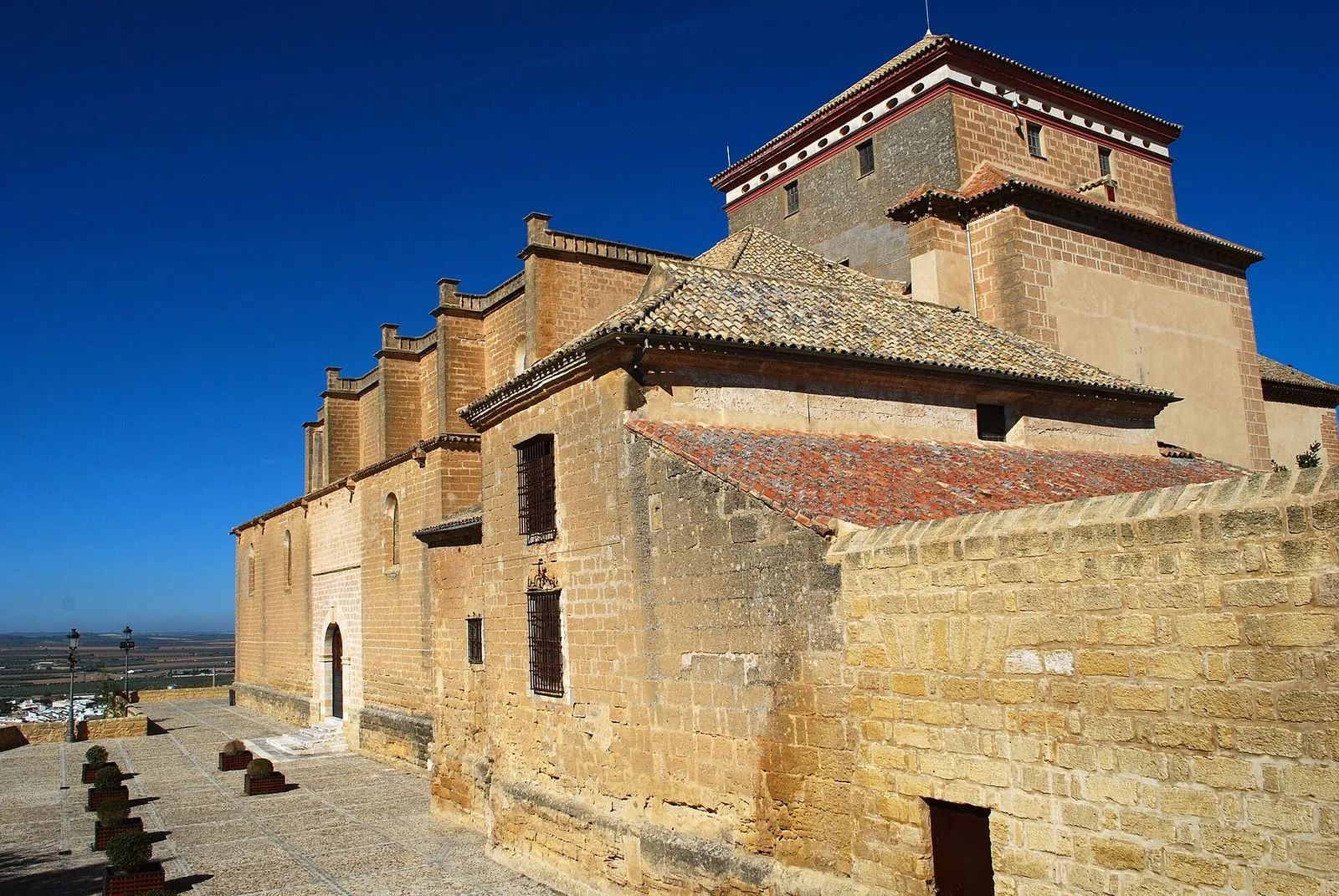
The Renaissance collegiate church stands on the hill above the town. It was built from 1535 for Juan Téllez Girón, 4th Count of Ureña, as the family’s church and burial place. The visit is guided only and includes:
- The paintings of José de Ribera, the Valencian painter who worked in Naples, including a Calvary with the Cristo de la Expiración, Saint Peter Penitent and the Martyrdom of Saint Bartholomew. Few towns this size have a group of his works.
- The Panteón Ducal, the family’s burial chapel under the church, reached through the small Patio del Sepulcro with its Renaissance carved arcades.
Guided visits leave at set times, about every hour, on Tuesday to Sunday mornings, plus a couple of afternoon slots from Tuesday to Saturday; closed on Mondays. Entry is about €6, or about €9 for a combined ticket with the Museo Arqueológico and the Monasterio de la Encarnación.
The old university
Just above the Colegiata, the Antigua Universidad was founded by the same count and approved by Pope Paul III in 1548; it taught theology, law, medicine and the arts until it was closed in the early 19th century. The square building with corner towers and a Renaissance courtyard now belongs to a university centre. Guided visits (about €4) have mainly run at weekends; check at the tourist office.
Calle San Pedro and the palaces
Osuna’s old town has been a protected historic site since 1967, and the Calle San Pedro is its showpiece: a straight street of Baroque mansions with carved stone doorways, coats of arms and ironwork balconies. Spanish media often repeat that UNESCO named it the most beautiful street in Europe; we could not find the original source, but we think it is certainly one of the finest streets in Andalusia. Look out for:
- The Palacio del Marqués de la Gomera, from the 18th century, with a carved stone doorway, gargoyles shaped like cannons and a lookout tower. It is now a hotel, so you can see the courtyard if you stop for a drink.
- The Cilla del Cabildo Colegial, the church’s 18th-century granary (built in 1773), where the tithes were stored, with a fine Baroque façade.
Monasterio de la Encarnación
On the square below the Colegiata, this convent of Mercedarian nuns, founded in 1626, is known for its 18th-century Seville tiles: a long tiled dado in the cloister showing the five senses, the seasons, bullfights and hunting scenes. Part of the cloister is a small museum of religious art. The visit is guided (about €4). The nuns sell convent sweets such as yemas, almond pastries and cakes through the turning window.
The bullring and Game of Thrones
Osuna’s bullring opened in 1904 at the edge of town. In 2014 it was used to film the fighting pit of Meereen (Daznak’s Pit) in Game of Thrones season 5, in the episode “The Dance of Dragons”, where Daenerys flies away on Drogon. Visits to the ring and its small bullfighting museum are guided and limited (about €4, recently only on Saturday afternoons), so check first.
For fans, the Museo de Osuna (about €3, free on Wednesdays) has two rooms on the filming, with photographs, props and costumes, next to rooms on the town’s history.
Coto Las Canteras
The old quarries that supplied Osuna’s stone since Roman times form a canyon of carved walls, nicknamed the “Andalusian Petra” (about €4). We think it is worth it if you have a car and time to spare.
A one-day plan
- 9:00: leave Seville by car (or take the morning train).
- 10:15: Colegiata guided visit, then the old university next door if it’s open.
- Monasterio de la Encarnación and its tiles; buy sweets.
- Lunch around the Plaza Mayor.
- Calle San Pedro, the Palacio del Marqués de la Gomera and the Cilla.
- Museo de Osuna for Game of Thrones, or the bullring on a Saturday.
- Drive back (1 hour), or stop in Écija on the way (see below).
Add Écija on the way
Écija is about 35 km north of Osuna and about an hour from Seville on the A-4, so by car you can drive Seville – Écija – Osuna – Seville in a loop. We’d spend the morning in Écija and the afternoon in Osuna (or the other way round, depending on visit times).
- The “city of towers”: a skyline of Baroque bell towers, many covered in coloured tiles. It is also known as “the frying pan of Andalusia”, one of the hottest towns in Spain in summer.
- Palacio de Peñaflor: an 18th-century palace with a curved façade and a balcony that runs its whole length, about 60 m. Part of the interior can be visited with an audio guide.
- Museo Histórico Municipal, in the Palacio de Benamejí: one of the best collections of Roman mosaics in Andalusia, from ancient Astigi, and the Wounded Amazon statue. Entry is free; closed on Mondays.
Écija has no train station, so combining the two towns is really a car day. Carmona is on the same A-4 road, so you could also pair Carmona and Écija (see our Carmona day trip).
What to eat
Osuna’s cooking is the country food of the Seville plain: stews, chickpea dishes and pork. We’d try the bars around the Plaza Mayor for tapas at lunchtime, and buy convent sweets from the Encarnación nuns. Écija is known for its bizcochos marroquíes (sponge cakes).
When to go
Osuna and Écija are inland and very hot from June to September, often above 38–40 °C in the afternoon, and visiting hours can be shorter in summer. We think spring (March to May) and autumn (October and November) are best; winter is mild and quiet. See the best time to visit Seville.
We’d go from Tuesday to Saturday: on Monday most sights close, and on Sunday many open only in the morning.
Stay over instead?
Most people drive back the same day. We think a night makes sense on a road trip towards Antequera, Málaga or Granada. Both of these are rated 8.5+ on Booking.com:
- Hotel El Molino: a converted mill on the edge of the old town, with a pool and free parking. Rated about 8.8.
- Balcones a San Pedro: small rooms with self check-in, right by the Calle San Pedro. Rated about 9.1.
Or see all hotels in Osuna. For the bigger picture, see our map of Andalusia, the Córdoba guide if you are heading north, and the Seville guide.
FAQ
How do I get from Seville to Osuna?
By car it takes about an hour on the A-92 (about 90 km). Renfe regional trains from Santa Justa take about 1 hour 10–1 hour 20, but there are only a few a day. Monbus buses from Prado de San Sebastián take about 1 hour 20.
Where was Game of Thrones filmed in Osuna?
In the bullring, which played the fighting pit of Meereen (Daznak’s Pit) in season 5, episode 9, “The Dance of Dragons”. The Museo de Osuna has two rooms about the filming.
What is there to see in Osuna?
The Colegiata (Ribera paintings and the ducal pantheon), the old university, the Calle San Pedro, the Encarnación convent’s tiles, the bullring and the Coto Las Canteras quarries.
Is Osuna worth visiting?
Yes, we think so, if you have a spare day and like art and architecture. It has one of the best-preserved old towns in Andalusia and very few tourists, but the main sights are guided visits at set times and most close on Mondays.
Can you visit Osuna and Écija in one day?
Yes, by car. Écija is about an hour from Seville on the A-4 and about 35 km from Osuna, so you can see Écija in the morning, Osuna in the afternoon and drive back on the A-92.