
Some links on this page are affiliate links. If you book through them we may earn a commission, at no extra cost to you.
The short answer
The Roman Necropolis of Carmona (Necrópolis Romana de Carmona) is one of the best-preserved Roman cemeteries in Spain, and we think it is worth an hour or two if you visit Carmona. Underground family tombs cut into the rock, a courtyard tomb with columns, the Tumba del Elefante and a small museum sit just outside the old town, about 35 km from Seville.
- Where: Avenida de Jorge Bonsor 9, Carmona, about 10 to 15 minutes’ walk west of the Puerta de Sevilla.
- Price: free for accredited EU citizens, 1.50 euros for visitors from other countries, according to the official site.
- Hours: seasonal. Tuesday to Saturday it closes at 18:00 in autumn and winter, but at 15:00 from 21 June to 20 September. Closed on most Mondays.
- Time needed: plan on 1 to 2 hours.
- Amphitheatre: only on a guided visit (see below).
The site is run by the Junta de Andalucía as the Conjunto Arqueológico de Carmona. For the rest of the town, see our Carmona day trip guide.
Quick facts
- Address: Avenida de Jorge Bonsor 9, 41410 Carmona (Seville).
- Entry: accredited citizens of the EU, free; other countries, 1.50 euros. Access is individual and needs no booking within opening hours.
- Phone and email: 600 143 632, [email protected].
- Photography: private photos are allowed, but not flash, selfie sticks or tripods.
- On site: a reception centre and museum, an introductory film, a terrace with views and a marked route through the tombs.
Opening hours
The hours change through the year. These are the official hours for 2026, checked in October:
| Period | Tuesday to Saturday | Sunday and holidays |
|---|---|---|
| 1 January to 31 March | 9:00 to 18:00 | 9:00 to 15:00 |
| 1 April to 20 June | Tuesday to Thursday 9:00 to 18:00; Friday and Saturday 9:00 to 21:00 | 9:00 to 15:00 |
| 21 June to 20 September | 9:00 to 15:00 | 9:00 to 15:00 |
| 21 September to 31 December | 9:00 to 18:00 | 9:00 to 15:00 |
The site is closed on Mondays, except when the Monday is a holiday or the day before one (12 October 2026 is one). It is also closed on 1 January, 6 January, 1 May, and 24, 25 and 31 December. Rooms start to empty 15 minutes before closing, so arrive at least an hour earlier. Check the official page before you go, because the holiday list changes each year.
History in brief
Carmona was the Roman town of Carmo, and its dead were buried outside the walls. The earliest burials on the site are Tartessian mounds of the 7th century BC, and the first Roman burials date from the 2nd century BC.
The shape you see today comes from the early empire. From the 1st century AD, cremation became the norm and local families built underground chambers cut into the soft rock, reached by a shaft or stairs, where the urns with the ashes were kept. The parts that stood above ground have mostly disappeared, lost to looting. The official site calls the necropolis one of the largest and best-preserved Roman funerary complexes on the peninsula; with the amphitheatre, the area covers about eight hectares. The family chambers went out of use around the turn of the 1st and 2nd centuries AD.
Finds were sold to collectors until 1881, when Juan Fernández López and Jorge Bonsor started a scientific project, bought the land and, in 1885, opened a visitor route and a museum. The necropolis passed to the state in 1930.
What to see
The official route starts at the museum and then follows the tombs in this order.
- Museum and terrace: a film, finds from Bonsor’s excavations, and a terrace overlooking Carmona, the line of the Via Augusta and the amphitheatre.
- Mausoleo Circular (round mausoleum): a 1st-century tomb with a vaulted underground chamber entered by a shaft.
- Tumba del Elefante: a tomb-sanctuary of the 1st century AD, named after the elephant sculpture found there. Images of Attis and Cybele link it to eastern cults.
- Tumbas de las Guirnaldas and de los Cuatro Departamentos: a group of family tombs; the Guirnaldas chamber still keeps traces of painted garlands. Nearby are cremation pits (ustrina).
- Tumba de Postumio: niches for urns beside a burial, an altar and restored decorative paint.
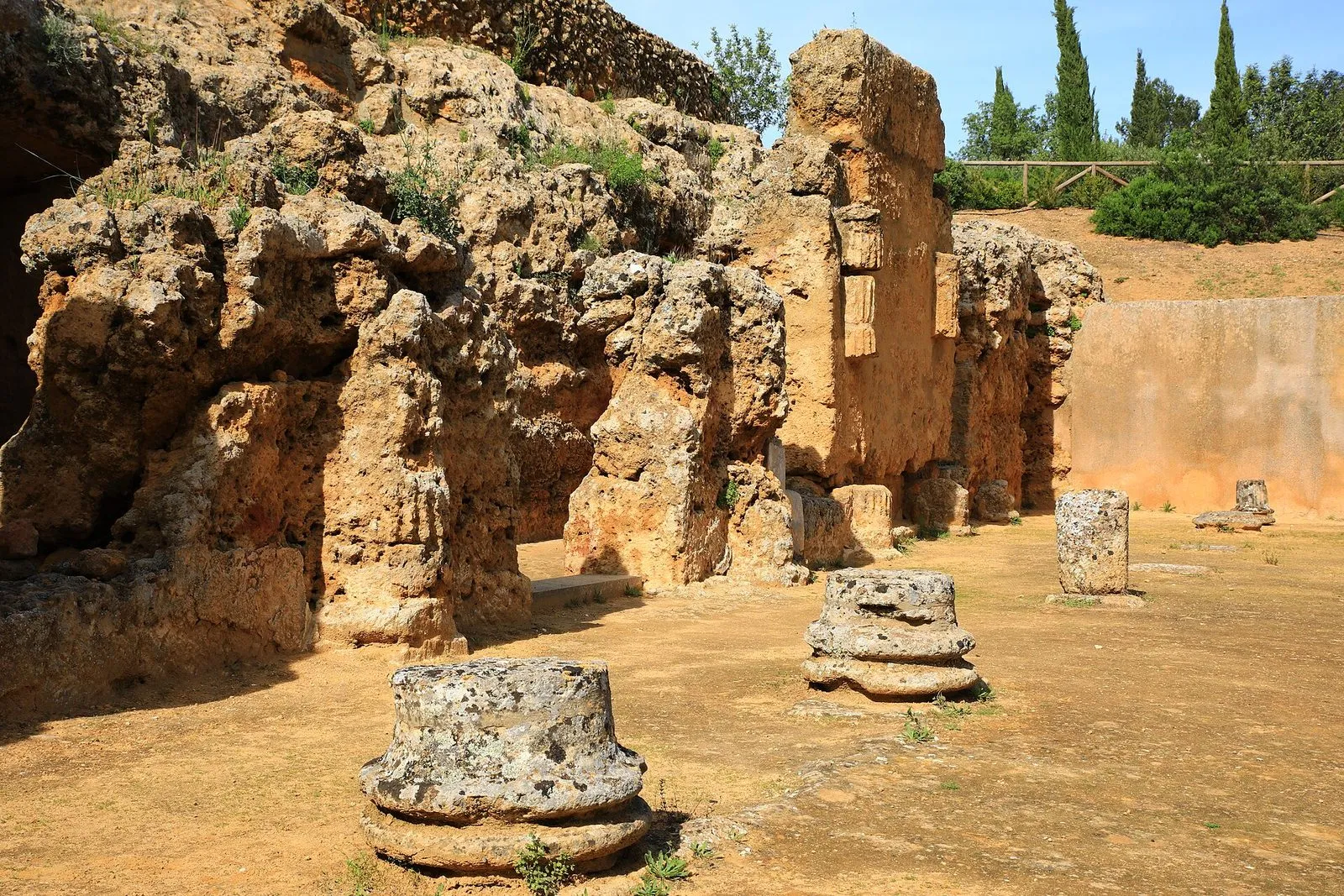
- Tumba de Servilia: a key stop, with a large colonnaded courtyard and side rooms that kept traces of sculpture and paint.
The Tumba de las Cuatro Columnas, with a pillared courtyard and a large round opening, is described on the official site but lies in an area that is currently closed to visitors, so do not count on seeing it.
The amphitheatre
The amphitheatre, dug partly into the rock on a natural slope, dates from the 1st century BC and is described as the oldest preserved entertainment building in Baetica, the Roman province of southern Spain. You can look at it from the museum terrace, but you can only enter on a guided visit. The Junta offers weekend and holiday morning visits of the amphitheatre and then the necropolis. Booking is by phone on 600 143 632 (Tuesday to Sunday), with a maximum of 8 people per booking. They are not offered in July, August and September, and the times vary by month.
How to get there
From Seville: take the Casal bus M-124 from the Prado de San Sebastián station (about 35 to 40 minutes on direct services) to the Paseo del Estatuto. Timetables are in our Carmona day trip guide. By car, take the A-4; the official site names the Paseo del Estatuto as the nearest public car park.
From the old town: go out through the Puerta de Sevilla and follow the Avenida de Jorge Bonsor west. It takes about 10 to 15 minutes. Bring water, because we could not confirm any cafe on the site.
Accessibility: the official site gives no details on step-free access. The route runs over uneven ground between excavated tombs, so if you use a wheelchair or have limited mobility, ask the staff on 600 143 632 before you go.
Tips
- Heat: from June to September there is little shade and temperatures often pass 38 degrees. We’d go at opening time (9:00). In summer the site closes at 15:00, so the afternoon is not an option.
- Autumn to spring: afternoons until 18:00 are pleasant. From April to 20 June the site is also open until 21:00 on Fridays and Saturdays.
- Monday: closed, so we’d use that day for the old town and the Museo de la Ciudad.
- Footwear: we’d wear shoes with grip, since the paths are earth and rock.
- Photography: no flash, tripod or selfie stick.
Guided visit and free walking tour
Sponsored section: we work with the first company below, and the second link is an affiliate link. We may earn a commission at no cost to you. The necropolis is easy to visit alone, so treat these as options, not a necessity.
Guided visit of the Roman Necropolis with Ciudad Secreta Tours (sponsored). A local guide company. According to the operator, the guide is an art historian and official tourist guide. The operator also states: Tuesday to Sunday at 10:00, about 1 hour 30 minutes, 12 euros per person (online payment), in Spanish, in small groups, meeting at the visitor centre (Centro de Interpretación). We have not independently verified these details, so check dates, language, price and whether the site entry fee is included when you book.
Free walking tour of Carmona (GuruWalk, affiliate link). A tip-based tour of the old town, usually at 12:00 and 17:00 on most days, in Spanish, starting at the Plaza de San Fernando and lasting about 2 hours. Dates vary, so check them when you book. You pay the guide what you think the tour was worth. See the free tour on GuruWalk.
A morning combo (suggestion). We’d take the necropolis tour at 10:00 and the free tour at 12:00 in the Plaza de San Fernando. This works only if the operator’s schedule matches, and not on Monday, when the necropolis is closed. Allow 10 to 15 minutes to walk between the two.
No Spanish? For guides in other languages, see the Carmona day trip from Seville, and check what each tour includes.
Nearby
- Carmona day trip guide: the gates, the Alcázar, the convents and a plan for half a day or a full day.
- Where to eat in Carmona: lunch after the visit.
- Parador de Carmona: the hotel and terrace at the eastern end of the old town, with a wide view over the plain.
FAQ
Is the Roman Necropolis of Carmona free?
For accredited EU citizens, yes. Visitors from other countries pay 1.50 euros, according to the Junta de Andalucía’s official page. Bring your ID or passport.
How long does the visit take?
Plan on 1 to 2 hours for the museum, the terrace and the marked route through the tombs. Add time if you join a guided visit.
Where is the Roman Necropolis of Carmona?
At Avenida de Jorge Bonsor 9, on the western edge of the town, about 10 to 15 minutes’ walk from the Puerta de Sevilla. The bus from Seville stops at the Paseo del Estatuto.
Can you visit the necropolis on Monday?
Usually not. It is closed on Mondays unless the Monday is a holiday or the day before one, such as 12 October 2026. It is also closed on 1 January, 6 January, 1 May and 24, 25 and 31 December.
Is a guided visit worth it?
The route is signed and you can see the site alone in an hour or so. A guide adds the stories behind the tombs, and the amphitheatre can only be entered on a guided visit, so we think it is worth it if either matters to you.