
Some links on this page are affiliate links. If you book through them we may earn a commission, at no extra cost to you.
The short answer
Granada has two monuments side by side in the old centre, with separate entrances and separate tickets. The Cathedral is a huge, white-and-gold Renaissance church built over the city’s great mosque after the Christian conquest of 1492. The Capilla Real (Royal Chapel) next door holds the tombs of the Catholic Monarchs, Isabella and Ferdinand, and a small museum with Isabella’s crown and her own collection of Flemish paintings.
- Time needed: about 45 minutes for the Capilla Real and an hour for the cathedral. Allow 1.5 to 2 hours for both
- Price: Capilla Real €7. Cathedral €10 until 28 November 2026 (while the Kerygma exhibition is on), then €7. The audio guide is free on a mobile app
- Free: Wednesday afternoons for both, with a free ticket booked online in advance
- Book ahead? Not usually. Buy at the door or on the official site, ticketsgranadacristiana.com
- Where: the cathedral entrance is on Gran Vía de Colón; the Capilla Real entrance is on Calle Oficios, around the corner. Both are 5 minutes’ walk from Plaza Nueva
If you only have time for one, we’d choose the Capilla Real: it is shorter, and the royal tombs are the historic heart of Granada after the Alhambra.
Opening hours
| Monday to Saturday | Sundays and holy days | Closed | |
|---|---|---|---|
| Cathedral | 10:00 to 18:15 | 15:00 to 18:15 | 25 December, 1 January, Good Friday |
| Capilla Real | 10:00 to 18:30 | 11:30 to 18:30 | 25 December, 1 January |
The doors close 30 minutes after the last entry time (18:45 at the cathedral, 19:00 at the Capilla Real). Both are working churches, so visits stop during services and religious celebrations, and hours change on some holidays: the Capilla Real, for example, closes at 13:30 on Corpus Christi and opens only from 16:00 on 12 October. Check the official site before you go.
Tickets and prices
| Ticket | Cathedral | Capilla Real | Notes |
|---|---|---|---|
| General | €10 (€7 from 29 November 2026) | €7 | Free audio guide via the app |
| Reduced | €8 (€5 students from 29 November) | €5 | Students up to 25, visitors with a disability, large families; bring ID |
| Children under 12 | Free | Free | With an adult |
| Combined ticket | €33 for six monuments | Cathedral, Capilla Real, Sacromonte Abbey, San Jerónimo, the Cartuja and San Nicolás |
Tickets are sold by the Archdiocese of Granada at the ticket offices and on its official website, ticketsgranadacristiana.com. Neither monument has timed slots or tends to sell out, so you can simply turn up. The combined ticket only pays off if you also plan to see the Sacromonte Abbey, the Monastery of San Jerónimo and the Cartuja.
Free entry: every Wednesday afternoon, both monuments offer free visits in fixed sessions (around 15:15 to 16:30 at the cathedral, 15:15 to 17:00 at the Capilla Real). You book a free ticket in advance at entradasgratuitas.diocesisgranada.es, with your name and ID or passport number. People born or registered in Granada province also enter free on Tuesdays, with ID.
The Kerygma exhibition: from 8 May to 28 November 2026 the cathedral hosts Kerygma, a large exhibition of Holy Week sculpture and religious art from Granada’s brotherhoods, laid out through the naves. It is included in the ticket and is the reason for the higher price until the end of November.
The Cathedral: what to see
Queen Isabella wanted the new cathedral to be built in the old great mosque, but it was too small and a new church was begun on the site in 1523. The first architect, Enrique Egas, planned a Gothic cathedral. From 1529 Diego de Siloé took over and turned it into one of the first great Renaissance churches in Spain, working on it for almost four decades. It was only finished in 1704, which is why the outside mixes styles.
- The façade. In 1667 the painter and architect Alonso Cano redesigned the main front on Plaza de las Pasiegas as a giant triumphal arch with three tall recesses, one of the most original Baroque façades in Spain.
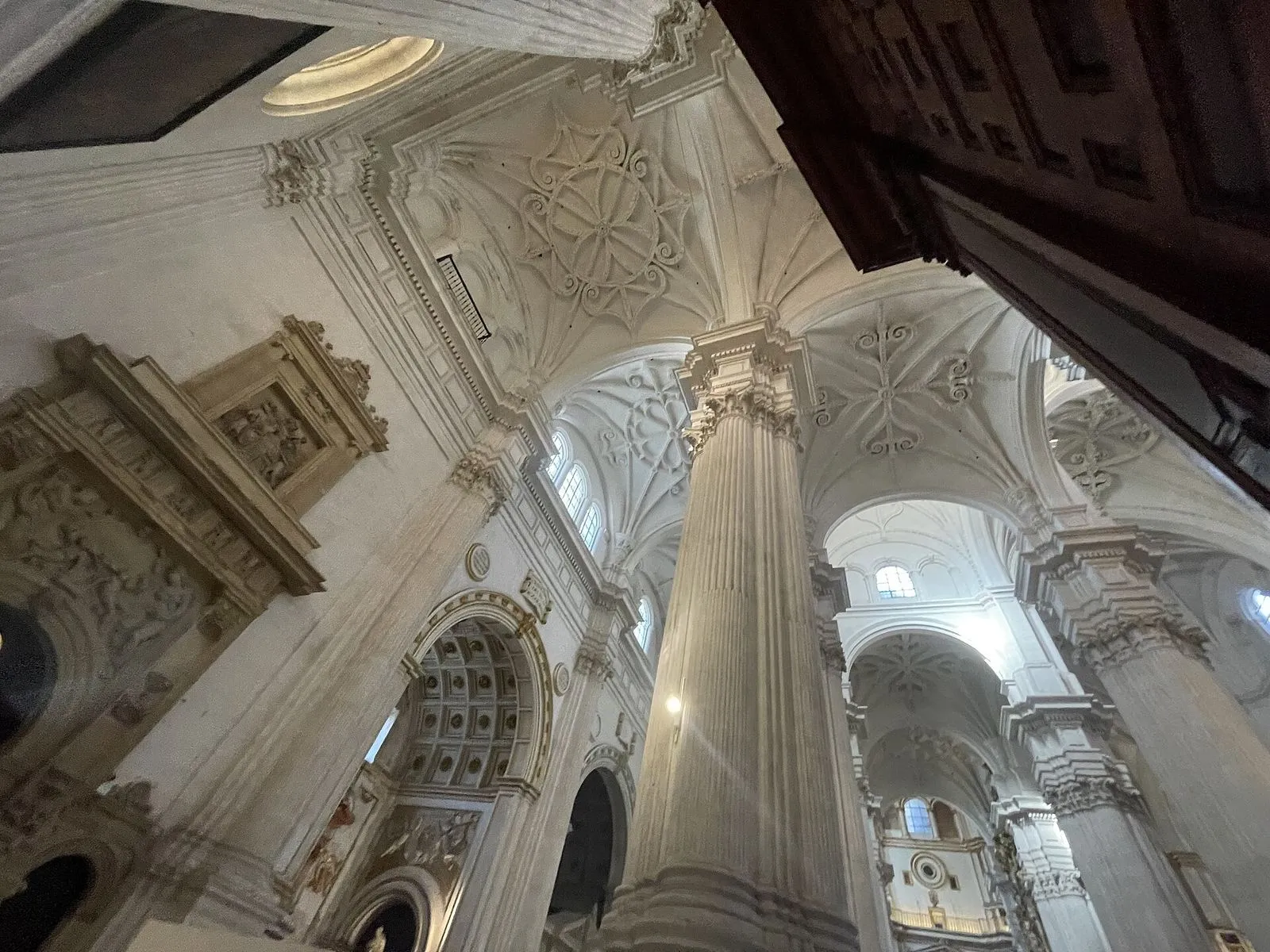
- The naves. Siloé gave the cathedral five naves instead of the usual three, with huge clustered columns and a bright, white-and-gold interior. It feels far lighter than the Gothic cathedrals of Seville or Toledo.
- The Capilla Mayor. The main chapel is a round, domed space rather than the usual apse, ringed with 16th-century stained glass. Look for the kneeling statues of Isabella and Ferdinand by Pedro de Mena, and Cano’s seven large paintings of the Life of the Virgin high up around the walls.
- The organs. Two 18th-century organs face each other across the main nave in matching Baroque cases. They are still played at services.
- The side chapels and sacristy. Walk the ambulatory for the chapels and the sacristy, with more works by Cano, a Granada native who spent his last years working for the cathedral.
The tower was never completed as planned and is shorter than the design intended. A viewing terrace at about 55 metres, looking straight across to the Alhambra, has been built at the top, but it was not yet open to visitors at the time of writing.
The Capilla Real: what to see
Isabella and Ferdinand chose Granada, the last city they conquered, as their burial place. They ordered the chapel in 1504, shortly before Isabella died, and it was built by Enrique Egas between 1505 and 1517 in the late Gothic style known as Isabelline. Isabella was first buried at the Alhambra and moved here with Ferdinand in 1521. Later kings chose the Escorial near Madrid, so the chapel remained theirs alone.
- The grille. A tall gilded iron screen by Maestro Bartolomé de Jaén closes off the royal tombs. It is one of the finest pieces of Spanish ironwork.
- The royal tombs. Two white Carrara marble monuments with the reclining figures of the dead. Isabella and Ferdinand’s is by the Italian sculptor Domenico Fancelli. The taller one beside it, for their daughter Juana “la Loca” (Joanna the Mad) and her husband Philip the Fair, is by Bartolomé Ordóñez.
- The crypt. A few steps lead down under the tombs to a small vault with five plain lead coffins: Isabella, Ferdinand, Juana, Philip and their grandson Prince Miguel, who died as a child. In our view, it is the most striking moment of the visit.
- The altarpiece. The main altarpiece by Felipe Vigarny includes carved scenes of the surrender of Granada and the baptism of the Moors, a rare contemporary image of 1492.
- The sacristy museum. Here are Isabella’s crown and sceptre, Ferdinand’s sword and the queen’s illuminated missal, together with the paintings she collected: Flemish panels by Rogier van der Weyden, Hans Memling and Dieric Bouts, and Italian works including a Botticelli and a Perugino. For a small room, we think it is an outstanding collection.
Photography and video are not allowed inside the Capilla Real.
Tips for your visit
- Which first? We’d start with the Capilla Real to understand the story, then see the cathedral. On a Sunday, the Capilla Real opens at 11:30 and the cathedral only at 15:00, so split them or choose another day.
- Pair it with the Alhambra. If your Alhambra ticket is for the morning, we’d do these two in the afternoon, and the other way round.
- Dress code: dress respectfully, remove your hat and keep quiet. We recommend covered shoulders in both.
- No big bags: suitcases and travel backpacks are not allowed in either monument.
- Audio guide: we suggest downloading the official app before you go, and bringing headphones.
- Guided visits: the Archdiocese runs official guided visits of both monuments (about 2 h 30) for groups, booked 72 hours ahead. Individual travellers can compare Granada Cathedral and Royal Chapel tours, often combined with a walk through the centre and the Albaicín.
Nearby
The cathedral sits in the middle of the old commercial centre, and everything below is within five minutes’ walk.
- La Madraza. Opposite the Capilla Real on Calle Oficios, the 14th-century Nasrid Islamic college, now part of the University of Granada. Its restored prayer hall, with a carved dome and mihrab, is the Alhambra’s style in miniature. It opens on weekdays, with a small fee for the visit.
- The Alcaicería. The narrow lanes of the old Nasrid silk market, rebuilt after a fire in the 19th century, now full of souvenir shops, lamps and ceramics.
- Plaza Bib-Rambla. A square of flower stalls and café terraces behind the cathedral, a classic spot for churros and chocolate.
- The Corral del Carbón. A 14th-century Nasrid inn for merchants, with a horseshoe-arch doorway, off Calle Reyes Católicos. Free to look inside.
- The Albaicín. Cross Plaza Nueva and climb Calle Calderería Nueva, the lane of tea houses, into the Albaicín for the sunset from San Nicolás.
For lunch, we’d avoid the touristy streets right beside the cathedral; see where to eat in Granada for the free-tapas bars a few minutes away. The Granada itineraries show how to fit both monuments into one or two days, and things to do in Granada has the full list.
Where to stay nearby
We think the flat centre around the cathedral and Plaza Bib-Rambla is the most convenient base in Granada, with good-value hotels and everything on foot. Browse hotels in Granada city centre, or read where to stay in Granada for the areas compared, and our Granada travel guide to plan the rest.
FAQ
How much are Granada Cathedral tickets?
€10 for adults, or €8 reduced, until 28 November 2026, while the Kerygma exhibition is on. After that the general ticket returns to €7 and €5 for students. Children under 12 enter free, and the audio guide app is free.
Is the Royal Chapel included in the Granada Cathedral ticket?
No. The Capilla Real is a separate monument with its own entrance on Calle Oficios and its own ticket (€7). The only joint option is the €33 combined ticket for six church monuments.
Is Granada Cathedral free on any day?
Yes, on Wednesday afternoons, in sessions you book for free in advance at entradasgratuitas.diocesisgranada.es. The Capilla Real has free Wednesday sessions too.
How long do you need for the Cathedral and the Capilla Real?
About 45 minutes for the Capilla Real and an hour for the cathedral, so 1.5 to 2 hours for both, including the walk between the two entrances.
Who is buried in the Royal Chapel of Granada?
The Catholic Monarchs, Isabella I of Castile and Ferdinand II of Aragon, their daughter Juana “la Loca” and her husband Philip the Fair, and their grandson Prince Miguel. Their lead coffins are in the crypt below the marble tombs.